Spirituality—it’s a big word.
Some people use it to refer to their belief system. Others avoid it altogether because it’s “too abstract,” “mystical,” or downright “woo-woo.”
But strip away the rituals, the aesthetics, and the hashtags, and what you’re left with is the profound realization that spirituality isn’t any of that to begin with.
Your spiritual growth begins the moment you stop moving through life on autopilot and start asking yourself, “Who am I, and what am I doing here?”
What is spirituality?
In a nutshell, it’s the pursuit of finding meaning, purpose, and connection to something bigger than yourself—whether that “something” is a higher power (like God), spirit guides, the Universe, or simply a deeper layer of your own self-awareness.
According to Agapi Stassinopoulos, a renowned speaker on spirituality and bestselling author of Speaking with Spirit, spirituality is about reacquainting yourself with your divine self. “It’s your awareness,” she says in her Mindvalley program of the same name, “that the Spirit already lives inside you, regardless of your beliefs.”
Meanwhile, Vishen, the founder and CEO of Mindvalley, associates being spiritual with moving through different levels of consciousness. This process, as he often emphasizes in his teachings, expands your sense of identity beyond the individual self.
However you define it, it often starts with the “pull” to consider that you’re more than your body, your name, or the circumstances that have shaped your life. Kind of like when Neo, the main protagonist of The Matrix (1999), realizes he’s not Thomas Anderson, stuck in a system he never chose.
“You are,” Vishen points out, “something the whole universe is doing in the same way that a wave is something that the whole ocean is doing.”
The importance of exploring your spirituality
When you see yourself only as a physical being, life feels finite. You move on autopilot. Then, you react to external circumstances. All while you repeat emotional patterns from your past without ever learning how to reprogram your subconscious mind, which scientists say speaks volumes about how your brain predicts reality.
That prediction process? It’s called predictive processing. Research published in Nature Reviews Neuroscience shows that the brain does not passively receive reality. Nope, it actually actively constructs it by using past memories and emotions to anticipate what will happen next.
And here’s where spirituality enters the conversation.
Sadhguru, a renowned yogi and the founder of the Isha Foundation, points out that it’s all too easy for any of us to get tangled in that space between blaming the world and taking ownership of our lives. “All human experiences,” he points out in his Mindvalley program, A Yogi’s Guide to Joy, “are generated from within.”
Think about:
- The rush of a new connection.
- The sting of insecurity about your place in the world.
- Even the fear of death surfaces after someone you love dies.
How you feel about any of these experiences ultimately happens inside you.
An interesting thought is when you consider what spiritual mystics of the past have said about looking inward:
- Jesus Christ: “The kingdom of God is within you.”
- Marcus Aurelius: “Look within. Within is the fountain of good, and it will ever bubble up, if you will ever dig.”
- Rumi: “Yesterday I was clever, so I wanted to change the world. Today I am wise, so I am changing myself.”
Taken together, these phrases seem to suggest a common ground: that transformation can only come when you understand how experiences are created… and who’s in charge. (Hint: you.)
And chances are, it’s also why Sadhguru says, “If you take charge of your interiority, you take charge of your life… The only way out is in.”
The main goal of spiritual growth
If spirituality is the path, then what’s the destination? What’s the point of all this inner work every mystic’s talking about?
Well, author Amin Martin Ebrahimi has a guess: it’s to be an übermensch—German for “perfect human.” In his book, The Mystical Übermensch, he cites numerous examples of this universal archetype, from Buddha and Muhammad to Mahatma Gandhi and Mother Theresa.
Each of them created massive ripple effects in the world, because they, through awakening the übermensch within:
- Became conscious of their conditioning,
- Was no longer driven by fear, blind habit, or inherited scripts, and
- Leveraged their personal growth to help others.
But this, Amin adds, didn’t happen without their realization that spirituality transcends belief systems, including religion, which are shaped by culture. And culture is, in fact, driven by language, the system we use to name everything, including “God,” “soul,” or “truth.”
Interestingly, the science of linguistics, or how language exists, backs this up. The Sapir-Whorf Hypothesis, according to a study in PLOS ONE, suggests that the language you speak shapes how you view the world, including the divine.
So, if spiritual growth is about you evolving into an übermensch, then chances are, it starts with noticing the invisible forces shaping you through the beliefs you’ve absorbed through words.
“To transcend culture is not to reject it,” Amin writes, emphasizing spiritual transcendence as the heart of spiritual growth. “It is to see through it, to recognize the invisible hand of the culturescape and release its grip… What lies beyond the chaos is clarity.”
Interestingly, Vishen’s own work echoes the same principle. “Extraordinary minds,” he states in his book, The Code of the Extraordinary Minds, “are good at seeing the culturescape and are able to selectively choose the rules and conditions to follow versus those to question or ignore.”
The different types of spirituality
No two spiritual journeys look the same. Who you are, where you grew up, what you’ve been through, and how your mind works all shape the way spirituality shows up in your life.
Some people learn how to become mystics through grief meditation after a heartbreaking loss. Others, through eye-widening bewilderment, as they pursue scientific truths or acts of service.
If you don’t integrate spiritual wisdom into your day-to-day life, it remains an abstract concept.
— Mahatria Ra, trainer of Mindvalley’s A Journey to Infinitheism program
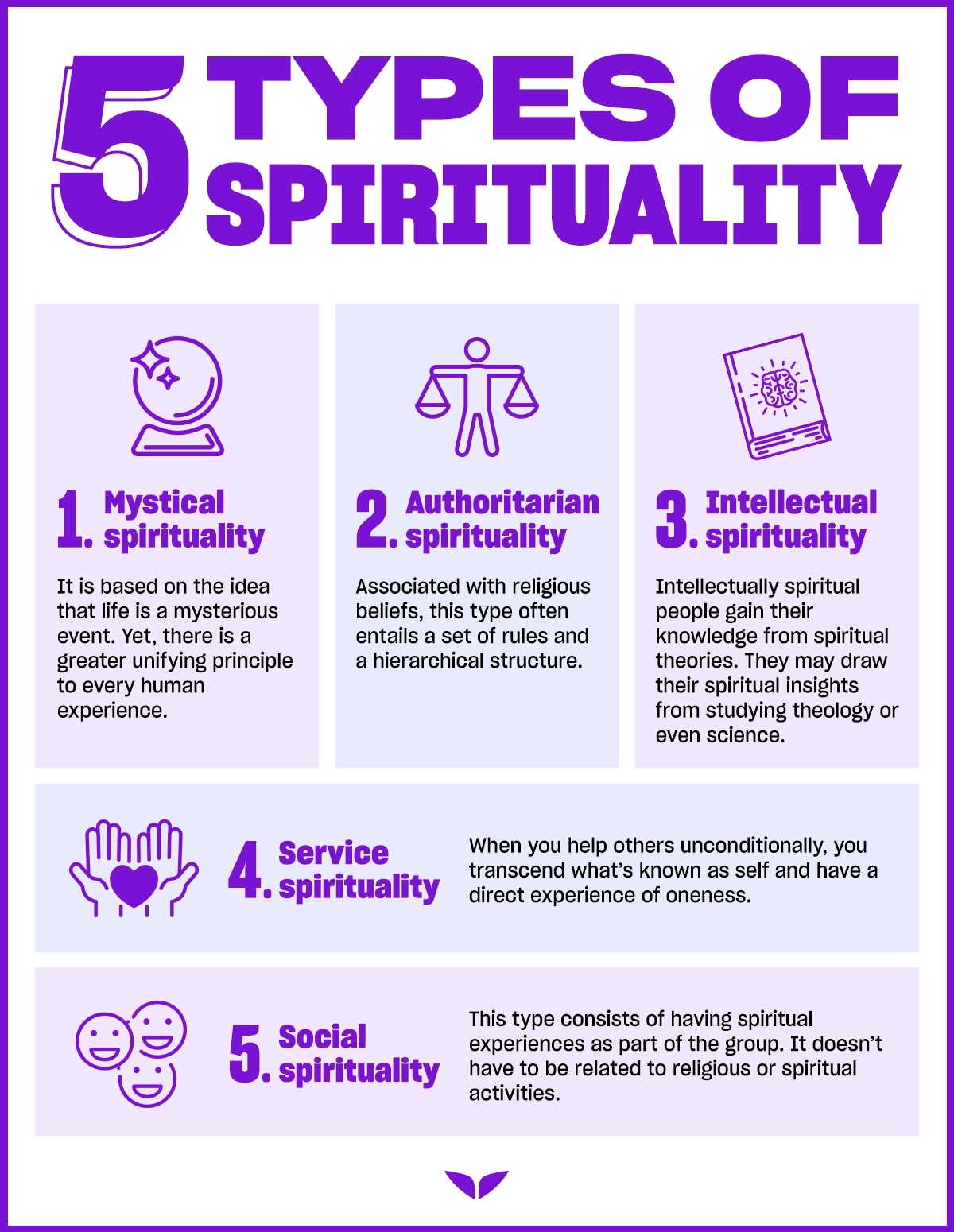
In short, spiritual growth isn’t one-size-fits-all. Here are five versions of what it can be like:
1. Mystical spirituality
This is the experience-based path centered on direct realization in the present, rather than on beliefs inherited from the past.
In his Mindvalley program, Sadhguru describes this path as the point where “you are willing to go beyond the limitations of your body and mind.”
Martin parallels this concept in The Mystical Übermensch when he says, “The mystic is not someone who escapes reality, but someone who penetrates it more deeply.”
Now, bring Neo back to mind.
He didn’t leave the Matrix by simply following what others told him. Nope, he investigated every place and person he encountered along the way. Each aha! moment he experienced unlocked his awareness about the “code” that programmed his old self’s reactions. From there, his perception of existence shifted.
Once that happens to you, too, you can’t go back to how things were. Triggers for awakening can look like:
- Grief after losing someone you love,
- Feeling empty even after getting the dream job or relationship, or
- Hitting the point of burnout.
But instead of fighting agents like Neo, you can look at your feelings and ask yourself where they stem from. Or sit in moments of deep emotions, from awe to sorrow and back again, and let them show you the part of yourself you’ve been hiding from.
2. Authoritarian spirituality
This path involves spiritual teachings passed down by central figures, from prophets to ascended masters, through sacred traditions, texts, and lineages. clear doctrines, prescribed practices, and structures of authority seen in organized religion, monastic orders, formal doctrine, or tightly structured spiritual schools.
For some people, this container is grounding. It makes spiritual transcendence tangible through regular prayer, chanting, scripture reading, or ceremony.
You see this in:
- Islam’s command for prayers done five times a day,
- Christianity’s emphasis on liturgy,
- Buddhism’s call for daily mantras (like the Heart Sutra),
- Hinduism’s centuries-old temple rituals.
The power behind these intention-based frameworks lies in devotion and discipline, which science has long shown to be beneficial. Consistently showing up for your goals through structured, reflective practices, as a 2021 study in Current Opinion in Psychology reveals, can foster psychological well-being while reducing stress.
Of course, any authority-driven system, if experienced for the wrong reasons and without self-inquiry and discernment, can drift you into dogma.
But at its healthiest? Authoritarian spirituality, informed by culture as it is, helps you honor your divine nature through structured commitments.
3. Intellectual spirituality
For some people, spirituality doesn’t start with a room full of incense or meditation cushions, but rather, questions—big ones. Like:
- “What is consciousness?”
- “How does reality actually work?”
- “Why are we here in the first place?”
Albert Einstein was one of them. He made his spiritual nature known, amid larger-than-life investigations into spacetime and gravity, when he famously said he believed in a God “who reveals Himself in the lawful harmony of the world.”
You can see the same curiosity in theoretical physicist Nassim Haramein, the founder of the Resonance Science Foundation. He’s known for trying to bridge the gap between quantum physics and spirituality. His main goal? To know what consciousness really is and why humans eventually became so damn self-aware.
“To me, consciousness is the fundamental information structure of the universe,” the Resonance Science Foundation founder says on The Mindvalley Podcast. “It’s information moving through its cycles, feedforward, and feedback information throughout the whole network of creation that produces complexity… like a 100 trillion cell human being that eventually becomes self-aware.”
Both Einstein and Nassim prove that when your question is big enough, they tend to reach the same realization mystics danced around all along: that everything is energy.
Watch Nassim Haramein’s full interview with Vishen:
4. Service spirituality
For some people, sitting alone in silence doesn’t cut it. They need to serve others to feel connected to something greater than themselves.
Take Mother Teresa, who founded the Missionaries of Charity in Kolkata, India, to care for the sick and dying on the streets. There’s also Mahatma Gandhi, whose spiritual convictions shaped how he led India’s nonviolent resistance and mobilized millions from suffering.
Both figures demonstrate that service is an act of worship in itself. Outward contribution, done right, can shape one’s inner devotion to the greater good that ultimately benefits all.
There’s a tangible reason why this path feels expansive: collective effervescence. It’s a term coined by Émile Durkheim to describe the heightened sense of unity people feel when they act together toward a shared purpose.
The thing is that a 2015 study in the Journal of Social Issues shows that shared emotions in group settings tend to increase well-being, strengthen social bonds, and amplify a shared sense of meaning.
So when you feel lost in the thick of purposelessness, help someone. Service, says Mahatria Ra, a spiritual teacher and Mindvalley trainer, pulls you out of self-absorption and into renewed perspective. This is how you notice what you have instead of obsessing over what you don’t.
As he likes to say, “Let all relationships in life bask in your love.”
5. Social spirituality
Perhaps you don’t feel the divine glow on a meditation cushion. That’s okay. Maybe for you, spirituality comes alive in spaces where you can experience collective effervescence through shared moments, interests, and activities.
Like:
- Breathing in sync with a room full of strangers at a retreat,
- Singing along with a thousand other voices at a concert,
- Praying or chanting in a group at a temple, mosque, or church,
- Hiking with your loved ones to catch the sunrise at the peak of a mountain together.
In moments like these, your focus shifts from “me” to “we.” In psychology, it’s called the self-transcendent experience, which a 2017 review in the Review of General Psychology describes as a tangible shift in which self-focus gives way to a sense of group unity.
So, that shared breath, shared voice, or shared silence? Each is enough to remind you that you’re not separated at all from everything and everyone, as you thought.
What is the difference between religion and spirituality?
If you’re asking yourself, “Is spirituality a religion?” it’s likely because you’ve sensed the difference between the two, even if it’s hard to put a finger on.
Well, you’re spot on… because they are, indeed, two different things, interchangeable as they are in conversations. Here’s what sets them apart:
Rules
Religion typically includes sacred texts, established teachings, rituals, and a recognized list of leaders who have contributed to its doctrine. For many people, that structure offers steadiness without the anxiety or confusion that guesswork often triggers. And since it operates on communion, you’d always have other people in your vicinity to turn to for answers.
But spirituality? It begins somewhere else.
Instead of starting with inherited answers, it starts with direct experience. There’s no fixed script. No universal checklist. You explore through your own questions, insights, and moments of awareness. What feels true becomes something you discover, not something you’re told. The authority shifts inward.
In religion, revelations often come through prophets and mystics, then become teachings for the community. But in spirituality, you take responsibility for your own revelation. The whole process? It’s personal.
Restricted definition of God
In most religions, God is described through specific terms, like:
- A name. In Hinduism, you’ll hear Brahma or Vishnu. In Islam, it’s Allah. In Sikhism, God is Waheguru.
- Attributes. Think “all-knowing,” “all–powerful,” and “the most benevolent”—the full divine resume.
- Stories of origin. Origin stories, from how God created the world in seven days to human enlightenment under sacred trees or in front of bushes.
- Divine messengers. A.k.a., the übermensch figures guiding entire civilizations to update their ways of thinking and living.
- Commandments. They’re practices that help you become a better person, from “loving thy neighbor” to observing Shabbat on Fridays (phones off, presence on) to following the Buddhist Eightfold Path (honest, ethical actions).
And that kind of structure actually matters. Why? Well, a large review in ISRN Psychiatry found that people who actively practice religion tend to report lower depression, higher life satisfaction, and stronger social support. And the opposite, like philosopher Friedrich Nietzsche once warned, is true; when meaning collapses, people can drift into a sense of emptiness.
But that doesn’t mean religion is for everyone, which is where spirituality comes in. In this journey, you’re not handed a name for the divine or a fixed set of attributes to memorize. And instead of describing God, the path invites you to experience the sacred directly, with your own awareness as your guide and your intuition as your compass.
Where religion offers a map, spirituality asks you to explore the terrains ahead.
External vs. internal God
In many religious traditions, God is understood as a presence beyond you. A higher power who created the world, set the laws in motion, and, in some beliefs, intervenes in human life.
Ken Wilber, the creator of Integral Theory (a mind-body-spirit framework that holistically maps the stages of human development), notes that people often imagine God as an external authority figure. You know, the bearded old man who watches, guides, rewards, and occasionally keeps score from somewhere above.
“It’s a childlike belief that many adults have,” he explains in his Mindvalley program, The Integral Life. “And this pre-rational approach can be detrimental to adult rationality.”
On the flip side of this? The sacred is not perceived as some distant, personified “supervisor” of your life, but rather, the sum of your lived experiences.
Anything can teach you everything, at any moment. For example, your anger can become a signal that someone crossed a line you never clearly set.
So, instead of asking, “What does God want from me?” the question then shifts to “What does spirituality mean?” and even “What is life showing me right now?”
No outsourcing authority upward. Just a deep recognition that insight, correction, and guidance can arise from within your own awareness.
Truth vs. mystery
In many religions, truths are laid out in sacred texts passed down through generations. They’re based on the revelations of prophets and mystics, then packaged into easy-to-understand teachings you can follow to activate your divinity.
Spirituality, though, happens when you trust your own revelations in your direct experiences, instead of relying on someone else’s. No fixed script. No final answer is handed to you. You gain firsthand insights into life by asking your own questions and then sitting with them.
Neither pillar is inherently better. The one you choose often reflects your temperament and what helps you grow.
Do you feel steadied by clear guidance, shared rituals, and wisdom refined across centuries? Or do you come alive when you question everything and arrive at your own realizations?
Ultimately, both paths come down to the same thing: remembering who you truly are.
Religion and spirituality: What they have in common
Despite their differences, spirituality and religion both come down to one thing: living what you claim to believe. Alas, insight on its own doesn’t change much.
Think back about Neo for a second. He could memorize every line Morpheus told him about the Matrix or intellectually understand that the reality inside was basically a set of codes. None of these made him “The One.”
What did, though, was his understanding that control over your actions starts in the mind. The moment he realized this and that the rules in the Matrix weren’t, in fact, fixed, he started acting from this place of realization… towards real freedom.
The overlap between religion and spirituality works in the same way.
According to the Oxford English Dictionary, the word “religion” traces back to the Latin religare, meaning “to bind fast” or “to bind back.” The Roman philosopher Cicero, in De Natura Deorum, later linked it to relegere, meaning “to go over again” or “to consider carefully.” Then, Christian theologians Lactantius and Augustine eventually preferred religare, because it emphasized the idea of being bound to God.
From here, it’s easy to see that the original, multifaceted context of the word underscores a spiritual tone. Which overlaps with Mahatria’s view on the spirituality vs. religion spectrum. “Religion is to go back to your origin,” he says, adding that your origin point itself is spiritual, because “it is divinity.”
The heart of spiritual religiosity
So, being religious can mean living in a way that brings you closer to your true divine self. It’s no wonder that all religions seem to highlight the same set of universal principles, such as:
- Compassion for others,
- Self-restraint,
- Service,
- Forgiveness, and
- So much more.
Sure, the symbols and languages used across scriptures are different. The geography associated with each religion varies. But the values preached? They all remain the same.
For this reason, ritual alone may not be enough. Praying five times a day means little if kindness disappears the moment someone disagrees with you. Quoting scripture loses power if gossip fills your daily conversations. Lighting incense at dawn doesn’t mean much if resentment towards your partner runs the rest of the day.
“If you don’t integrate spiritual wisdom into your day-to-day life,” says Mahatria, “it remains an abstract concept.”
Deconstructing spirituality myths
Spirituality has a reputation problem. Somewhere along the way, it got wrapped in incense smoke, cryptic quotes, and the idea that only certain people qualify.
Like… the calm monks on mountaintops. Or the enlightened beings in robes. Maybe the “zen” teachers at Burning Man who look like they’ve transcended taxes and traffic.
But most of what people assume about spirituality is all a myth layered on top of misunderstanding. Let’s clear a few up:
1. Spiritual people must have a guru
It’s a plus to have great teachers pointing you in the right direction on your spiritual journey. But it’s not a must to look up to them.
The reality is, you can be your own guru or “buddha” (“awakened”) if you wish, with the right tools and realization.
“Your life and the experience of your life are entirely your making,” says Sadhguru. “The quality of my life is entirely my making and nobody else, and nobody else.”
2. There is a point when you will finally get there
Unlike the “heaven and hell” debate society’s been pushing down on you, there’s actually no finish line to get to on a real spiritual journey. As soon as you reach a mountaintop, you will see another mountain to conquer.
It’s all a continuous process of evolution and growth.
As Sadhguru points out, nothing’s ever fixed. “A human,” he reminds people, “is not a being; he’s a becoming, he’s an ongoing process.”
3. You have to act, talk, and live in a certain way to be spiritual
A 2004 review in the Annual Review of Psychology explains that conformity and compliance are often driven by the basic human desire for approval and belonging. When a culture associates spirituality with certain clothes, tones of voice, or rigid behaviors, people unconsciously mirror the image to fit in.
But this mirroring, Sadhguru notes, isn’t spiritual awakening. You don’t “perform” spirituality; you experience it. As he says, “It doesn’t take any damn scripture or a guru to tell you this.”
In other words? You’re born a spiritual being because divinity is your true nature, meaning that being spiritual is about awakening your essence.
4. Following a spiritual path entails asceticism
Somewhere along the way, spirituality got confused with deprivation. Chances are, you’ve heard statements like:
“If you’re serious about this, you probably shouldn’t enjoy yourself too much.”
“Enlightened people don’t crack jokes in temples.”
“Real seekers must rise above the body.”
Now, here’s a Buddhist lore that helps dispel the myth.
Before his awakening, Siddhartha Gautama practiced extreme asceticism. He fasted until his body was dangerously weak, convinced that denying it would bring clarity. It didn’t. When he accepted food and regained strength, he realized that self-denial was not enlightenment.
That realization? It became the foundation of the Middle Way, a crucial concept in Buddhism, proving that spiritual depth was never about punishing your body.
Though not a Buddhist himself, Sadhguru would always remind us all that true spiritual growth starts by paying loving attention to your body, which is the gateway to a peaceful mind and soul.
“If your body becomes pleasant, we call this health,” he points out. “If your mind becomes pleasant, we call this peace… If your emotions become pleasant, we call this love.”
See how everything informs the other? When your entire life becomes pleasant, he adds, “we call this blissfulness,” a.k.a., the real goal to live by.
5. If you are spiritual, you never experience negative emotions
Another stubborn myth? That spiritual people float above anger, grief, jealousy, or fear. As if awakening deletes your humanity.
Well, here’s the real picture of what emotionally healthy spirituality is: you become more aware of what’s happening inside you, with detachment, without self-judgment.
“Your anger is your anger,” Sadhguru puts it plainly. “Your misery is your misery. Your joy is your joy.” Ergo, the experience is generated within you. Which means it can also be understood and handled within you.
In real life, it’s about:
- Admitting you’re hurt when someone crosses a line, instead of pretending you’re “sooo above it.”
- Catching your own insecurity before you turn it into gossip about an acquaintance.
- Sitting with disappointment after a financial setback and asking what it’s teaching you, instead of blaming everyone else for your failures.
Emotional responsibility, in the end, is the stuff of spiritual depth.
6. You cannot be spiritual and religious at the same time
Now, this is perhaps the most interesting myth to dispel, because it assumes you must pick a side. Either you follow rituals and scripture, or you explore consciousness and inner work.
But that’s the thing: structure and self-inquiry can actually coexist. Here are some examples of how you can experience this dynamic:
- Praying daily because your faith asks you to, and reflecting afterward on what this practice means for you as an individual.
- Singing the hymns on Sundays, then journaling later about the resentment you noticed during the session.
- Chanting the Heart Sutra at a temple, and also questioning your own reactions when someone challenges your beliefs.
- Reading any scripture for guidance, then applying it by taking responsibility for your behavior at work or at home.
Look closer, and you’ll see that religion can offer language, community, and rhythm, while spirituality deepens the practice with awareness, direct experience, and personal responsibility.
One gives form. The other gives depth.
The real tension to care about is when practice becomes performance or when self-realization turns into a sense of superiority (newflash: that’s actually spiritual ego).
But in a well-lived experience? These two aspects can strengthen each other.
How to get into spirituality
If you find yourself wondering about this, then consider Agapi’s entire philosophy: you don’t chase whatever you think being awakened looks like. Ultimately, spirituality, she says, is about being aware that the divine “already lives inside you, regardless of your beliefs.”
And to reconnect to your higher self, she shares, involves simple, grounded practices that shift your awareness, soften your ego, and help you experience life to the fullest. Like the ones below:
1. Become aware that you are Spirit
Self-awareness begins the moment you see circumstances that make up your personal history, from the kind of job you have to your relationships, but don’t sum up who you are, as much as they matter.
“You have the blueprint to your soul,” says Agapi in her program. “What is your blueprint? Don’t confuse purpose with ego recognition.”
According to her, the ego builds identity out of roles, achievements, wounds, and other people’s approval. It keeps score and measures your worth by status, productivity, and perception. After all, labels feel solid, so it makes sense that it clings to them.
But Spirit? It is, as Agapi says, much quieter… simply because it is awareness itself that remains constant, whether life is going your way at a given time or not.
2. Pray
You’re sitting in your car after a hard conversation on the phone. The engine’s off. You’re not ready to go inside your house. Your hands rest on the steering wheel. And for a moment, they press together without you planning it.
That’s usually how prayer begins—as a moment of recollecting yourself after a storm.
Contrary to what you may have grown up believing, prayer isn’t confined to ritual, even if the culturescape shapes how it’s practiced. It can be as simple as whispering to yourself:
- “Help me see this clearly.”
- “Give me strength.”
- “I don’t know what to do. Show me.”
Agapi often says to pray the way you’d talk to your best friend. So, keep it real—and keep it honest. “Bring that light in, and you become a light warrior,” she says. For her, God isn’t a distant being keeping score. “God is not a being. It’s a state of being that we have access to 24/7.”
And here’s something interesting: research published in Frontiers in Psychology found that personal prayer is associated with reduced anxiety, greater emotional regulation, and a stronger sense of meaning in life. In other words, speaking your fears out loud and placing them in a larger context helps your nervous system settle.
Which means that moment in the car, hands pressed together? That’s you, steadying your psyche before you step back into the world.
3. Listen to classical music
Sometimes spirituality can look like putting your phone down, pressing play on Mozart’s greatest hit, and letting it carry your spirit.
Here’s where science backs this claim up.
A study published in the Journal of Public Health Science at Universitas Airlangga found that listening to classical compositions significantly reduced anxiety and supported physiological relaxation in observed listeners. Why? Well, when listened to, their breathing would sync to its steady, even tempo.
See, when your breath slows and deepens, your heart rate follows. From here, your nervous system eases out of fight-or-flight mode into a calmer state of mind.
In plain language, the body stops acting like it’s under attack and starts believing it’s safe.
And when the body feels safe, awareness can surface. That quiet, steady presence underneath the noise? That’s the doorway spirituality has been pointing to all along.
4. Spend time in nature
Think about the universal Garden of Eden trope at the heart of many spiritual myths. The origin story of humanity, as it goes, begins in nature.
Biology tells a similar story. The human nervous system was shaped outdoors, not under fluorescent lights. It makes sense, then, that the body responds differently when it returns to that setting.
Research published in Nonlinear Dynamics, Psychology, and Life Sciences has found that many natural forms, such as coastlines, leaves, clouds, and tree branches, display fractal patterns. These are repeating shapes that echo themselves at different scales, like how a tiny twig resembles the branch it grows from. The same study shows that when people look at these kinds of patterns, their stress levels often drop, in some cases by as much as 60 percent.
What that means in real life is this: your brain recognizes what it’s seeing because it was made to sync with these patterns. And when the brain settles, the body follows, and that internal pressure suddenly eases.
From here, it’s easier to be less caught up in who you’re supposed to be… and more aware of your inner state, the true “seat” of your spirituality.
“When you watch natural wonders,” Agapi asserts, “you start experiencing wonders within.”
5. Practice free writing
“Your soul is a wise voice within you, waiting for you to hear it,” says Agapi. And one of the best ways for you to hear its words is through what she calls free writing.
It’s exactly what it sounds like. You sit down with a notebook, set a timer if you want, and write your heart out about whatever you feel like, without stopping. Try not to edit or judge yourself, and certainly avoid fixating on grammar. Just let the pen move as fast as your thoughts do.
If you don’t know what to write, she adds, you literally write, “I don’t know what to write,” until something honest slips through.
And you will. Because the thing is, when you translate an experience into sentences, your brain, as a Trends in Neuroscience and Education study reveals, begins organizing it instead of just reacting to it. You stop spiraling and start understanding yourself… which is the nucleus of spiritual growth.
“The more you allow it to come in,” Agapi assures, “the more you trust it.”
8 recommended books on spirituality
A paragraph that makes you breathe differently. A chapter that shifts how you see a painful memory. A real-life recollection that tells you that you’re not alone.
Sometimes, that’s all it takes to activate your self-awakening. And you can find them in these great books:
- Conversations with God by Neale Donald Walsch. Explore an author’s profound dialogue with God about the meaning of life, beliefs, religion, modern society, and the human experience.
- The Power of Now: A Guide to Spiritual Enlightenment by Eckhart Tolle. This book is all about nudging you back into the present moment, where you can choose to spiral in life or liberate yourself from self-imposed suffering.
- The Untethered Soul: The Journey Beyond Yourself by Michael A. Singer. Think of it as a groundwork for peace through self-exploration and self-dissolution.
- Becoming Supernatural: How Common People Are Doing the Uncommon by Joe Dispenza. This one bridges neuroscience and mysticism to help you shift your thoughts so you can heal your biology… and reality.
- The Seat of the Soul by Gary Zukav. Here, the spiritual teacher invites you to step into your inherent power. Self-empowerment, he argues, is how humans eventually evolve into higher beings, rather than through culture.
- Inner Engineering: A Yogi’s Guide to Joy by Sadhguru. Master your inner chemistry so your experience of life comes from within, rather than from outer circumstances.
- Speaking with Spirit by Agapi Stassinopoulous. Learn the step-by-step guide to reconnect and build a lasting relationship with your higher nature.
- Buddha and the Badass by Vishen. It’s a blueprint for blending material ambition with spiritual awareness. “When your values infuse your business,” he writes, “you’ve given special life to your creation.”
At the end of the day, these books meet you where you are to guide you back home to yourself.
8 inspiring spirituality quotes by Mindvalley’s teachers
Sometimes, a single sentence can stay with you longer than an entire book. That’s the power of spiritual quotes—they capture lived wisdom in a few precise words you can carry with you into real life, moment by moment.
Here are ten spiritual quotes from Mindvalley teachers that can steady your thinking, sharpen your awareness, and remind you of what’s real in life:
- “It dawned on me that I could bring this awareness of Spirit into everything I did… Doing the things that brought me joy is how I connected to the Spirit daily.” — Agapi Stassinopoulous
- “Once you understand what’s going on—the divine process—you take part in it in a brand new way. Not unconsciously, but consciously.” — Neale Donald Walsch
- “Your soul isn’t here to achieve. Your soul is here to grow. Most people get this wrong.” — Vishen
- “It’s not what you learn that changes your life; it’s the daily choices and actions you take.” — Jon and Missy Butcher
- “Spirituality, in the widest sense of the term, is an indispensable part of understanding the nature of the mind.” — Sam Harris
- “We’re so attached to who we’ve been that we can’t quite become all of who we’re meant to be.” — Lisa Nichols
- “Feelings come and go like clouds in a windy sky. Conscious breathing is my anchor.” — Thich Nhat Hanh
- “Awakening isn’t about escaping the body; it’s about embodying spirit. When we align our energy centers, heaven and earth meet within us.” — Anodea Judith
Read them slowly. Read them again and again. Let each and every one of them speak to you whenever you want, wherever you are in life.
Expand your consciousness
Spiritual growth becomes real the moment you practice it in ordinary life—in the pauses between moments, throughout the quiet walks, and on the blank pages filled with unfiltered truth.
And the journey never stops. In fact, there’s always another layer of awareness to uncover, another belief to question, and another part of you ready to evolve, which Mindvalley’s free soul-searching resources can readily support.
Expect guided tools and masterclasses designed to help you deepen your clarity, strengthen your intuition, and live from that steadier place within. Like:
- The Manifestation Journal, which helps you name your truths and let them guide you along your journey;
- Soul-Searching Questions, a spiritual survey that reveals the deepest needs and desires that you’ve long suppressed;
- Spiritual masterclasses, taught by spiritual teachers like Agapi, Vishen, Mahatria, Sadhguru, and more, to get you all prepped for what lies ahead;
- And so much more.
These tools are designed as a starting point into the deeper work available inside the Mindvalley app. Ultimately, it’s a space where timeless spiritual insight meets people who want to live with more awareness, purpose, and emotional steadiness.
And the impact is real. Roopa Sharma, a Dubai-based life coach and Mindvalley member, says the platform helped her reconnect with her spiritual path. In her words:
I get my daily dose of physical, mental, and spiritual healing through these wonderful trainers. I now co-create my world with Mindvalley.
Experiences like hers reveal what can happen when your inner life is given consistent attention and support. When you commit to that expansion, something shifts. And you begin to meet yourself at a deeper level and grow into the version of you that’s been quietly waiting.
Welcome in.