Ever notice how frazzled your day can be whenever you doomscroll first thing in the morning? Then recall your best days. Chances are, you took your time to breathe, hydrate, and maybe
even journal your innermost thoughts as soon as you wake up.
“How we begin our mornings,” Ariana Huffington highlights in her book, The Sleep Revolution, “sets the tone for the rest of the day.”
What she said is no self-help cliché. Because having the best morning habits down pat can gently pull you into clarity, away from the grips of unnecessary stress.
Disclaimer: This article is for informational purposes only and is not a substitute for professional medical advice, diagnosis, or treatment. Always consult a qualified healthcare provider before starting any new health routines.
Why are good habits important in the morning?
Good habits matter most in the morning because the nervous system is more open to influence early in the day. That openness makes it easier to guide thoughts, emotions, and reactions before stress patterns take hold.
A study in Current Biology that looked at 1,000 wake-ups found that the first few minutes after waking are a unique period when the brain shifts from deep sleep to being awake and is especially sensitive. So, anything you do here will set the tone for your entire day.
It’s why gentle “inputs” like slow, mindful breathing or meditation help you feel safe, while, on the other hand, doomscrolling and checking your email first thing get you on edge.
Expert perspectives on starting your day right
According to productivity expert and Atomic Habits author James Clear, we’ve only got 25,000 mornings on average in our lifetime. So, what we do with them can either set us up for success or hold us back. That number feels more concrete when placed next to the average U.S. life expectancy of 79 years, as reported by the World Health Organization.
“I don’t know about you, but I’ve let a lot of those mornings slip by,” he reflects on his website. “Once I realized this, I started thinking about how I could develop a better morning routine [for success].”
He’s not the only one. Stanford neuroscientist Andrew Huberman, known for translating brain science into everyday behavior on his Huberman Lab podcast, often speaks about how early-day signals guide the nervous system.
In a 2026 interview with Business Insider, he describes the importance of tuning in to the body’s natural cortisol rise after waking up, which helps you manage stress throughout the day.
“You’d want a big, massive spike of cortisol in the morning,” he shares on morning habits for happiness. “If you don’t spike your morning cortisol, your cortisol spikes in the afternoon or evening, and then everything goes awry.”
So, it’s clear: well begun is half done. How you begin your day quietly decides how much agency you can have throughout the rest of it.
5 tips to develop morning habits that last, according to experts
When it comes to creating morning habits that work for you, there’s no one-size-fits-all approach. It’s like trying on clothes; what looks good on one person may not flatter another.
Here’s where renowned brain coach Jim Kwik, along with Mindvalley’s founder and CEO, Vishen, offers a clear way forward. Check out their unique tips for an early self-love routine:
1. Start with your mental state, not your schedule. Your brain, Jim explains in his Mindvalley program, Superbrain, performs based on the state it’s in. “Design the first hour a day to be brain-friendly,” he shares, “and you’ll win the rest of the day.”
2. Plan your perfect morning routine ahead of time. According to Vishen, clarity reduces the risk of stress blowing over. “Inefficient people wake up and then try to decide what to do,” he teaches in his program, Super Productivity. “Highly effective people already know what to do.”
3. Reduce distraction before introducing new habits. Focus, Vishen says, improves when distractions are designed out—that’s how habit-stacking works. So, instead of piling on new goals, keep your phone out of reach, block all notifications, and be comfortable saying no to social invites.
4. Keep habits small enough to repeat. Jim encourages starting with actions that feel easy to return to, like drinking more water, making your bed first thing, or doing five minutes of simple breathwork.
5. Reflect on your routine on a regular basis. “Reviewing your own performance in a dispassionate manner,” Vishen explains, “will help you get better and better at going through your task list and becoming masterful at executing.”
Ergo, get your foundations right, and see those morning inspirations follow suit.
10 morning habits to power up your day
“First, you make your habits, and then your habits make you,” says Jim on how great morning habits of successful people happen. He would know, since he’s worked with everyone from Fortune 500 entrepreneurs to Hollywood actors, including Hugh Jackman and Will Smith.
It’s all rooted in the science of conditioning, where repetition is central to reprogramming your subconscious mind. Research published in Psychological Research shows that habits emerge through reinforcement that, when done in stable conditions, strengthens the brain’s neural pathways for automatic behavior.
This lens informs Jim’s morning routine ideas in Superbrain, seen below. Each one is meant to prepare the brain for clarity, focus, and steadiness. Practiced together, they uplevel how you steward your time and attention.
That said, a side note: while these practices are widely recommended, it’s important to find what truly resonates with your lifestyle and needs.
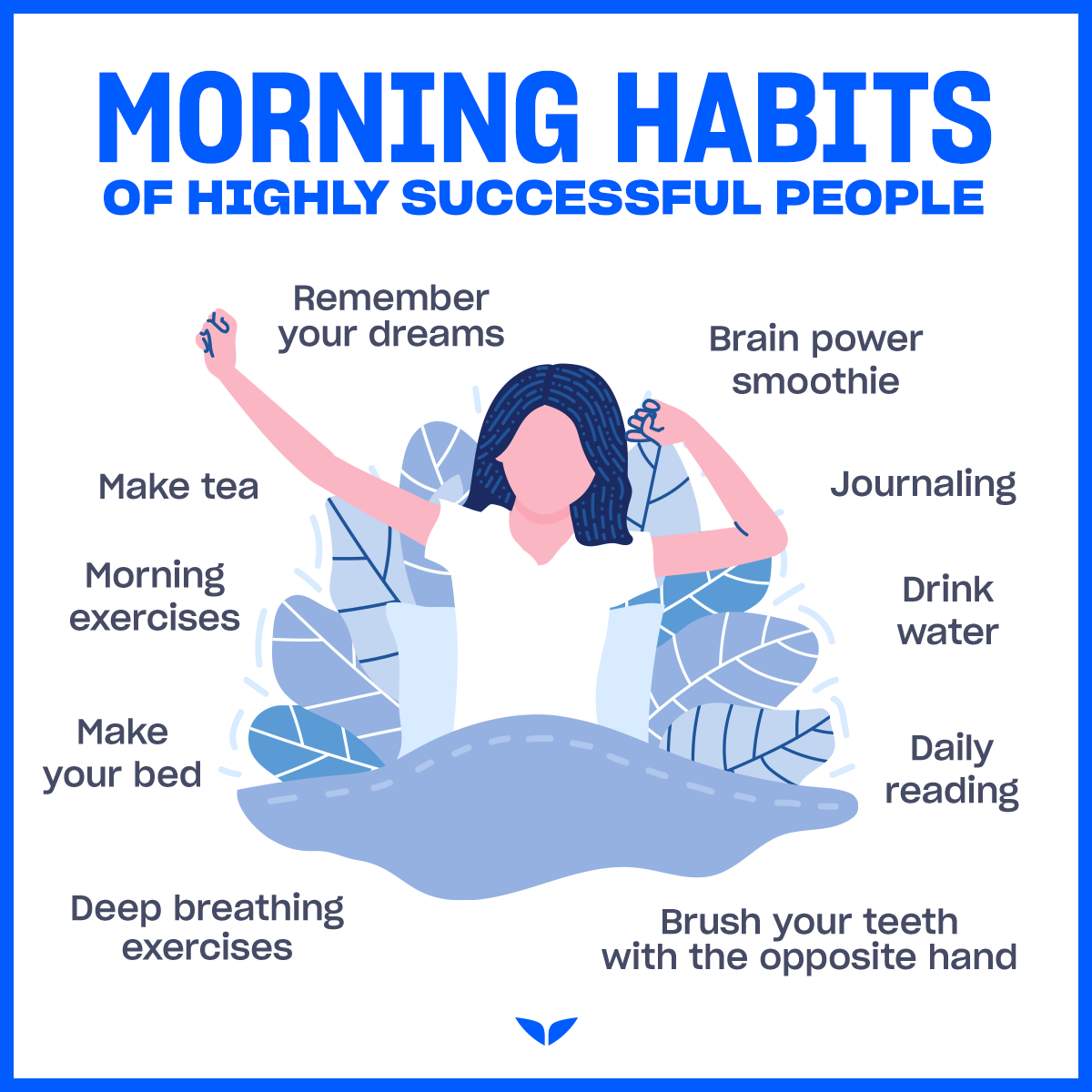
1. Remembering your dreams
Documenting your dreams as soon as you wake up is a habit that Jim highly encourages. It’s such a simple practice, yet it has a significant impact on your life.
When you’re working and learning all day, your brain doesn’t shut off at night. In fact, it gets more active, which is how it dreams up solutions and answers during sleep.
So, it’s worth paying attention to them. As Jim points out, “Your dreams can reveal your deepest desires, fears, and concerns. Sometimes, they may even provide you with solutions to problems that you’re struggling with in your waking life.”
Keep a pen and an empty journal by your bed. When you wake up, write down whatever you remember before your beta brain wave—a.k.a., the part of your brain that switches on thinking and doing—fully kicks in.
2. Making your bed
“If you want to change the world, start off by making your bed,” said William McRaven, a U.S. Navy Admiral, once, in his 2014 commencement speech at the University of Austin, Texas.
Sounds mundane, right? But there’s a reason this advice has endured the test of time.
Turns out, making your bed is one of those small morning habits that creates an early sense of order and completion. And an orderly environment, as research in Psychological Science shows, can increase your sense of self-control and goal-directed behavior.
No wonder it’s at the top of Jim’s recommendations in his program. It’s a great way to anchor your day in a positive mindset and wield self-control. As he says, “How you do anything is how you do everything.”
3. Drinking enough water
Your brain is made up of 80% water, according to the Nature Reviews Neuroscience journal. And during the night, it gets dehydrated.
So, Jim says, drinking water first thing in the morning can help rehydrate your organs and improve your cognitive function, memory, and energy levels.
Here’s a simple way to approach it:
- Drink one to two glasses of water shortly after waking.
- Add lemon or cucumber if that helps make it more enjoyable.
Research published in The Journal of Nutrition concurs with Jim, showing that even mild dehydration can impair your attention span and working memory. This, in turn, forces your brain to work harder to perform your usual tasks. But thankfully, rehydration helps restore your cognitive efficiency, sustaining alertness and focus throughout your day.
4. Brushing your teeth with your non-dominant hand
Brushing your teeth with your non-dominant hand may seem like an odd habit. But as Jim sees it, it can offer benefits beyond just clean teeth.
Turns out, it helps activate the opposite side of your brain, which can, in turn, help create new neural pathways and connections. And these new connections? They can bump up your brain’s ability to process information, and you can become more coordinated over time.
Of course, this can also be a fun new way to start your day, simply because it changes things up and challenges you to think and do differently.
But remember, Rome wasn’t built in a day. This habit may take some getting used to and can even feel awkward at first. But with practice, it’ll become a natural part of your morning routine.
5. Deep breathing exercises
“A lot of people get easily tired and have brain fog,” Jim points out. In fact, a 2024 study in Frontiers in Human Neuroscience found that 28.2% of individuals in the U.S. experience mental fogginess on the regular.
But thankfully, Jim says, the solution to this is a lot simpler than you think. “I’d say the number one thing to do is get more oxygen in your body.”
And here’s where breathwork comes in. A few minutes of slow, intentional breathing, a Cell Reports Medicine journal reveals, helps your nervous system settle and gives your mind a great starting point. From here, you can step into the rest of your day feeling more grounded.
6. Making a good cup of tea
Making tea in the morning is a soft rebellion against rushing. You’re not rushing or reacting but simply waiting for the water to heat while you intentionally choose the leaves you want in your cup.
Jim himself loves how this ritual grounds him in the A.M. And he takes it further by making what he calls “brain tea.” He reveals, “It has gotu kola, ginkgo biloba, and lion’s mane… really good ingredients that boost my focus and my memory.”
Of course, you can also opt for the ol’ caffeinated leaves. Remember what Andrew Huberman said earlier about mandatory A.M. cortisol spikes? Think of this ritual as your chance to leverage this window for eustress—the kind of stress that nudges you forward instead of knocking you sideways—so you can move toward your goals with clarity.
7. Filling in your gratitude journal
Jim takes advantage of his tea-making time to also journal what he’s grateful for (habit-stacking at its finest). Because what better time to do so than right in the morning, when your heart and mind are at their most open?
“Your brain really thrives on gratitude,” he says. And the effects, according to science, go beyond a fleeting feel-good moment. A study conducted by researchers for the Journal of Personality and Social Psychology has shown that people who regularly express their heartfelt thanks tend to have lower levels of stress and a greater sense of overall happiness.
Jim’s not the only expert to vouch for the wonders of penning your gratitude daily. Dr. Tal Ben-Shahar, a positive psychology expert and professor at Centenary University and formerly at Harvard University, would attest to it all the same.
“Journal writers experience significant benefits to mood and physical health,” he shares in his Mindvalley program, The 5 Elements of Happiness. “This exercise helps in achieving your goals and realizing dreams.”
This is also why Ana Juma, a certified Journal to the Self instructor and founder of journal tools brand Prophsee, is always quick to help people learn how to journal. “When you journal consistently,” she tells Mindvalley, “you are creating a dedicated space to your inner sanctuary for you to process your thoughts, emotions, and your experiences.”
Now, imagine priming those 25,000 mornings of your life with this positive energy. It’s only a matter of time before you see everything else in your life fall into place.
Unsure how to start? Just turn to some good morning motivation quotes to inspire you into action.
8. Exercising
See, this is one of the things you know you should do but often lack motivation for. But here’s the brutal truth, though: you need it. Even just three to four minutes of movement in the morning, Jim says, can make a difference in how you feel throughout the day.
“Three to four minutes? Pfff, that’s nothing,” you might be thinking.
Well, don’t underestimate those short rounds of jumping jacks, push-ups, or yoga. They’re enough to get your heart pumping and your blood flowing. A systematic review in the British Journal of Sports Medicine found that exercise enhances overall cognition, memory, and executive function. This explains why even a few minutes of activity can sharpen your attention and focus long after you’ve stopped moving.
And as Jim says, “What is good for your heart is also good for your head.” With your heart rate up, more blood will go to your brain and other organs. This means you’ll have more energy in your reserve to tackle whatever the day throws your way.
9. Jim’s brain power smoothie
“There are certain foods that are really great for your brain,” Jim says in Superbrain. And he makes sure they’re all packed in what he calls the “brain power smoothie,” his favorite staple for extra brain support in the morning.
It’s simple to throw together, with ingredients you likely already have in your kitchen (or are easy to find if not). In a blender, throw in:
- Half of an avocado
- 1/4 cup blueberries, fresh or frozen
- A tablespoon of coconut oil
- A handful of leafy greens, like spinach or kale
- A small handful of walnuts, soaked overnight
- A tablespoon of raw cacao (it can be in powder form)
- Up to two cups of nut milk or coconut water
Pulse all the ingredients until super smooth. Then drink it and move about your day knowing that you’ve already “fed” your brain the booster it needs to thrive.
And if any of these ingredients aren’t up to your liking, no problem. Jim suggests making your own by swapping the fruits or changing up the greens—add what you like.
10. Daily reading
“Leaders are readers,” Jim points out. “The average person reads only about one or two books a year. But the CEO reads about four to six books a month.”
The thing is, that much of regular reading supercharges your brain’s ability to slow down, follow ideas through, and make sense of complexity without glazing over.
And science supports this, with a 2023 study published in Frontiers in Psychology showing the “why” behind it all: improved attention, memory, and mental flexibility. And what better time to have your brain learn well than when it’s at its most sensitive to new knowledge, right?
Now, Jim knows the power of this habit all too well. He’s been a voracious reader for as long as he can remember. In fact, he attributes much of his out-of-the-box learning success to reading outside his comfort zone, from brain science to cognitive psychology to memory training techniques—topics not usually taught in school.
“I just started to understand things for the first time,” he recalls of the pivotal moment, after years of being known as “the boy with the broken brain” following a childhood accident. “I started to absorb information. It’s like I had just activated my super brain.”
Whether you prefer fiction or nonfiction shouldn’t matter as much as the fact that a page or two each morning does wonders for your well-being. So pick a new book or check out a new article topic, and just get going from there.
Need a little inspiration to start with? Check out the Mindvalley Book Club’s extensive list of recommended self-help titles and personal development books.
Live vibrantly, naturally
There’s a reason people say “rise and shine.” Getting up is automatic, but shining while at it takes intentional work.
Which is what Jim Kwik’s free Superbrain masterclass on Mindvalley can help you with. By signing up for this session, you’ll learn to:
- Debunk the myth we’re all told about how our brain works and learn,
- Uncover the perfect morning routine for optimal brain power,
- Master the five-minute brain exercise that spurs mental growth,
- Clear up any mental fog with the right brain foods, and
- So much more.
So, seize your place among the millions of Mindvalley members who have unleashed the power of their super brains through Jim’s guidance.
Like Milica Lazovic, an opera singer in Italy, who credits the program for helping her get her mornings together and boost her memory. As she shares in a testimonial:
This program has literally transformed my whole life. I am getting up early these days. Reading, meditation, my brain smoothie… they’re all the highlights of my mornings now.
As her story proves, small shifts create real momentum. “Your life today is the result of your thinking yesterday,” reminds Jim. “Your life tomorrow will be determined by what you think and do today.”
Your inherent greatness? It awaits you at the other side of this choice.
Welcome in.