Big beds adorned with cute cushions. Artworks of calming landscapes on the wall. Sheer, organic curtains frame the space, lit to perfection by the morning sun.
There’s a chance you’re into these features. But do you know why?
Well, according to Marie Diamond, a celebrity feng shui master, these are great “do’s” for a zen feng shui bedroom layout. As she puts it in her Mindvalley program, Feng Shui for Life, “Your bedroom is a place that is important for your health, your romance, and even your abundance.”
So, whenever that restless stupor gets you down, it’s worth considering that it might not be your mindset at work. Sometimes it just might be the very space where you spend your most vulnerable hours.
Thankfully, with Marie’s insights and easy-to-apply tips, you can make it a better place to return to so it can give back to you, ensuring you’re all renewed—day in, day out.
Why should you use feng shui in your bedroom?
The ultimate goal of embracing bedroom feng shui is to harmonize and align the flow of qi (pronounced like “chee” in lychee), which, in English, means “life force.” Think in terms of an Architectural Digest look and feel that intentionally supports all areas of your life, from your health and wealth to your career and relationships.
Think it’s woo-woo? Well, turns out, feng shui is not the mystery you may think it is. As a 2021 peer-reviewed study in Building and Environment notes, many of its principles align closely with modern architectural design around layout, comfort, and how people experience space psychologically.
In classical feng shui, which draws from traditional Chinese cosmology and principles shared with traditional Chinese medicine, different areas of the home are associated with specific aspects of life. The bedroom, in particular, says Marie, “influences your romantic life, your health, and even money.”
That idea holds up even when examined outside of traditional feng shui. An architectural study in Open House International found that bed placement, spatial balance, and room orientation consistently ranked as the most influential factors in how supportive a bedroom can feel.
And she’s not alone in this view. Joey Yap, one of the most widely respected teachers of traditional feng shui, often addresses the bedroom’s role in personal growth. After all, it’s where you reset your energy levels night after night.
In fact, a 2019 OnePoll survey found that the average American spends about 11 hours a day in bed. (That’s equivalent to nearly half of their lifetime.)
“Everything is about energy,” says Joey on his official YouTube channel. “Your thoughts are energy. Your emotions are energy.”
So it’s no wonder the bedroom is considered the most important room in your house.
How to get started with feng shui
“What, exactly, is the feng shui bedroom approach all about?” you might ask. Well, before you start rearranging your furniture, it’s important to understand the feng shui basics. Here are a few things to know:
1. Assess your environment with the muscle test
Developed by Marie, this test allows you to easily discern where there’s positive energy flow in your space, including your bedroom, and where there isn’t.
And it’s all rooted in the science of brain waves. According to research published in Frontiers in Neuroscience, your nervous system regulates these waves, which shift in response to stress, relaxation, and environmental cues.
In feng shui, Marie focuses on two states when assessing a space:
- Alpha, which comes in during deep relaxation. When you’re in this mode, your body softens, your attention widens, and your subconscious mind becomes more receptive.
- Beta is the frequency you operate in when you’re alert, problem-solving, or hypervigilant. It’s useful during the day, but when it dominates at night, it often shows up as restlessness or tension.
The bottom line is, how a space influences your brain states in real time tells a lot about whether it’s working for you or against you, according to Marie. As she explains, “Everything that is around you affects your brain, your energy, non-stop.”
2. Identify your personal energy number
Your personal energy number defines the flow of qi in your life.
The thing is, everyone responds a little differently to the same environment. In feng shui, that difference is mapped through your personal energy number, calculated from your birth date and the gender you were born with. It reflects the way qi naturally supports you and how it tends to show up across different areas of life, including:
- Your purpose,
- Your attraction to certain colors and practices,
- Your level of success and money flow,
- How your health and well-being unfold,
- Your personal and professional relationships, and
- The energy you focus on to receive wisdom.
“The energy number,” explains Marie, “directs you and tells you how is your qi in your life and what to activate in your home and space to manifest that one-third of good luck, your earth luck, to the maximum.”
Discover more insights into finding out your energy number:
3. Discover your personal directions
In Chinese wisdom, the feng shui bagua map is a powerful tool that helps you influence how qi moves through your environment and how that movement affects you in return.
Its eight sides align with all cardinal directions on a compass, with each associated with a specific area of life:
- North: your career path and life direction,
- Northeast: wisdom, self-development, and inner growth,
- East: health, vitality, and family harmony,
- Southeast: wealth, abundance, and resources,
- South: reputation, visibility, and recognition,
- Southwest: love, relationships, and partnership,
- West: creativity, joy, and self-expression, and
- Northwest: mentors, support, and helpful people.
The next step? Making these directions work for you, personally.
Before locking in some positive energy placements in your feng shui bedroom approach, it helps to see how those directions actually sit in your space. Here, a simple feng shui bedroom layout generator online comes in handy, so you have a clear visual starting point before you move anything around.
Depending on your energy number, some directions will feel more supportive, while others can subtly drain your focus or momentum. Pay close attention to how your body responds to each of them. From here, it’s easier to rearrange your space to accommodate what feels right.
Intrigued? Here’s how you can find your directions and begin working with them intentionally:
7 feng shui bedroom tips to spruce up
Often mistaken for interior design, feng shui goes beyond revamping your space or rearranging furniture and decor. Instead, it works with the qi of the space around you—in this particular case, your bedroom.
Here’s how to feng shui your bedroom, while avoiding feng shui mistakes, in seven steps:
1. Keep clutter out
This isn’t just about physical hygiene. The way your bedroom appears to you can impact your sleep quality and mental clarity.
Research published in Building and Environment found that bedroom conditions, including visual disorder and poor layout, are directly linked to poorer sleep quality, anxiety, and lack of next-day focus. It’s why you can’t quite power down when you’re sleeping next to, say, piles and piles of books and files.
To tackle this, Marie suggests keeping your bedside table well-lit and, above all, neat. Here, only important trinkets should be around you, like:
- An inspiring book to read before bed,
- A picture of your family and loved ones, or
- A calming object (like a crystal or a keepsake item) that signals rest.
Whatever sits closest to your body, she says, falls within your energy field and directly affects how you wake up in the morning.
2. Make it a safe space
Your bedroom is where you detach from the hustle and bustle of your day. So, it’s important to keep it clear of negative energy so the energies of love and prosperity can linger.
A study in Environmental Research and Public Health found that perceived safety, comfort, noise, and light in your resting environment influence sleep quality and stress levels. The safer your bedroom feels to you, the deeper your nightly rest gets and the fresher you’ll feel every morning.
Now, you can reinforce this sense of safety in simple, intentional ways, such as:
- Placing rose quartz (symbolizing love and peace) in the right area,
- Clear your room energetically by smudging with sage or palo santo, or
- Practicing positive affirmations intentionally, like “I feel safe and supported” and “I am getting the rest I deserve.”
As Marie points out, “Your body is there at night in a very vulnerable place.” These things help ensure that “it’s safe, that your bedroom is a wonderful, loving space for you.”
3. Incorporate earthy colors
Ever notice how you sleep more deeply in a hotel room with warm, muted tones than in one that’s stark white or drenched in bold color?
There’s a reason for that. According to a study in the International Journal of Innovative Research in Technology, earthy shades such as beige, tan, soft peach, and warm yellow naturally help the nervous system feel calm. Each, in their own way, makes a space feel held, grounded, and steady—exactly what your body needs when it’s winding down for rest.
It’s not surprising, then, that traditional feng shui approves of these tones. After all, they can anchor your bedroom’s energy so it’s supportive rather than stimulating.
In contrast, bold shades such as red, green, blue, and black tend to overstimulate your senses. That’s why Marie advises avoiding them in large doses in the bedroom; they shouldn’t be wall colors, bedspreads, or oversized furniture.
Still, if you love these hues, keep them subtle. A small accent pillow, a piece of art, or a decorative object is enough to bring them in without disrupting the calm.
4. Be mindful of the things you hang up
This is especially important for the wall above your headboard. To make the most of your bedroom’s role in romance, display images that represent love, like pictures of you and your partner, a romantic quote, a picture of the two of you, or even your vision boards.
At the same time, avoid anything that features or symbolizes water. Per Marie’s wisdom, water imagery in this position can subtly trigger feelings of instability or emotional overwhelm. As she puts it, it’s like sleeping with the sensation that “you’re drowning,” which can leave the body feeling exposed rather than supported.
5. Avoid or cover sharp angles
Sharp corners, exposed edges, and pointed furniture don’t just look harsh. In feng shui, they’re known as “poison arrows” because of how they direct energy toward the body while you rest.
YouTube’s feng shui sensation Julie Khuu, who’s helped millions of viewers optimize their homes, is known to apply this step in very practical terms. When the energy of pointedness sits with you night after night, she says, it’s hard for your body to fully relax.
“Avoid anything sharp, angular, or cutting, especially when it cuts through right to the top of your head,” she advises on her channel. “This sends out cutting qi to your head and your bed.”
6. Relocate your mirror elsewhere
Ever wondered about where best to put a mirror in bedroom feng shui? Here’s your simple answer: anywhere it doesn’t reflect the bed.
In feng shui, mirrors, whether as a purely reflective surface or in the form of a TV screen, are highly active. They bounce energy around, amplify movement, and keep the space alert. That’s helpful in areas where you’re awake and active, like hallways or dressing areas.
But in the bedroom? Not ideal.
“The mirror is always a doubling effect,” Marie explains, adding that when you’re in passive modes, like sleeping, you’re actually doubling your vulnerability.
You’ll discover this philosophy at work in Julie’s teachings, too. “Mirrors have too much active yang energy for a place of rest,” she says. “They reflect way too much energy when you should be sleeping and recharging.” (In elemental terms, the Chinese term yang refers to active, stimulating energy.)
7. Place your bed in an ideal position
For Marie, the best feng shui bed placement turns concept into lived experience. Where your bed’s positioned, she explains, affects how safe, supported, and relaxed you are while asleep.
And your sleep quality? It affects everything from your mood and focus the next day to your long-term vitality. “When you wake up,” she notes, “your brain has to be totally clear to be successful in the rest of the day.”
This practical, body-first approach is also something Julie often emphasizes in her practice. It’s no wonder she often teaches her viewers that “the most important factor to good feng shui in the bedroom is the orientation of your bed.”
Feng shui bedroom layout examples
“Feng shui is all about energy,” says Marie. “And how everything within your domain has its own intrinsic energy.”
Now, the bedroom’s no exception to this rule. Since it’s where you renew yourself each night, it has a “say” in how you support and steady yourself and open to new possibilities in life—on the daily.
But what, exactly, is a helpful bedroom feng shui practice? And what is considered bad feng shui for the bedroom? As Marie sums it up, it usually comes down to layout choices that either support or disrupt flow, balance, or a sense of safety.
Below are two common layout scenarios and how each affects the space’s energy:
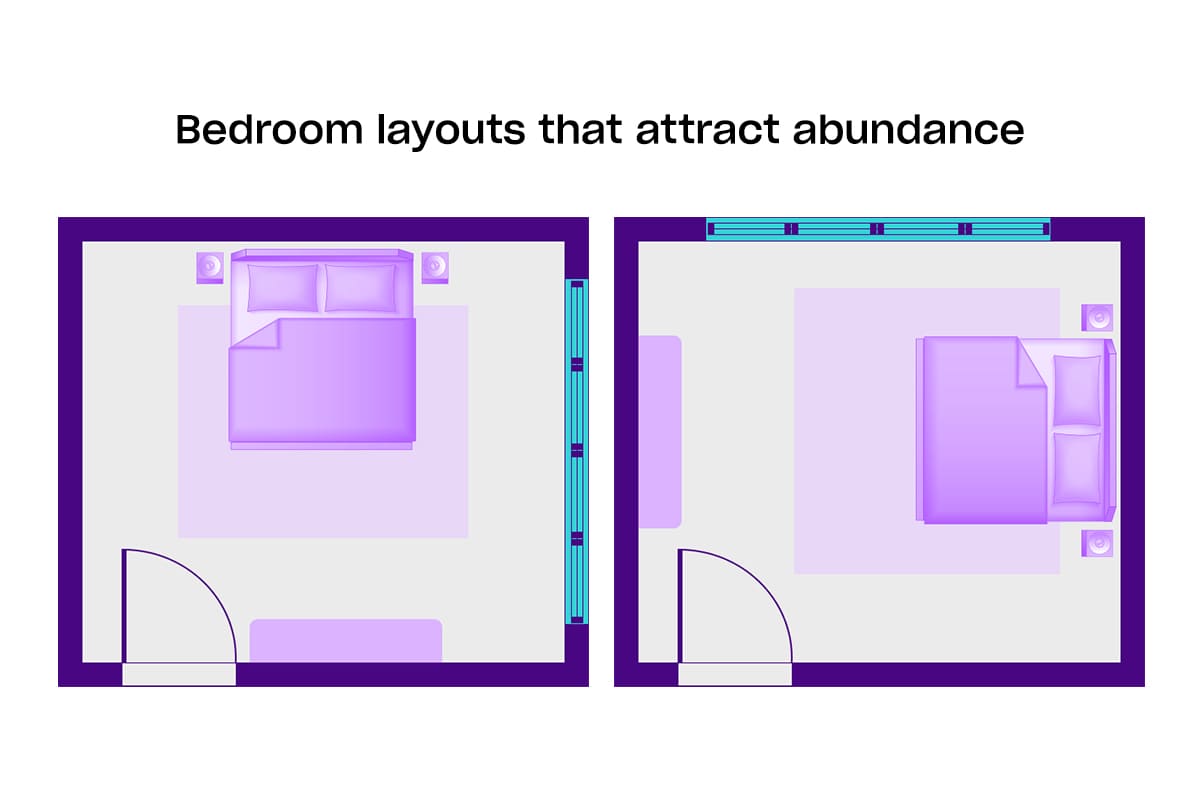
Bedroom layouts that attract abundance
Bedrooms that are easy to enjoy and relax in tend to include these common features…
- The bed is in a commanding position, where the door sits within your peripheral vision. This helps the body feel aware and protected while you rest, rather than startled or on edge.
- A solid headboard and matching nightstands on both sides to create balance and a sense of support. As a 2020 peer-reviewed study in Cortex discovered, symmetry here signals stability, allowing the nervous system to feel safe.
- An area rug next to the bed to ground the space visually and energetically. This helps the room feel settled rather than floating or fragmented.
- Larger furniture, like a dresser, near the foot of the bed. Placing them this way keeps energy moving smoothly without crowding the area where you sleep.
Below are two layout examples you can try that incorporate these features:
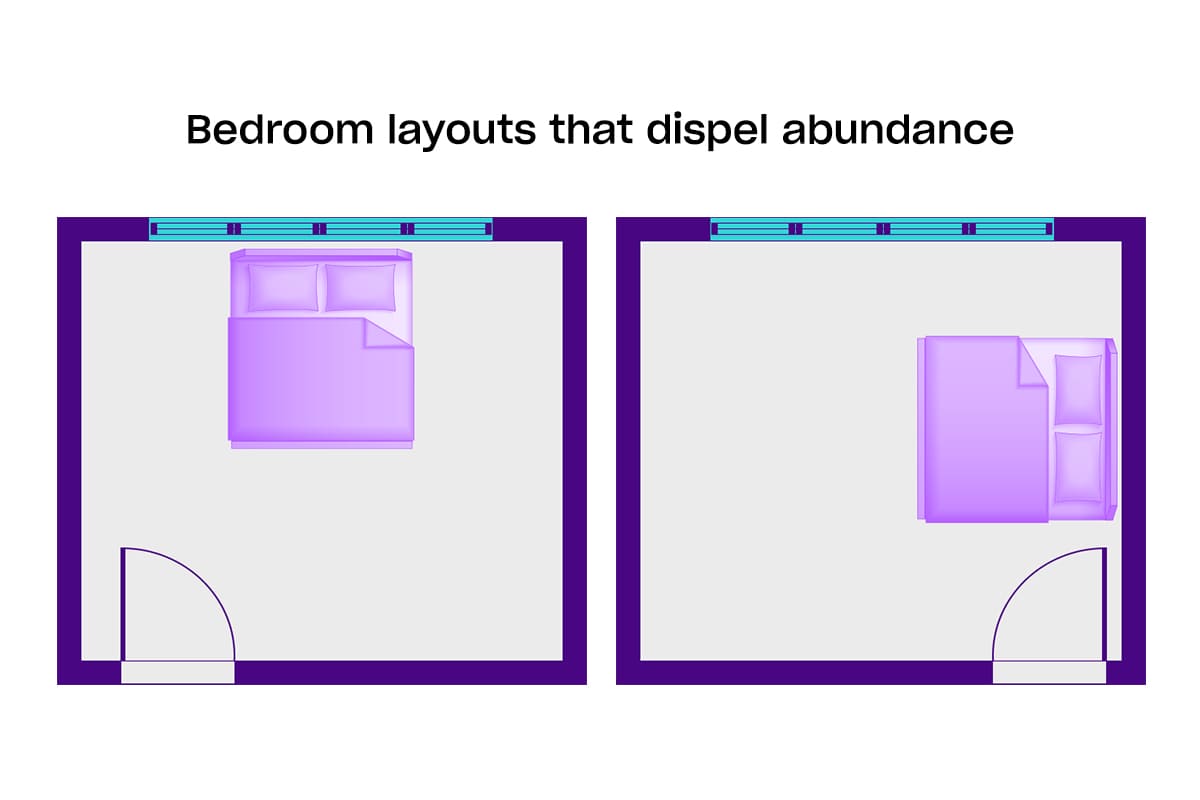
Bedroom layouts that dispel abundance
Layouts that quietly drain energy often appear fine at first glance. But spend a little more time in them, and you’ll eventually feel something off.
Look even closer, and you’ll likely find unsupportive, flow-disrupting arrangements like…
- A bed that sits in line with the door or under the window. This position, Marie says, places the body directly in the path of incoming qi. So, instead of settling, energy rushes toward you, which can keep you on edge while you sleep.
- Visual asymmetry around the bed. For example, when one side of the bed has a nightstand and the other doesn’t, or when one side table is crammed with items while the other is bare. Energetically, this asymmetry often brings feelings of instability and lack of support.
- Heavy or visually busy items above the headboard. Shelves, large frames, or clutter overhead can make the space feel heavy. Even if you don’t think about it, your body still picks up on that pressure, which can make it harder to fully relax and settle into sleep.
- Too much furniture around you. When large pieces sit too close to where you rest, the room can feel compressed. Instead of free-flowing, qi can stagnate, which weakens the relaxing effect the bedroom is meant to provide.
Live vibrantly, naturally
When it feels like you’re stalling or a little out of sync, sometimes the best thing to do is to look around you.
The spaces you move through every day, from your home to your workplace, can affect you more than you think. After all, words, thoughts, and deeds are energy and linger where you move and think every day. And more often than not, uplifting yourself starts with uplifting those spaces… gently and intentionally.
Here’s where Marie Diamond’s free Feng Shui for Life class on Mindvalley serves as a natural starting point. It’s a less-than-20-minute glimpse of her full program, which guides you on how to:
- Optimize positive energy in your bedroom and home,
- Turn your space into a three-dimensional vision board for your goals,
- Clear energetic blocks that show up as restlessness or stagnation,
- Support abundance, focus, and momentum through layout choices, and
- Create a home that feels safe, nourishing, and emotionally supportive.
Many Mindvalley members have benefited from Marie’s guidance. Dr. Debora Trimpe, the founder and executive coach at Prime Performance Strategies, is one of them. She shares:
The directions Marie gave on how to implement different feng shui ideas were very clear and simple to implement. I noticed a change in myself and my environment every week after applying what she taught.
Like Dr. Debora, you, too, can experience the quiet shifts that feng shui makes possible, some of which start in the very room you wake up in.
Because when your environment reflects where you’re headed, rather than where you’ve been, momentum returns in subtle but meaningful ways. And it’s only a matter of time before the path to greatness unfolds naturally before you.
Welcome in.