Have you ever been in a conversation and the other person is absolutely not responsive?
No matter what you do—yell, scream, nag, speak calmly, express clearly—all you get back is dead silence.
There’s a term for it. It’s called stonewalling.
But what can you do when someone’s downright determined to shut you out? All’s not lost… if you know how to respond.
What is stonewalling?
The “stonewalling” definition, as Jenna Nielsen, LCSW, explains to Mindvalley, is essentially when you or the one you’re speaking to stops responding or exits the conversation altogether.
“Emotionally,” she adds, “it means that you are closed off and avoiding conflict.” It leaves one of you talking to, well, a “stone wall.”
But why “stonewall”? The phrase itself comes from warfare and prison architecture. It was a structure built to block movement, seal people in, or keep others out.
By the 19th century, “to stonewall” entered political language. Lawmakers used it to describe deliberately blocking debate or refusing to cooperate in legislative proceedings. This tactic didn’t allow anything to move forward if one side refused to engage.
Nowadays, the term is typically synonymous with relationships—or more specifically, trouble in them. According to psychologist John Gottman, the founder of the Gottman Institute, stonewalling is one of the Four Horsemen of relationship breakdown (the other three being criticism, contempt, and defensiveness).
That could look like anything from one-word replies, flat sarcasm, the silent treatment, scrolling through the phone, or even leaving the room when you or the other are mid-sentence. Subtle? Hardly. Intentional? Definitely. Rude? Absolutely.
Interestingly, Dr. Gottman’s research shows that about 85% of people who stonewall in heterosexual couples are men. In interviews with the participants, he found that many stonewallers believed they were exercising restraint.
And, because you should never judge a book by its cover, what stonewalling looks like on the outside rarely matches what’s happening underneath.
What does “stonewalling” mean emotionally?
While it may seem like a calculated attempt to control the situation, stonewalling, emotionally speaking, is most often a response to nervous system overload. The thing is, when conflict pushes you past your capacity to cope, your body will likely go into shutdown.
Your heart rate spikes, your thinking narrows, and you feel that if you say anything, it could make the situation explode. So, the safest thing to do, in the end, is to withdraw.
From the outsider’s point of view, that move can look deliberate or dismissive. But from the inside, it usually feels like containment. As Dr. Gottman explains the “stonewalling” meaning in an interview with Anderson Cooper, “The stonewaller is really trying to calm down and not make [the situation] worse.”
What most people don’t know is that silence creates urgency. And according to Kipling D. Williams, a professor of psychological sciences at Purdue University, unanswered conflict feels unresolved and unsafe. Your brain starts asking questions it doesn’t like not having answers to:
- Are we still connected?
- Did I do something wrong?
- Is this conflict about to cost me the relationship?
It definitely triggers a different kind of internal response. That can, in turn, trigger an undesirable, escalated external response. And so, as Dr. Gottman points out, it’s “a very destructive pattern.”
If this dynamic leaves you feeling anxious, distressed, or unsafe, consider reaching out to a qualified mental health professional for help.
Stonewalling vs. healthy space-taking
Have you and your partner butted heads, and you walked away? From one perspective, it could be that you’re taking some space to clear your head before the argument gets to the point of no return. But from another, it could be that you’re avoiding confrontation.
But when is one, and when is the other? Here’s a closer look:
| Stonewalling | Healthy space-taking |
| Shuts down without explanation | Says clearly, “I need a break” |
| No timeline for returning | Gives a time to come back |
| Avoids eye contact or leaves abruptly | Leaves calmly and intentionally |
| No reassurance | Reassures the relationship is okay |
| Refuses to engage | Plans to re-engage |
| Feels like punishment | Feels like regulation |
| Leaves the other person guessing | Leaves the other person informed |
| Conflict stays unresolved | Conflict is paused, not avoided |
| Increases anxiety | Lowers emotional intensity |
| Creates distance | Protects connection |
Not knowing the clear distinction between the two can scramble your communication line and create relationship problems, according to Jenna. She notes that the intention of, let’s say, your partner may not be to punish or manipulate you. However, it can “invalidate the person who is being accused of stonewalling feelings.”
So it begs the question: if it’s not always punishment, what drives someone to shut down at all?
Why people stonewall during conflict
“People can stonewall to try to control the situation, to try to punish someone, or to gain power,” Jenna explains. “They can also stonewall unintentionally because they do not know how to express or regulate their own emotions.”
For instance, you spent hours cooking up a restaurant-worthy meal for dinner that’s so finger-licking delicious even Gordon Ramsay would be left speechless. Your partner shows up, eats the food, and then parks themself in front of the TV for the rest of the night.
Exhausted and exasperated, you bring up that you didn’t get a “thank you,” not even a half-hearted offer to help clean up. Your partner picks this up as nagging, throws up their arms in a fluster, and walks right out the door.
The thing is, there’s usually a pattern behind the behavior. Here’s what could be driving it:
- You hit overload faster than you think. A raised voice, a sharp tone, or even perceived criticism can register as danger if you’re already on edge. What feels like a normal disagreement to one person can feel destabilizing to you.
- You learned that conflict isn’t safe. If someone grew up in a home where conflict meant yelling, criticism, or emotional chaos, disengaging may have been the safest move available. That strategy can follow you into adulthood without you realizing it.
- You were never taught how to argue constructively. We all have our own unique fight language. But if you didn’t, shutting down can feel easier than fumbling through a hard conversation.
The stonewaller is really trying to calm down and not make [the situation] worse.
— Dr. John Gottman, psychologist and founder of the Gottman Institute
Based on Gottman’s Four Horsemen, stonewalling will show up after criticism, contempt, and defensiveness. The more you do it, the more it becomes a reflex. Even the teeniest, tiniest thing could send a person to put up a wall.
Left unchecked, it can turn from self-protection into something far more damaging.
When stonewalling becomes a red flag
No doubt, getting shut out and shut down sucks. But how do you know if this has become a red flag in your relationship?
- It happens almost every time there’s a conflict.
- The conversation never gets revisited or resolved.
- Silence is used to punish, control, or make you chase.
- You start shrinking yourself to avoid triggering it.
- They refuse to acknowledge or take responsibility for their behavior.
The unfortunate thing is, this pattern can shift the relationship dynamic. One person controls when conversations happen (if they happen at all). The other adjusts, waits, overthinks, or walks on eggshells to avoid another shutdown. That imbalance is where real damage starts.
If these patterns start affecting how you think, feel, or function, Jenna explains that “this might mean that this is not a healthy pattern or relationship.” And as she advises, “You should reach out for help if it starts to feel emotionally or mentally abusive.”
Awareness, of course, is the first move. But how you decide to respond is what changes things.
How to respond to stonewalling in a relationship
“So many people feel trapped or out of their power in their relationships,” says Dr. Laura Berman, a relationship therapist, television host, and the trainer of Mindvalley’s Quantum Love: The Blueprint for Extraordinary Relationships.
And when there’s a communication breakdown between you and your partner, it can feel like you’re hitting a wall. The good news is, resources like free relationship classes offer practical tools for improving communication and handling issues such as stonewalling.
We must identify our worthiness-killing stories and loosen their grip on our thinking patterns.
— Dr. Laura Berman, trainer of Mindvalley’s Quantum Love: The Blueprint for Extraordinary Relationships program
Dr. Berman, for example, suggests these strategies in her Quest to help you shift things when problems like stonewalling arise:
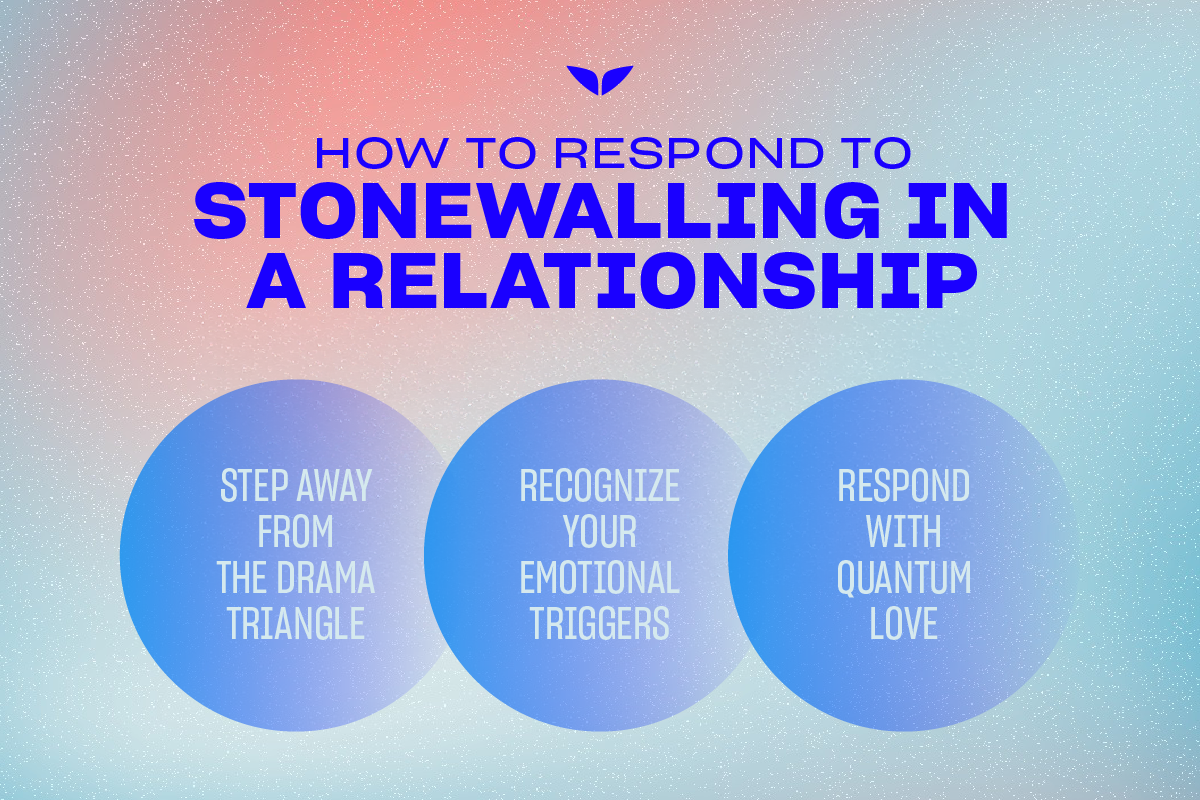
1. Step away from the drama triangle
In relationships, we often fall into roles—victim, villain, or hero—without realizing it. They’re part of what Dr. Berman calls the Drama Triangle.
Here’s taking a look at them more closely:
- The victim often feels powerless or helpless in the situation. Having this mindset can lead to passive-aggressive behavior, where you might not directly express your needs but instead expect your partner to notice and fix things.
- The villain might be defensive, critical, or unwilling to accept any responsibility. But one thing’s for sure: they’re the ones blamed for all the problems.
- The hero steps in to “fix” everything and make it better. However, this often comes at a cost: taking on the responsibility for everyone’s emotions can end up draining your own energy.
Now, if you’re being stonewalled, you might feel like a victim, blaming your partner (villain) for shutting you out or even trying to “fix” the situation (hero).
But the first step to responding to it is to “recognize when you’re on the drama triangle and get off it,” according to Dr. Berman. How can you tell? “The tried and true guarantee that you’re on the triangle is if you’re convinced you’re right. It’s as simple as that.”
So, instead of focusing on being “right,” shift your mindset. Ask yourself, “What is my role here, and how can I take responsibility for my own emotions?”
In the heat of the moment, that can sound like, “I don’t want this to turn into a fight. I care about what we’re talking about. Can we slow this down?” Or even, “I’m not trying to attack you. I just want to feel heard.”
By stepping out of the Drama Triangle, you create space for healthier communication where both partners feel heard and respected.
2. Recognize your emotional triggers
Conflicts in relationships can bring out deep emotional reactions, especially those from your past.
Dr. Berman suggests these triggers are like “thorns” buried inside you—hidden pain from past experiences that gets touched in your present relationship. A study published in Personal Relationships found that when you’re unable to recognize or manage them, though, misunderstandings and negative feelings often surface.
“In order to really move to the quantum love zone and stay there, we must identify our worthiness-killing stories and loosen their grip on our thinking patterns,” Dr. Berman advises.
So here’s how you can do so using her “thorny story timeline”:
- Start by centering yourself. Take a moment to breathe deeply and open your heart, creating space to explore your emotions without judgment.
- Think back to your earliest memory of feeling let down, abandoned, or hurt. Write this memory down, along with your approximate age.
- Map out similar memories, moving from left to right, like a timeline. Include moments where you felt emotionally or physically abandoned.
- Once your timeline is complete, revisit each memory. How did you feel during these moments? Reflect on the emotions and experiences through the lens you had as a child. These emotions may be fueling your reactions today.
If you feel yourself getting flooded, say so. “I need 20 minutes to calm down, but I want to come back to this tonight.” A pause only works if there’s a return plan.
“When you can lovingly forgive, detach from, and observe those events that have happened to you from a coherent home frequency,” says Dr. Berman. “Then you can release it; you can love it; you can bless it, and you can let that energy go.”
3. Respond with intention, not reaction
What doesn’t help is chasing, escalating, or demanding a resolution on the spot. Pushing harder when someone has already shut down usually builds a thicker wall.
With any kind of challenging behavior, you best believe the energy around that person is not great. But what if you learn how to respond to stonewalling by tapping into what Dr. Berman calls “quantum love”? Chances are, you’ll go about your day feeling calm, peaceful, and full of love, no matter what’s happening around you.
That’s what quantum love is all about—aligning yourself with a higher frequency, or, in Dr. Berman’s words, “home frequency.” How?
- Ground yourself with deep breaths to stay centered and avoid reacting emotionally.
- Pay attention to any tension or stress in your body, acknowledge it, and then shift your focus to how you want to feel.
- Identify the feeling you desire in your relationship. Whether it’s feeling loved or appreciated, let that guide your response and strengthen emotional intimacy instead of weakening it.
- Choose to stay in your home frequency. It not only affects you but can also change the energy around you.
- Imagine sending love and calmness to your partner, even if they’re stonewalling. This simple act can shift the dynamic between you.
When (or if) your partner is open to the idea, invite them to revisit the conversation with love. You’ll find it’s easier to break down walls and open up a meaningful dialogue when you’re both aligned with positive energy.
How to respond to stonewalling at work
No doubt, dealing with people who give you the silent treatment, cut you off mid-sentence, talk over you, or leave you feeling ignored can truly test your patience.
Having it happen in relationships is one thing. But dealing with stonewallers in your workplace? It’s just as challenging.
According to a global study by the International Labour Organization (ILO), nearly 18% of workers have dealt with some form of psychological harassment, like being ignored or shut out. What’s more, many people don’t speak up about it because they feel embarrassed or think it’s not worth the hassle.
So, learning how to respond to stonewalling, especially at work, can help you stay grounded and avoid saying, “Peace out.”
Here are a few ways you can respond:
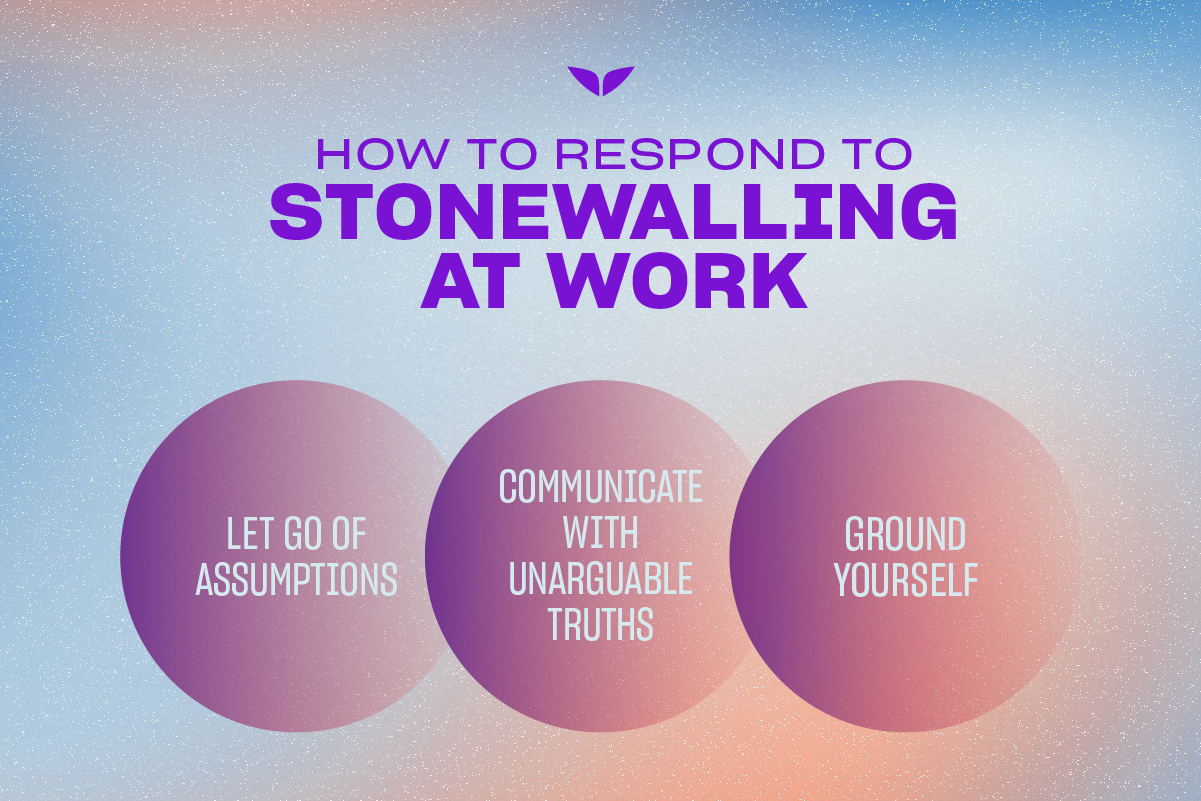
1. Let go of assumptions
Say you greet a coworker, but they walk right past you, or your boss snaps at you during a meeting. Your first instinct might be to think, “Did I do something wrong?” or “Do they hate me?”
It’s really easy to jump to conclusions or let frustration take over when you don’t have the full picture. As Dr. Berman says, “When we’re in a negative emotional state, it’s like you’re wearing those gray-colored glasses, and your whole worldview is clouded.”
But instead of overreacting, you can ask yourself questions like, “Am I reacting to what’s really happening or to my assumptions about the situation?” This is the power of focused attention—it can help you shift the energy.
You may then realize that your coworker didn’t hear you. Or your boss is stressed for reasons unrelated to you.
Remember, where your attention goes, energy flows.
2. Communicate with unarguable truths
When you’re going head-to-head with someone who refuses to engage in a real conversation, frustration can quickly build up. But instead of accusing your coworker or getting defensive, there’s a more effective way to communicate how you feel, by speaking unarguably.
Here are four steps to guide you through this process:
- Start by describing how your body feels in the moment. For example, say something like, “I feel a knot in my stomach” or “My shoulders are tense.” These are things no one can argue with because it’s your physical experience.
- Share the emotion behind it. For instance, “I feel stressed and uneasy because of the knot in my stomach.” This helps your coworker understand what’s going on with you emotionally.
- Tell the story you’re creating in your mind. Acknowledge that your feelings might be based on assumptions. You could say, “I’m feeling stressed and uneasy because I have this story in my head that you’re upset with me for missing the last deadline.”
- End with what you need or want from the situation. For example, “I would like it if we could clear the air and work through any concerns so we can move forward.”
“When you’re speaking unarguably, you’re speaking truths that apply only to you,” explains Dr. Berman. “So you’re not projecting anything… nor are you making assumptions or accusations about how they’re thinking or feeling.”
If the pattern continues, it’s appropriate to move from emotional clarity to professional boundaries. It could be something like, “I need a response by Thursday so we can stay on deadline,” or “If I don’t hear back, I’ll move forward with the information I have.”
Clear timelines reduce ambiguity and prevent silence from stalling progress. What’s more, in workplace settings, following up in writing can also protect you and keep communication transparent.
3. Ground yourself
When someone’s energy is off at work—whether they’re snapping at you, giving you the cold shoulder, or just in a bad mood—it’s easy to think, “Oh, there they go again.”
David Feinstein, a clinical psychologist who co-trains Mindvalley’s The Energies of Love program with his wife, Donna Eden, explains that instead of letting their mood affect you, you can recognize that their energy is scrambled.
And with that awareness, you can choose to ground yourself and stay centered, no matter what’s going on around you, using the Four Thumps technique.
Here’s how to do it:
- Tap your cheekbones. This connects to your stomach meridian and grounds your energy down to your feet.
- Move to the K-27 points. Located just below your collarbone, these points clear your energy and keep it flowing smoothly.
- Tap your thymus. Tapping on the center of your chest supports your immune system and boosts vitality.
- Tap your spleen points. Located below your bra line, these points help you process information and release toxins.

Grounding yourself is important, but it doesn’t mean tolerating ongoing dysfunction. Research published in the Journal of Applied Psychology shows that when silence or exclusion consistently blocks collaboration, delays decisions, or undermines team morale, it affects performance, not just personalities.
At that point, consider escalating it to HR, a direct supervisor, or formal feedback, especially if the behavior affects deliverables or team outcomes.
Great change starts here
Whenever emotions are thrown into the mix, conflict happens. That’s just the nature of humans. But what you do next is what matters the most.
You can choose to react. You can also choose an alternative—to break the pattern, to put up boundaries, to understand why you respond the way you do, and change it…
It all starts with awareness. And Mindvalley’s free relationship resources are built for exactly that. Here’s what you can find:
- Quizzes and self-discovery tools to understand how you show up in relationships
- Guided meditations to build confidence, calm, and emotional balance
- Practical communication tools to handle conflict with clarity
- Free classes to deepen connection, intimacy, and self-awareness
- Downloadable resources to spark more meaningful conversations
Change your response, and you change the dynamic. What you choose to do next is entirely up to you.
Welcome in.