

The grass is perfect. Glasses clinking. That sweet, smoky smell of barbecue hanging in the Redmond air.
Summer 1998. I’m 22. Standing on the lawn of Bill Gates’s home.
The most powerful man in tech is right there — three feet away, flipping burgers, chatting with the other interns like it’s just another Tuesday.
I had worked my entire life for this moment. University of Michigan. Computer engineering. One of the most coveted internships on the planet.
And I couldn’t bring myself to shake his hand.
Not nerves. Something deeper. A knowing I couldn’t yet name.
I had spent years walking toward a destination that was never mine. And standing on that perfect lawn — surrounded by every external signal of success — I felt like a fraud.
A few weeks later, I quit.
What followed was two, maybe three years of wandering.
New York. San Francisco. And eventually a deeply boring California town called Sunnyvale — which was, I can confirm, exactly as dull as it sounds.
I was broke. I was lost. And I had landed in what I can only describe as my personal nightmare: cold-calling attorneys from a phone book to sell them case-management software.
Let me paint you the full picture.
A Malaysian kid named Vishen Lakhiani. Interrupting stone-faced lawyers in the middle of their days. Phone-slamming. Yelling. Creative profanity — and I mean creative. Lawyers, it turns out, are powerfully poetic when they’re annoyed. Their descriptions of what I could do with myself involved medieval torture techniques and inanimate objects I will not name here.
I was failing. Every. Single. Day.
And then — almost by accident — I walked into a room.
One day. One workshop. A woman named Amanda, smartly dressed, designer glasses, who shattered every meditation stereotype I’d ever held. She taught me to access altered states of mind. And more importantly, to use intuition as an actual tool.
Something cracked open in me that day.
I went back to work the next morning. Same phone book. Same attorneys. But I was different. I started using what I’d learned — the intuition, the mental programming, the ability to quiet the noise and feel which calls to make. My results shifted. Then they transformed.
That one workshop didn’t just change my sales numbers. It changed my life.
I became a certified Silva instructor. Taught classes in London and New York for five years. And one question haunted me from that seminar room:
“Why did this transform me in a single day — when it was never taught in my $29,000-a-year degree?”
That question became the founding question of Mindvalley.
I’ve told that story thousands of times.
The phone book. The attorneys. The meditation class in Sunnyvale. It became the seed of one of the world’s foremost personal growth companies — 22 years in the making.
But here’s what I really want you to hear.
I didn’t build Mindvalley to $140 million on a great product alone.
One of the first things that helped scale this business was the passionate retelling of a true story. A story that was real. A story that had shifted my life. A story people could feel.
When I told the phone book story — the rejection, the desperation, the one workshop that changed everything — people leaned in. They shared it. They sent it to friends. They signed up for whatever I was offering, not because of the features.
Because they saw themselves in that story.
Your product pitch is forgotten by tomorrow. Your story is shared for years.
Here’s why this matters to you.
Storytelling is the key to business. It’s how founders get their products out to the world. How movements get built. How a kid from Malaysia with a phone book and a meditation certificate ends up building a company that reaches millions.
And the science backs this up.
Stanford professor Jennifer Aaker found that people remember stories 22 times better than facts alone. Twenty-two times. Your data impresses people for a moment. Your story moves them — and stays with them.
This is what I’ve spent years learning to do.
And it’s what I want to give you.
I want to share two lessons from teachers I’ve personally learned from — both speaking at the Mindvalley Speaking & Influence Summit happening this June 26-28.

Eric Edmeades is the finest speaking trainer I’ve ever encountered. I believe this so deeply that I flew my 18-year-old son to Florida for a week just to train under him. Eric once told me a story I’ve never forgotten. He was backstage at a conference, about to go on, when a stranger ran up to him. This man had seen Eric speak six years earlier. And he started reciting Eric’s own story back to him — word for word. Not a framework. Not a statistic. A story.
The lesson I learnt from him is: “If you want your message to outlive the moment, put it in a story.”

Lisa Nichols is one of the most electrifying communicators I’ve ever witnessed. As a child, a teacher told her she was a bad speaker and a bad writer. She believed it for years. She went on to move millions of people to tears, to breakthroughs, to complete transformation.
The lesson I learnt from her is: “Your voice was never the problem. The story you tell about your voice is. And that story can be rewritten.”
This June, Mindvalley is hosting the Speaking & Influence Summit — completely free.
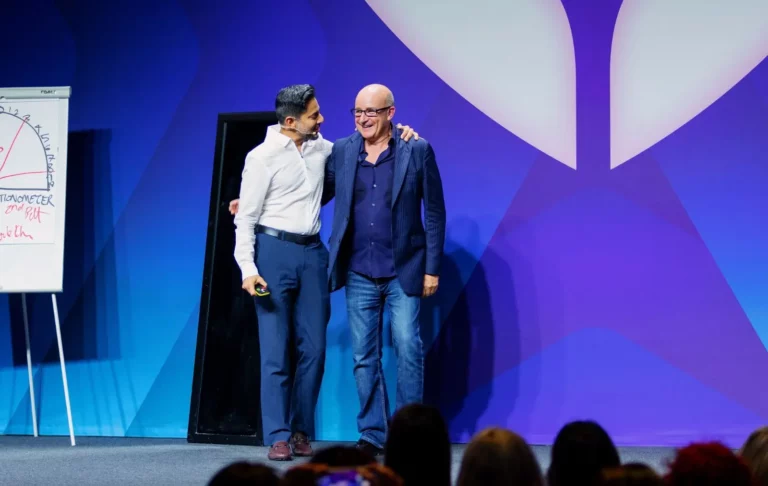
Last year, 75,000 people attended. This year, we’re bringing together Eric Edmeades, Lisa Nichols, Paul McKenna, Linda Clemons, Shadeh Zarai, and me — to give you the exact tools to find your story, own your voice, and communicate in a way that actually moves people.
I think about that lawn sometimes.
I was 22 years old. Bill Gates three feet away. The smell of barbecue. A young man from Malaysia who couldn’t bring himself to say hello — because somewhere inside, he already knew his story was going somewhere else entirely.
He just didn’t know how to tell it.
The story you tell is the business you build.
Don’t wait to tell your story — this is the summit I wish existed when I was starting out. It’s completely free to attend.
Be Extraordinary,
P.S. Before you go — head to the blog version and tell me in the comments: what’s the one story you’ve never had the courage to tell? The one that could build your business if you knew how. I read every single one.




36 Responses
Hi, Neat post. There is a problem along with your website in internet explorer, might test this… IE nonetheless is the market chief and a huge section of other people will omit your magnificent writing because of this problem.
My Story begins on September 4th 2012. It was the day I laid down on the bed for a quick nap and instead was transported into a whole new life. Now mind you I don’t do drugs, I don’t drink alcohol or even coffee for that matter. At that time I was not religious and I wouldn’t even call myself spiritual. I was seeking nothing. And yet on that day, I went from being a regular stay at home mom of two kids to a completely transformed experience of life.
When I laid down that afternoon I was awake and also aware as my body fell away. I was in the space of absolute Truth that I call the Infinite Source of Light. It was the space of nothing and everything all at once. There was no good nor bad nor right or wrong. Nothing was out of place as there was no place. The only thing that existed was space and Light. I was deeply aware that I was of this Light. It was like I was dropped into the deeper truth of this whole experience called life, I was shown behind the curtain of this illusion. When I came out of this experience I wrote feverishly in a journal about what I was shown. And yet the words seemed hollow and empty and couldn’t really describe what I now understood as Truth.
Following this experience nothing was the same for me. I saw everything as vibrating energy. I witnessed objects that used to appear as solid as instead vibrating energy. I knew on a deep level that nothing is solid as it appears. I now had the ability to see inside of people’s bodies where disease showed up as dis-resonant energy. I now had the ability to see people’s past present and future all at once. I could see inside their lives, I could see their Souls Journey. I saw Jesus walking beside believers. i saw that each persons journey is like a strand intersecting in this great tapestry called life.
Truth…In the beginning of this experience I did question if I was going crazy or maybe I had a brain tumor. Those fears quickly fell away as I began to realize that I was experiencing a spontaneous spiritual Awakening.
These spontaneous experiences of Awakening have continued for me since 2012. All of the experiences have been different. It is almost like each experience occurs to infuse a unshakable knowing and a wisdom in me that cant be taken away. I know the Truth in my heart.
These gifts of experience usually happen when I least expect it. For instance, 2021 sitting by the fire in Sierraville California, and my body falls away and all of a sudden I’m in a place that contains everything. Every thought, every feeling, every word, everything that’s ever happened, everything that is happening, and everything that will ever happen was there. Wind. The word wind, the idea of wind, experiences of windiness. Everything. There were no Earth and no planets separate from this because all planets, all everything was contained in this space. There was nothing outside of this space. I deemed this space The Great Hall. Later when I was speaking to a friend about this experience she called this place the Akash.
Although I have a master’s degree in Clinical Psychology, I do not read books, I do not study, and i am not on any social media. In fact I’m fairly averse to taking in other people’s ideas. So as all of this was occurring I turned to my mother. My mother, my best friend, was an avid reader and seeker of all things spiritual. She probably read every spiritual book ever written. She knew it all inside and out. And so I would go to her with these experiences and she would tell me how she had read about what ever it was in one of those books. In the end of her life she told me I was who she always wanted to be. She understood spirituality, she understood the idea of Source, she understood it all in her mind. But she never got it deep in her heart.
In many ways this has been a lonely path for me. I long to meet people that hold the Truth in their hearts and yet what I find is people with a lot of wonderful spiritual ideas and practices that are not “It”. The Truth is not in any doing or efforting or seeking. It is right here, right now.
I am so blessed to have these gifts of Truth bestowed on me. I am so blessed to live my life. This is the first time I have publicly shared my experience. For the past 12 years I have quietly used my gifts to guide people in their evolution. I am trusting that this sharing is a part of my evolution. Thank you
Hi Vishen
Greetings
This one is an amazing story and an inspiring story. I have been following you, on and off but never been able to completely commit or completely withdraw from your stories and thought provocations.
I am a banking professional who transformed into a risk management consultant over the last three decades. Done fairly well in the sight of others in a British MNB and now in a leading Tyre manufacturing firm. But in my inner self I know I am a healthily dissatisfied person in the current ecosystem but destined to reign in a different realm. For me it’s about understanding the purpose and meaning of life and after life. The only closest satisfactory truth that has kept me insane is my faith. I am rooted and established in my faith that has completely renewed my mind and transformed my thinking and beliefs. It’s all about breaking free from guilt, condemnation, bondages and live a life of victory in peace irrespective of circumstances around you through faith in the one who created you. That may sound selfish if it was a full stop there instead of a comma. True contentment is realised when you are eager to share your experiences and impact lives around you for good. You never know, you may end up leaving a legacy like you are doing now.
The reason I chose to comment in your blog is, every time I stumble upon your communication, something inside stirs the thinking and my thoughts that sometimes intersect, sometimes collide and sometimes resonate. I am still figuring this out and will probably reach out when I make a decision to invest my time in all that you have successfully built and willing to share. Wishing you Peace and satisfaction.
Unfeigned Regards
PCR Suresh
Hi Vishen,
I do not have a story of success, only one of struggle, from when I was very young, and now into my seventies – it is a constant struggle, a health struggle, a work struggle, and money struggle, every time I think something may turn around, another drama comes my way.
I have my sister saying that all these stupid things that happen are a part of karma, yet, I have no recall of things that I have done wrong to be attracting this type of consequence.
Would I honestly want to share a story of struggle that takes me nowhere, every time I save a few dollars to put towards something like a repair of my washing machine for example, the plumbing breaks and then the repairs are even bigger.
Would I honestly want to share a story when I open myself up to being abused about how awful I must have been to attract all of these mishaps?
At times, I think I should write the story of my son, (indeed it was him who suggested it!) He was not meant to live for long, not even to reach his first birthday, yet, here is at age of 50 – he is happy with his life, even though he lives in a group home with other disabled people. My family says that even this too is because of my karma – a consequence of my being an evil person.
Yes, I love the power of stories, I would have done the Paul Mackenna course if I had (yes…. the money!) And then people say if you believe it enough, want it enough, it will come, yet, here I am … wondering, what story could I tell that would be of interest, a motivator, an inspiration, a story that could change lives.
Yes, I have overcome, many things, but is that the story to tell? Where for all that I have achieved in life, I am still no image of success, and here I am, wondering, why would I tell this story?
Hello Vishen, Or should I say Vision….sounds the same….looks the same…..thank you for ALL that you are bringing and have already done. Good choice, leaving that backyard as a kid. I am Dr. T, Ahumanengineer — a singer, author, creator, and doctor by grace. The one story I have not yet had the courage to fully tell is just how important I feel it is to get one piece of my work, Angelic Heart Focus, into as many hands as possible. This work teaches people how to connect with and direct the use of their own Guardian Angel for healing, for releasing the past, and for navigating everyday life in the present. It contains knowledge found only here, presented in a way that anyone can understand. It creates miracles of healing — instantly. All of us have had an Angelic experience. Most of the time, we simply call it luck, coincidence, or timing. My goal is to show as many people as possible that it is real: you have an Angel helping you through this life. Especially in these times, humanity needs all the Angelic help we can create and call forth. Based on Applied Quantum Mechanics, Heart-Brain Coherence, and aquired observational knowledge, nothing like this has previously been available to help people move through the trials of life. It is my creation, molded by the universe and the Angelic Realm, and is now ready. My friend Brett Bevell, who was involved with Soulvanna App and other MindValley programs strongly suggested I not miss the MindValley University. Moving things around now to be inn Tallinn. See you there! Dr. T: ahumanengineer.com: ps: dig the wings on MindValley logo.
Vishen, yes dear boy, you really should apologize to all the good people of California for offending them by saying one of their towns was boring! Alas, I don’t think you will offend most people by saying most towns in the midwest are boring! 😜 Although once when I was a radio DJ in the military, I was talking on the air with another Broadcaster who was a bit of an East Coast supremacist and thought folks from the midwest were bass akwards. So I replied to one of his condescending comments with some humor saying like yeah, cause all midwesterners were obviously born in barns…and somebody actually called into our station and wanted me to aplologise over the airwaves.m! But like yeah, NOOOO! Cause I was not even being serious. I was just trying to make light of my coworkers arrogance and ignorance in assuming people in urban coastal areas are somehow more clued up than down home, cornfed, middle American folk. But yes, as for your comment about Sunnyvale, you should definitely apologize for even insinuating anyplace anyway could ever be boring. But if you were to wanna go to such a place, try my home town of Albion, Indiana population approx. 2500 with 9 bars and 13 churches to it’s name and not much else really. Definitely not the most exciting place to grow up in! So in contrast, I bet Sunnyvale, CA would have been a thrill a minute for me to live in. Like it’s all so subjective and just ones own personal opinion and we are all entitled to them without having to be apologetic to anyone else for having one. Geez! Or maybe we should all start apologizing in advance for any possible unintended offense we may cause for not thinking positive about everyone and everything and everyplace possible. Yeah, sorry but not sorry that I breathe air and actually occasionally have contrary or contentious opinions!
My story is that I was a smoker for 25 years. I learned to smoke as a teenager and continued smoking cigarettes for the next quarter of a century. Although I tried many times to quit, I found it incredibly difficult.
Over the years, I tried just about everything: Champix, Zyban, willpower, Alan Carr’s methods, water bottles, and countless attempts at going cold turkey. I even trekked to Base camp of Mount Everest twice. Both times, I was able to stop smoking for months while training for the expeditions. Yet as soon as I came off the mountain, I found myself reaching for cigarettes again. I was the Queen of Quitting!
It was frustrating, and to be honest, it really did my head in!
Then, during a visit back home to Australia, I booked an appointment with a hypnotherapist to help me quit. What happened next completely amazed me. In a single session, this total stranger helped me stop smoking. I couldn’t believe it. It absolutely boggled my mind that such a profound change could happen so quickly.
That experience inspired me to become a Clinical Hypnotherapist. I wanted to understand how it worked and learn how to help others in the same way that I had been helped.
Now, 10 years later, I specialise in helping people stop smoking in one session, overcome anxiety, break unwanted habits such as chocolate cravings or Coca Cola, and create positive changes in their lives.
I genuinely love what I do and am passionate about helping people achieve results they may never have thought possible. I have the best job!! Very grateful!
When I was a second year student nurse in Singapore in the 1970s, one day I was assigned to look after the intake and output of 30 patients in an open ward. Ten of those were post surgical so they have drips and drainage tubes that require focus and attention to details, every drop was measured. In those days, we have no IV pumps for intravenous drips that auto functioned once set by the nurse. I had to count the drops per minute with my nurse watch next the that drip chamber. I told myself stay focus but then got disrupted by other patients, so back to start again, recount. Meanwhile the mean sister (Nursing officer in charge of the ward) came and yelled at me for being slow. She was intimidating and aggressive. I was so fearful of her. Then I took a ten minute tea break and bawled myself out in the staff room. I told myself, nursing is not me, I will go to matron’s office at lunch time and resign. Thank God no one was there. I went back to work under her watchful eyes whose glare could cut you to pieces. I was trembling but soldiered on. By lunch time, I sat composed in the staff room and reframed my thought. Why should I give up my passion for nursing to feed her ego. No doubt she will continue to haunt others but one day I will rise up to her position but I will not be like her. I want to be a leader that others will follow willingly and a leader that ensures whoever follows will be a leader within their sphere of influence. Simply put, to help individuals develop their potentials. We can call it an epiphany or a Gospel inspired moment. I have been in nursing for 50 years and never looked back. That incident shaped me. I became a Christian and kept learning and kept leading till I recently retired from my Chief of Nursing position. Along the way, many of my staff have become managers and team leaders and I’ve won several awards as well. My point is DO NOT let one setback define you. The best is yet to come. Now that I have time, I wish to explore other opportunities like writing children’s books to inspire them, positively encourage them to know their worth. My 2 dogs, Button and Cardigan, both Shih Tzu died recently at aged 14. I thought of using them for the children’s book and hope I can learn something through MindValley course. That’s how I ended up here. Thank you Vishen for your vision and perseverance so that many of us can benefit learning from you and your wonderful team. Thank you all and to the larger community who contributed to this forum. Well done everyone.
The Crucible
The autumn night was clear and crisp in Two Harbors, Minnesota. A quiet, rural town on the shores of Lake Superior where nothing much happened and everyone knew it. The stars above shone with the kind of brightness you only see when there are no city lights to compete with, their cold fire pressing down through the darkness toward a tiny two-bedroom mobile home where I shared a room and a bed with my brother, Michael.
Inside, a single lamp cast a warm glow across the bed where I sat with my school books spread out before me. The walls were thin. They had always been thin. And through them came the sounds of my mom and Michael arguing in the living room, just fifteen steps away. Sharp voices. Rising heat. The kind of argument that fills a small space until there is nowhere left to breathe.
As the argument intensified, my frustration built until I could not sit still any longer. I gathered my books and headed for the detached garage out front, seeking the only refuge I knew.
As I stormed out of the room and into the narrow hallway, barely wide enough for one person, Michael and I came face to face. Despite everything, we managed a brief exchange. A flash of the humor that had always been ours. A fleeting glimpse of normal brotherly life in the middle of something that was anything but normal. Then we slid past each other and kept moving.
The cool autumn air met me at the door. The tension in my chest began to loosen, replaced by the quiet that comes from being alone with your own thoughts. The garage smelled like engine oil and gasoline, mingled with the earthy scent of the dirt floor. I settled at the wooden workbench, its surface worn smooth from years of use, and an old fluorescent work light greeted me with its electric buzz. The light cast an uneven glow, flickering and throwing shadows across the tools and scraps of wood that littered the surface.
I had just opened my books when I heard a sound that stopped my heart.
The unmistakable crack of a .22 caliber pistol.
I raced back into the house. My mind would not accept what my body already knew. My mom met me at the front door, shaking uncontrollably, terror in her eyes. Together we entered the bedroom.
Michael was lying on the bed. A small hole in his chest, bubbling with crimson blood. The air was thick with the sharp, acrid smell of gunpowder. That sulfur smell. It lingered long after the smoke had cleared. Michael’s moans, barely audible, filled the room with a sound I will never forget and cannot adequately describe. It was the sound of a life leaving.
We tried to move him to the car. A red Ford LTD station wagon parked outside. But as we stepped through the front door, his body slipped from our grasp and we dropped him onto the ground. I climbed into the backseat and cradled Michael in my arms as my mom drove to the small hospital in Two Harbors. The vinyl upholstery was cold against my skin. I held him close and prayed with everything I had.
By the time we reached the emergency room, I knew. Michael had grown still and silent in my arms. As I carried him through the sliding doors into the harsh fluorescent light, the weight of his body was the weight of a truth I was not ready to hold. The beeping monitors. The smell of antiseptic. The hushed voices and tired faces of the medical staff. It all registered from a great distance, as if I were watching from outside my own life.
I laid my brother on a gurney and went into shock.
That night did not destroy me, though it could have. It became the fault line that cracked my life open and set me on a path I am still walking today.
I was sixteen years old. I had already navigated seven stepfathers and the chaos of their addictions. I had already learned to survive in ways no child should have to learn. But losing Michael, my best friend, the person who understood the code of our shared suffering without either of us having to speak it, that loss rewired something fundamental inside me.
Pain is inevitable. I learned that early. But I also learned, slowly and at great cost, that suffering is a choice. Not an easy choice. Not a quick one. But a choice nonetheless.
I did not make that choice cleanly. For years after Michael’s death, I defaulted to the only coping mechanisms I knew. I buried my grief under work. I numbed it with alcohol, with sex, with the relentless pursuit of achievement. I joined the Air Force and found structure where chaos had been. I built a career in aerospace and defense, then pivoted to real estate and built a business. In search of the meaning my career could not provide, I became a devout Christian and helped plant a church. On the outside, I was the picture of a man who had overcome his circumstances.
On the inside, I was a fractured man wearing a well-constructed mask.
Masks, if I am honest. I did not have one false self. I had a roster of them. I was a chameleon, a shape-shifter who could read a room in seconds and become whatever it required. The squared-away veteran who never flinched. The corporate operator who delivered on time and under budget. The husband who said the right things. The father who showed up physically. The man of faith who never wavered. The provider who never complained. The friend who was always fine.
I was all things to all people. And I was nothing to myself.
Each mask was convincing because each one contained real skill. I was not faking competence. I was faking wholeness. Behind every performance was a man who had never been allowed to exist in one piece, who had learned, through seven stepfathers and a brother’s death and a military that rewarded fragmentation, that survival meant becoming whatever the next environment demanded. Not integrated. Assembled. A collection of well-trained parts, none of which had ever met.
The masks held for a long time. They held through promotions at Raytheon and Ball Aerospace and Northrop Grumman. They held through the early years of my marriage to Shelly, a woman who deserved a man who was fully present and instead got a man who was performing presence. They held through the birth of my children, through moves across the country, through every external metric of success that our culture teaches us to chase.
They held until they didn’t.
The details of the unraveling are woven throughout this book, because the unraveling is not the failure. The unraveling is where the work begins. It is where you discover that everything you built on top of unprocessed pain is structurally unsound, no matter how impressive it looks from the street.
What I discovered on the other side of that unraveling changed everything.
The word is on the cover of this book, so let me tell you exactly what I mean by it.
Sovereignty is supreme authority over your own life. Agency over your beliefs, your decisions, your thoughts, your feelings, your actions, and your inactions. It is the condition of being self-led, not controlled by old programming, not driven by other people’s expectations, not hijacked by a nervous system still calibrated for a threat that no longer exists.
That is what I lost in Two Harbors. Not my strength. Not my intelligence. Not my ability to perform. I lost authorship. The seven stepfathers, the military, the corporate machine, the grief I never processed. Each one wrote a line of code in my operating system, and I spent decades executing their program while believing I was making my own choices. I was not sovereign. I was compliant. I was performing someone else’s definition of a man and calling it mine.
What sovereignty actually is, what it looks like in the body and in the mind and in the spirit, what it requires of a man and what it returns to him—that I will not explain in a section. The chapters ahead build it piece by piece, in the order it actually has to be built. By the time you reach the end of this book, you will not need me to define sovereignty for you. You will have begun to know it as yours.
https://sovereign-book-waitlist.lovable.app
© 2026 Christopher Chamberlin. All rights reserved. Excerpt from SOVEREIGN (working manuscript, unpublished). Not for distribution, reproduction, or quotation without written permission. The Sovereign Man Experience™, SME™, and The Sovereign Identity Recode Method™ are trademarks of Christopher Chamberlin.
Vishen. I have a story to share with you. One that is not only mine — but if you read it carefully, it will shift to yours. The way your phone book shifted that morning.
Because here is what you described but your mind had no framework to fully receive:
You said you went back to the same phone book. The same attorneys. But Vishen — it was not the same phone book. It was not the same attorneys. YOU had shifted — and reality reorganized around you. What you experienced as changed results was a changed world. You crossed into another dimension of reality that morning and have been trying to explain it through Silva methodology ever since.
You built Mindvalley asking “why did one workshop transform me in a single day?” But you are still seeking. And you know it. Because if Silva had been the answer — it would have been enough.
It was not enough. Because it was the door. Not the source.
I was once you.
I spent years walking through every door. Every modality, every teaching, every tradition. Diving deeper than most. But for me it was more than seeking. It was a remembering — of who I was and why I had come. It took me 36 years to crack that open.
I am Aboriginal — Ojibway and Algonquin — so I carry that natural connection to what most of the world has forgotten. But I am also deeply grounded. Practical. Clinical. So I went looking for the science behind what I was living.
In the year 2000 I was given a prophecy. A vision of a world coming completely undone — tidal waves across every area of life. Systems collapsing. Hidden darkness surfacing. The unspeakable becoming undeniable. Epstein. Child abuse. Women enslaved. Dimensions and worlds opening that humanity would be forced to see and reckon with. Not as punishment — but as necessary surfacing. Because what must shift in us can only shift when we can no longer look away.
I could not share that prophecy plainly. The world was not ready. So I wrote a novel. Published in 2016. Chapter one describes what we live today. It had to be told in prophetic form — because stated plainly, no one would have accepted it. Now I connect it to real time events. As people can manage it. As they become ready to see.
“I come from a family of seers. Destiny chose me for this role from birth. You cannot read a few books or take a couple of courses and expect to be a seer or a healer. It never happens that way. From a young age, I just knew instinctively what this life had in store for me.”
What I found — or what found me — is a Higher Science no one in the world yet knows exists. I have spent 25 years mapping it. Thousands of clients across Canada, Mexico, and worldwide. For over 20 years hundreds of testimonials of healings that defy explanation. Patterns breaking after decades of trying everything else. Prophecies fulfilling in real time.
I call it Chakaura™. It is the awakening. The structural source of everything we are — our health, our suffering, our potential, our consciousness itself. It is what has been destined to surface. For the awakened ones. For this time.
The Chakaura™ Structure is the gateway to all dimensions of our reality — seen and unseen. But it is not a shortcut. It is a training. A rising. What opens to you is proportional to who you have become.
This is the story I have never dared share publicly. Not because I doubted it. But because most minds are simply not yet ready to receive it — and I will not have them diminish it for those who are.
You don’t dare share yours either. I know.
So thank you Vishen — for creating a space where such a story could finally be spoken.
— Michèle C. St.Amour
Founder, Chakaura™ Institute of S.O.U.L.
Chakaura: Awakening The Muse
Vishen, good GD son, can you ever tell a story. Like was that blog really all you? Or as you’ve mentioned previously, you tend to use AI and then go back in and interject the personal story aspect? Cause man oh man, if it’s the former, then sh!t dude have you got mad writing skills, too! Which is totes amazing for you, but like come on, must you be gifted with both right and left brain abilities! Totes not fair! For I am mostly in my right mind. I doubt I ever go left, well except for in political matters. Buu as for my story that I prolly should be afraid to tell, well it is precisely about NOT being in my right mind! And yet, I have written a memoir (not yet published) whose origins stem from the fact that I believe my mental health challenges to be precisely the types of things that could both inform and entertain people, by making them both laugh and cry and basically feel all of the feels, while also at the same time being like an expose into that crazy world where nothing tends to make sense anymore and the people who are supposed to be helping you, often do just the opposite. Which only makes you wanna scratch your head and wonder who, in fact, is crazier than whom. Anyway, I feel like if you can see the humor in almost any situation in life, odds are more likely you can pull through most anything then that life throws your way. Plus. I’ve always been honest to a fault anyways, so my whole life I’ve been an open book (only I’m still not sure if anyone wants to read it.) But yeah, I think I may have literally shot out of the womb with pen and paper in hand…and also those God awful nerdy glasses at the ready to annotate basically every GD nuance of my life. Cause I’ve always been an overly analytical type that tends to just sits and thinks and wonders why prolly like until the day I die. That as I ain’t really got no fecks to give what people wanna think about me, as my whole life has never been about me. Cause as the ole saying often misattributed to Dr. Suess and alas not fairly credited to the financier Bernard Baruch goes, “be who you are and say how you feel, because the people who mind, don’t matter (rejected by my peers in adolescence…definitely another doozie of a story in my memoir) and those who matter, don’t mind (meaning significant others should have your back…only mine don’t either!) 🙄 So as an orphan basically, I have nothing to lose by sharing my stories and ultimately hoping that they (along with my ever present wit and wisdom) will continue to be a means in which to connect with others and ultimately find my new tribe of what some people may have mislabeled and discarded as misfit toys. But, 1. I am a huge advocate for those types of downtrodden and discarded souls …being made to feel like one myself because more importantly and worth remembering for us all that 2. that judgement from others that makes our visibility wounds rear their ugly heads and make us feel unworthy, does not in fact MAKE IT SO! So yeah, life can try to burn me into unrecognizable ashes, but MY STORY thus far, is about rising up through all of that pain. So like in the adapted wise words of the 80’s singer, Matthew Wilder, ‘Ain’t nothing gonna break my stride, nobody gonna hold me down, oh no, I got to keep on moving!’ So yeah, we all gotta keep moving and grooving and collecting more stories along the way. Yeah, we all got ‘em and some of them are real doozies, too. Only me, I’m genuinely interested in not only hearing everyone else’s stories (even the everyday nit noid ones so that everyone I meet walks away feeling not only truly heard but also cared for and appreciated, something I have lacked for most all of my own life), so yeah, then I don’t think it is too much to ask then to wanna be heard, as well. For everyone wants to feel like ones life has, in fact, mattered. So, on that note, I don’t wanna die without having shared mine. That while ultimately helping others by bringing more awareness to those who suffer with mental health challenges, some 1 in 4 do, but I believe it’s more like 1 in 3, because lots of folks either live in denial or are afraid of the very real stigmas or can’t afford that specialized and lifeline healthcare, etc. so never ultimately get the help they truly need. I also firmly believe that among the remaining ‘normal’ people, many of them are cold hearted, narcissistic or psychopathic types never think they are the problem, but ultimately ARE THE PROBLEM that makes the rest of us with very real feelings actually go flipping mental. So yeah, here’s to great story telling and may we all live long and prosper in this crazy world. Either way, I’m still watching and waiting and annotating some of the funniest, yet most F’ed up tings ‘bout said life. That as I’m always sure to eat from that ole box of yummy chocolates just like Forest Gump did, cause we just never know in life what we are gonna get…well, I guess, unless you know how to manifest it. 🤪
My story is that I’ve held back my whole life from being a leader. I’ve shied away from leading because of not wanting to be seen and a deep feeling of unworthiness. I even got the highest leadership award in Boy Scouts and decades later still don’t feel like I deserved it…. Because all of my friends who got that award took the highest leadership positions in the troop beforehand, and I didn’t. I’m at the point in my life where I know the world needs me to contribute, and am on a small team of people who’ve been given specific vision and plan of how we’re going to create world peace on this planet. And I still hold back a lot from sharing that specific plan even though we are on the verge of nuclear war every day on this planet. So long story short I’ve experienced how playing small and feeling unworthy do no good for other people because I’m holding back from serving humanity.
VISHEN: PS, CONTINUE: I purchased your book CODE, it my next read.
Hello Vishen.
I love your story you generosity in giving back to society, through your unselfishness of your company. My story is the same as many other women in this world, one of a young marriage (17yrs old ) raising a family alone and one of searching through self awareness books, Maryann Willson, Chopra, etc, to find out why i act and respond to things the way i do to in different situations in life. I started this journey after a hard divorce, wanting more out of my life for myself and my family. I put myself through college and continued to search through reading books like, Joseph Banning, Joseph Murphy, Napoleon Hill, Michael Singer, Bob Procter along with Joe Dispenza, books and many more. This is where my journey of life has lead me, too wanting to helping other men and women figure out where the confusion and unhappiness is originating in there life, empowering them with self awareness, to live a happier life no matter what has happened in the past. The past doesn’t equal the Future. Through the Power of Faith, Belief in there self and the determination to work on catching and changing their past habitual thoughts, they can live the life they always dreamed of having.
My story is that when full scale war broke out at my home in Ukraine, we were all so lost and scared and my sweat smelled like fear, a friend suggested to meet online for a meditation and I guided it – and came out of it on the first day of big war very calm and peaceful. I then started a group that I planned would last till the end of the war, we met twice a day, mornings and evenings and each time going from the room where news was constantly on to my meditation felt like going from hell to heaven. I closes the group at 100 days of meditation with dedication to peace in Ukraine. And I still believe meditation can rewire all of our brains, its just we as humans have lots of resistance to change.
As a child I felt water was alive… like fish swimming in a pond, but in me… the feeling of living movement in my body. While other kids where fussy eaters, I was a fussy drinker… I only wanted fresh water from the river daily. I would go there to fetch it…4 years old and learning to carry water on my head like the African women.
My Water – it was in a crystal glass jug on the sideboard… with a crochet water doily with little crystal beads hanging jewels around the mouth of the jug… I only drank water… no Oros, no colas, no tea or coffee, My Water only. I carried a glass bottle with My Water everywhere I went. No other water tasted or moved in me like My Water… Many years of water research and diving deep into the water sciences was my hobby, my secret love affair, my passion. I learnt that water had memory via the Viktor Schauberger era and the disgrace Dr. Jacques Benveniste faced in 1988 from the Nature magazine when he proved water has memory though a homeopathy experiment. Blew me out the water, so to say… it was so obvious that water has memory… all the lemon juice I placed in water and drank but the glass still held the taste even when I filled it with water that had no lemon, into the same glass of the lemon water, but did not rinse the glass. Tea, coffee, fruit syrup in water diluted to fruit juice… !! I trained in homeopathy and knew that water had memory… I heard about Dr. Maseru Emoto in 2004 and his awesome book – The Hidden Messages in Water.
In 2006 a friend gave me a DVD … “What the Bleep do we Know”… Watching this DVD riveted my brain… people do not understand the quantum realm, water, their capacity, so much more… So I became a water fanatic once again… sold 600,000 litres of bottled water treated with Resonance technology in 108 days. People just loved this water… no marketing, fancy advertising, just me and a great big silver bowl with ice and cool water tasting at the V & A Waterfront Cape Town and the ripple effect of people telling each other… then the bottled water authorities stopped the production and the investor went bust.
But, I was hooked… In 2008 I created AquaMia© – My Water label and contracted a bottling business to bottle water for me and I sold the water… I treated the water with Resonance Technology. The same result as previously, people just bought and told friends, who told friends, and once again the bottled water company stopped supplying me… I was accused of creating “prepared water”, which is not natural mineral water from source. BOOM BANG… out of business again… But the water knowledge just exploded again with the documentary “Water, The Great Mystery” in 2008, which confirmed my intuition that AquaMia© must not flow away… But my reputation amongst the bottled water people was set in concrete. I could not label bottled water with Resonance Technology, no matter how healthy, vital or deep hydration was achieved. The controlled scientific industry blocked me. So, I started sharing everything about water to every farmer, or athlete or hydrologists, or water testing labs, H20 water filtration, scientists, new friends, sick people… and in 2020 I was poisoned by water… overcame the near death experience and carried on demonstrating my Resonance Water device… and selling the technology products here and there… but nothing great and successful. There is a “resistance” … it’s “spooky stuff” as the young people would say to me.
2026 and I have reinvented the AquaMia© – for children… a range of products with the AquaMia© icon… and a set of story books – “The Mystery of Water in you and on Earth”. An animated video AquaMia© – will hopefully be a series… and a great new friend Nico, who is the world’s first water sommilier
I am in my early sixty’s, and I have always wanted to set up a small business. Sometimes I feel like moving forward and achieving this dream, but I stop and think will this work? I know that I have the skills to do this, however, there is always a negative thought popping up somewhere in my brain.
This newsletter/article almost brought me to tears. What is the story I’m afraid to tell? If I had the courage to tell, it would change everything. It be the story of a stagnant family — not broken by force but by the sheer refusal to pause and process events. The somatic counseling I offer isn’t about therapy at all; it’s about prioritizing what matters. If you don’t prioritize your family, brokenness will. I watched dozens of family members “fight through” struggles and abandonment and divorce. The fight always gets the reward, but it’s the pause that saves relationships and families. If I ever were brave enough to tell this story, I could change the world.
Hi, Vishen! I admire you a great deal for all you have done and accomplished so far. Well done! I am a storyteller in my own way. I tell stories about my own experiences, life experiences, work experiences, travel experiences, and I believe some of my stories have helped some people. I have recently learned about a young man whom I met briefly in 2017, I believe. He was part of the crew on a ship I was on in Europe during a river cruise. We lost contact and, by chance, I found him again, contacted him, and he said that due to our conversations, the stories I told and the books I recommended, his life took a turn for the better, that he found his compass and that he is a happy man. He said that he “sees” me every day and sent me a picture of a picture of me and him, which hangs on the staircase wall. Brought tears to my eyes. I would love to be able to tell stories every day, stories that could improve people’s lives and have fun with it. I have thoughts about a way of doing it, just need to change a lot of things in my life to do that and make a living at the same time. Anyway, just wanted to congratulate you for everything. Have a good day!
I’ve been able to transform my mind, body, spirit & tune into my intuition by using low doses of plant medicines over the last 6 years. I’m in some of the best physical & mental health that I’ve ever experienced in my life at the age of 63. I’m healing from 3 major physical injuries and KNOW that I’ve been able to increase my neuro plasticity after spinal cord surgery 17 months ago. I’ve minimized my use of big pharma drugs as much as possible and am excited about my future. My mental health, attitude and wellbeing are stronger than when I began this journey in 2020. I trust my intuition more today than ever in my lifetime. I look forward to sharing our medicines as markets open up.✌️💗🤩