Scroll through social media, and you might stumble across a teen making a jaw-dropping prom dress from candy wrappers. Or someone playing Super Mario Odyssey and pulling off impossible-looking moves. Or Jake Peralta turning a lineup of suspects into a full “I Want It That Way” performance in Brooklyn Nine-Nine.
“Man,” you think. “I wish I could do that.”
You can. It just takes your creative intelligence.
Now, before you sell yourself short, creativity lies within all of us. And the more you understand it, the more you stop waiting for inspiration and start generating it.
What is creative intelligence?
The “creative intelligence” definition, in a nutshell, is your ability to imagine new ideas, make connections, and solve problems in your own original way. According to psychologist Robert Sternberg, it helps you think beyond the usual answers so you can shape moments, choices, and projects with more freedom and confidence.
He also connects this intelligence to what he calls experiential intelligence. This is your ability to learn from the situations you live through and turn those lessons into fresh ideas or inventive solutions.
Now, if you’re familiar with Brooklyn Nine-Nine, you know that the annual Halloween heists turn the whole squad into a pack of schemers trying to outthink everyone else. For instance, season five’s “HalloVeen” has Jake designing the entire heist as a secret setup for his proposal. He uses clues, misdirection, and playful strategy to build a moment Amy Santiago never sees coming.
That’s the thing with those who have creative confidence. They’re risk-takers, and they’re willing to be different and engage in divergent thinking (which is essentially the ability to think outside the box). Because of this “dare to fail attitude,” they’re often impulsive and change their minds.
One way to assess this type of intelligence is to ask an open-ended hypothetical question about an unusual problem that doesn’t really have a right or wrong answer. For example, here’s an interview question that was asked by Google: “How much would you charge to wash all the windows in Seattle?”
The intention is to see how the candidate approaches the problem and what type of intelligence they demonstrate the most. (Yeah, good luck with that one.)
Understanding Sternberg’s triarchic theory of intelligence
Sternberg’s theory is just one of four major theories of intelligence. As opposed to the others that focus more on behavior, the triarchic theory of intelligence accounts for a more cognitive approach.
He created this theory to show that intelligence is more than grades or test scores. He wanted people to understand that your mind works in different ways, and each way affects how you learn, make choices, and deal with life.
He also believed we forget about some of our most useful thinking skills because we focus too much on the ones that fit school or testing. His theory brings the focus back to the skills that help you come up with ideas, handle new situations, and respond to real life.
It shows that your thinking is not one single thing. Rather, it’s a mix of abilities that work together.
The thing is, this model helps you understand your strengths. It explains why some tasks feel easy and others drain you.
And once you see how these different thinking styles show up in your life, you get a better sense of how your mind solves problems, what sparks your ideas, and where you can grow next.
Analytical, creative, and practical intelligence explained
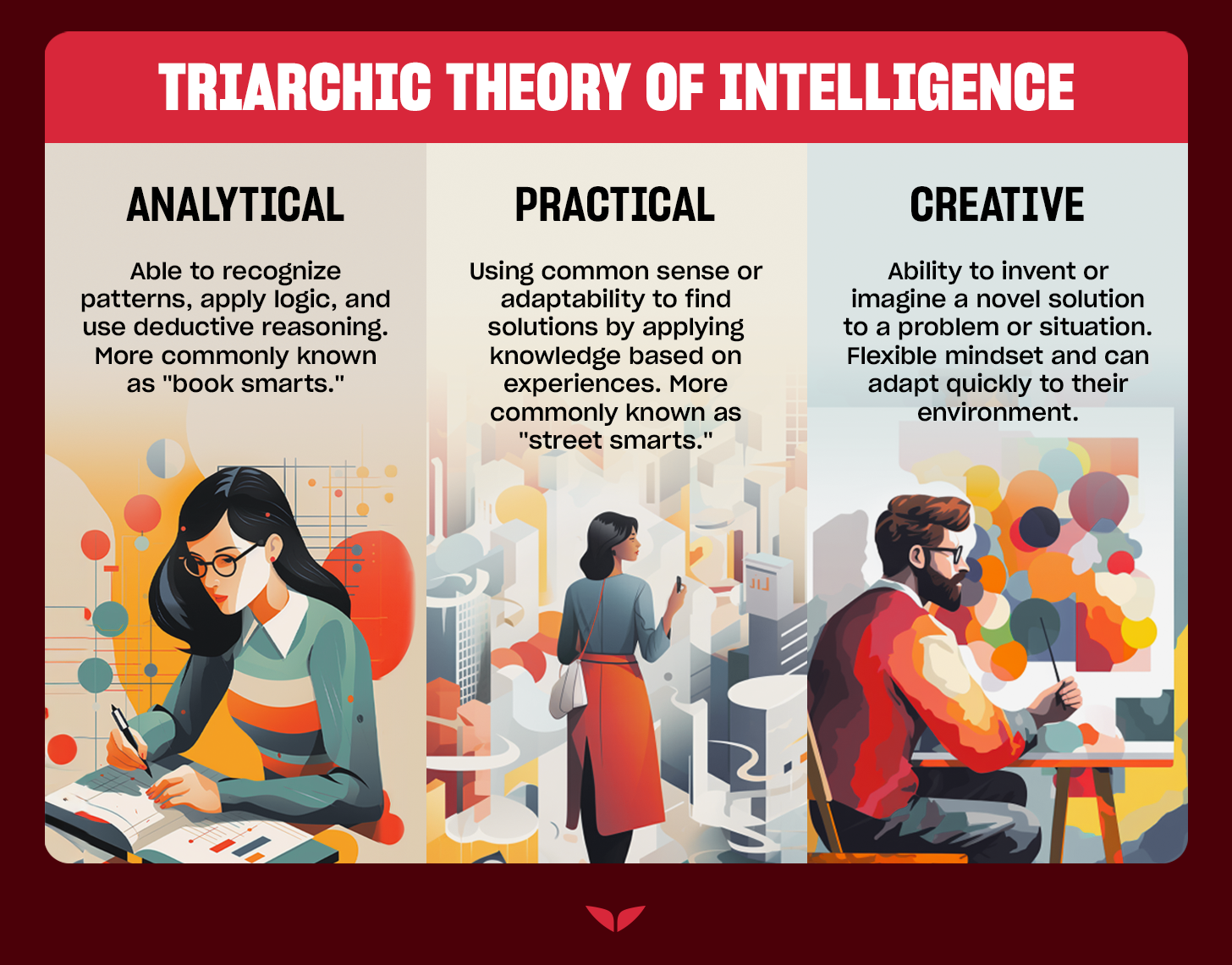
Sternberg’s triarchic theory of intelligence places our thinking abilities into three categories:
- Analytical (componential). Often called “book smarts,” this intelligence helps you recognize patterns, apply logic, and solve structured problems. If you take Brooklyn Nine-Nine as an example, this has Amy written all over it.
- Creative (experiential). This is your ability to invent or imagine a fresh solution to a situation. Creative thinkers tend to have mental flexibility and adapt quickly to new environments. And as previously mentioned, Jake’s the quintessential example of one.
- Practical (contextual). Often called “street smarts,” this intelligence shows up when you apply what you know to real-life situations to get things done. And if pop culture has anything to do with it, it’s Rosa Diaz who falls into this category.
The reality is, most people use all three types of intelligence. Analytical thinking keeps you precise, creative thinking keeps you inventive, and practical thinking keeps you grounded enough to pull it off.
But as humans, we tend to lean on the one that works best for us or that draws our interest.
Creative intelligence in psychology
Here’s the thing you need to know about creative intelligence: it is no magical gift. It is a mental skill that grows the more you use it.
That’s what psychologist J. P. Guilford discovered. He found that creativity grows when you can come up with lots of ideas, switch directions easily, think of unusual possibilities, and stay open to trying things that might feel a little bold.
Let’s take Mindvalley’s trainer and social media expert, John Lee, for instance. When he teaches his six-year-old daughter to create merch with AI, she throws out idea after idea with zero hesitation, from “a castle on a cloud” to “a unicorn jumping on a bed” to “a crazy orange.”
She doesn’t overthink anything. She just plays, shifts directions fast, and tries whatever pops into her mind, which is exactly the kind of bold, flexible thinking Guilford was talking about.
Now, another psychologist, Ellis Paul Torrance, built on Guilford’s work and created tests that measured things like imagination, storytelling, and innovative problem‑solving. His long-term studies found that creative thinkers often become adults who invent things, launch projects, and come up with ideas that shape culture.
More modern research shows that your brain actually uses two different systems when you’re being creative. One helps your mind wander and come up with ideas, like the ones that show up in the shower. The other helps you focus and choose which ideas to use once you sit down to work.
When you can move between these two states easily, your ideas feel natural and still lead somewhere. That’s when you get those “ah-ha” moments, when an idea suddenly clicks. Your brain links pieces you didn’t realize were connected, and creative intelligence helps you spot patterns that were right in front of you the whole time.
Examples of creative intelligence in action
This type of thinking manifests itself in all sorts of ways. Often, it’s associated with the arts, including paintings, graphic design, music, film, etc.
And it’s likely you’re familiar with these creative intelligence examples:
- Frida Kahlo, who turned her physical pain into visual storytelling that changes how people understand identity and emotion.
- Banksy, who transformed the walls of a city into social commentary that makes strangers question what they believe.
- George Lucas, who built entire worlds from his imagination and reshaped what storytelling looks like on screen.
- Taylor Swift, who channels her musical intelligence into full-scale reinventions that reshape her sound and storytelling with every album.
- Khaby Lame, who turned silent reactions into a universal language and built a global career by simplifying ridiculous life-hack videos with one calm gesture.
- John Lee, who turns a single idea into dozens of content angles and teaches creators how to turn imagination into income. He says, “I put it on the internet to simplify the process so people can learn complex things.”
- Ange Dove, a Mindvalley member and business owner, who turned one talk into an AI-generated Mandarin video that built trust and opened new opportunities.
This multipronged intelligence model goes beyond artistic license. Remember, creative intelligence equals finding creative solutions.
I put it on the internet to simplify the process so people can learn complex things.
— John Lee, trainer of Mindvalley’s The 7-Figure Creator program
For instance, imagine you and your friends go camping, and no one remembers to bring a lighter for the barbecue. One friend in the group (there’s always one, isn’t there?) keeps proposing and trying new ways to fire it up.
Fast forward to later, and that friend uses someone’s prescription glasses as a magnifying glass to create fire. This is also an example of creative intelligence.
It’s a tiny moment, but it says everything about how the mind works when it’s allowed to play.
Why is creative intelligence important?
Creative intelligence gives you the ability to work with what you have and still create something fresh. It helps you sense possibilities before they fully exist, then shape them into choices you can act on.
For instance, you get stuck on a problem. Then you notice one tiny detail you missed before, and suddenly the solution starts to take shape.
People who think this way build momentum in their lives. They’re the ones who experiment, refine, and turn half-formed thoughts into useful solutions.
John himself has had ideas that come in from nowhere. “If I’m flying on a plane and I get an idea, sometimes I go, ‘Oh, wow, I saw something,’ and that gives me the idea to do something,” he shares on The 7-Figure Creator program on Mindvalley. “Then I just pull the camera out, and I film it.”
Leaders like John notice the thing no one else caught and move the situation forward with a single, well-placed idea. And when life changes faster than your plans do, this kind of thinking becomes its own source of stability.
It keeps you flexible and curious. Most of all, it keeps you moving, even when the next step hasn’t revealed itself yet.
How to develop and improve creative intelligence
“The future belongs to the creatives,” says brain performance coach Jim Kwik, who is also the trainer of Mindvalley’s Superbrain program. As the world continues to turn to automated technology, like artificial intelligence, the one thing that we’ll still depend on is our imaginations, to which he adds, “There’s no limit to your creativity.”
So how do you tap into that power? Here are some practical ways that can help with boosting creativity.
1. Mindset
Your mindset has everything to do with your perspective—how you view the world, the people around you, and, most importantly, yourself.
So when it comes to creativity, reflect on how you look at it. Ask yourself:
- Do you believe you’re capable of being creative?
- And do you deserve to be so?
More often than not, if your perception is on the negative side, you tend to believe the myth that you’re either born with creativity or you’re not.
However, it’s something that’s built, not born. “You discover [creativity]; you develop it through work,” says Jim.
Jim’s tip: “I am…” are the two most powerful words in the English language. Whatever you put after that statement will be your life’s focus.
So be aware of your self-talk and limiting beliefs. And those “I am…” statements? It might be time to tell yourself, “I am creative.”
2. Ask
Ask, and you shall receive, as the saying goes. And questions can be quite beneficial.
According to Jim, asking questions helps your mind focus on something brand new. Behavioral science research even shows that it naturally improves emotional intelligence, spurs learning, fuels innovation, improves performance, and builds rapport, just to name a few.
Jim’s tip: Ask questions like:
- How can I be more creative?
- What am I not paying attention to?
- What elements can I connect to create something that wasn’t there before?
When you ask these types of questions, they’re going to lead to brand-new answers in creativity.
3. Goals
The goal of setting goals is twofold: 1) a long-term vision and 2) short-term motivation.
It helps trigger new behaviors, align your focus, and sustain that momentum. What’s more, it gives your brain clarity. And, as Jim points out, clarity becomes power.
So what are your goals for being more creative? Make them specific so that when you set your goals, you’re motivated to achieve them.
Jim’s tip: Write down your creative goals. By doing so, you take something that’s invisible and make it visible. Then transfer it to a vision board, which helps your subconscious mind focus on the goals and the steps you need to take to achieve them.
As you achieve each goal, drop a little note in a gratitude jar so you can feel the satisfaction of a job well done.
4. Imagination
“Knowledge is what is, but imagination is what could be,” says Jim. You could say that it’s a magnet for making things happen.
It’s a powerful way to give your brain a boost and help you look at the world from a whole new perspective.
Jim’s tip: Use your question-asking abilities as a way to rouse your imagination.
For example, think of a lemon. What does it smell like? Take a lick—how does it taste? How would the two change if you were to put sugar on it? Or salt?
Once you access your imagination, use your knowledge to create new answers.
5. Care
Creativity comes from your limitless mind, so taking care of it is super important.
There’s no need to make a drastic change when it comes to your brain’s well-being. Start off with simple habits and, as the old adage goes, take it one step at a time.
Jim’s tip: If your body energy levels are low, your creative energy levels are going to be as well. So get good sleep, eat nutritious food, and exercise.
And in Jim’s famous words, “When the body moves, the brain grooves.”
6. Repurpose
Your mind grows sharper when you learn to see more than one path inside a single idea. Instead of treating a thought as a fixed object, you start noticing how it can shift, expand, or take on a different shape.
This is exactly what John teaches in his Mindvalley program. Granted, he’s talking about social media strategy, but what he does is encourage you to look beyond the first version of anything and notice the hidden shapes inside it. And with that kind of insight, you can apply it to all aspects of your life.
Because one thing’s for sure: this habit helps your brain learn to imagine alternatives instead of stopping at the first version.
John’s tip: “So from one long content, you can create or repurpose into lots of different types of content as well.” Use this as a practice: the next time an idea lands, reshape it into at least two new forms so your brain gets used to exploring instead of settling.
7. Action
Some ideas arrive fast. You’ve likely experienced it: a thought sparks while you’re walking to your car or pouring a cup of coffee.
Most people let those moments drift away. But don’t.
When you respond to them, your mind learns something important: ideas are worth catching. The more often you act on them, the easier it becomes for your brain to generate new ones.
John’s tip: When he gets ideas, he just puts them up online. So next time you get an idea, capture it in whatever way fits the moment.
Write a line, sketch a shape, hit record on your phone, or save a prompt that you can build on later. Do something about it before it fades.
The power of creative intelligence in the AI era
Let’s face the facts: AI is going nowhere. But short of throwing in the towel and declaring, “AI’s taking over,” there are ways you can leverage it and use it to your creative advantage.
Sure, AI can generate, predict, remix, and refine. It can produce drafts at the speed of light. But it still needs a mind like yours to give those drafts pulse and purpose.
If you can partner that imagination with the right skills and the things that you’ve worked at for years and years, then you can do some pretty awesome things.
— Manon Dave, music producer, songwriter, and award-winning technologist
Research on creativity has found that AI works best as a co-creator. It can help with enhancing everything from small, everyday ideas to the kind of work professionals spend years mastering.
“We get the chance to, as I like to say, imagine again,” says Manon Dave, a UK-based music producer, songwriter, and award-winning technologist, at his stage talk at a Mindvalley event. “Skills and qualifications and all those things are cute, but now really it’s just about who has the best imagination.”
That’s why learning how to increase creative intelligence is so valuable right now. After all, you bring the nuance, the lived experience, and the taste and intuition that no system can replicate.
“If you can partner that imagination with the right skills and the things that you’ve worked at for years and years, then you can do some pretty awesome things,” Manon adds.
So in learning AI, you get to choose which ideas feel true, which ones hold weight, and which ones deserve to be shaped into something real. All by using your creative intelligence tools, obviously.
Frequently asked questions
Can artificial intelligence be creative?
AI can produce things that look creative, but it doesn’t experience the inner spark that drives human imagination. It works by predicting patterns, remixing information, and generating variations based on what it has already seen.
That means its output can surprise, entertain, or even inspire you. Yet, the intention behind it is missing.
What AI does well is help you move faster. It can give you options, drafts, or visual starting points that free your mind to focus on meaning and direction.
So while AI can imitate creativity, the part that gives an idea weight still comes from you.
How do you test creative intelligence?
One simple way to understand how to test creative intelligence is to give your mind a problem with no clear path and watch what it does next.
Psychologists use tasks that measure things like fluency and originality, but you can try a version of this at home.
- Pick an ordinary object and list as many uses for it as you can, or
- Set a timer and challenge yourself to create three different solutions to the same problem, even if they feel strange.
These exercises show you how easily your mind shifts, how comfortable you are with uncertainty, and how fast you recover when an idea doesn’t land.
The point isn’t to score yourself. Instead, it’s to see your brain in motion.
What type of people are the most creative?
There’s no single personality that guarantees creativity, but there are patterns you can look for in yourself:
- Curiosity comes naturally, especially when you catch yourself gathering details, questions, and small sparks that might grow into ideas.
- Playfulness stays intact, and you experiment, explore, or follow odd impulses without worrying about productivity.
- Subtle changes in the world catch your eye, and you file them away without thinking.
- Instinct guides you, and you rely on it when you test ideas or let them shift.
- Permission becomes part of your process, and you allow yourself to think in ways that feel different from everyone else.
Once you see these traits clearly, you can stop guessing about your creativity and finally start using it.
Awaken your unstoppable
There’s a quote by Sir Kenneth Robinson, an international advisor on education, that speaks volumes on the values of creativity in life. It goes like this:
“Creativity is as important in education as literacy, and we should treat it with the same status. Furthermore, creativity is basic to making our society viable because, without it, we would lose our competitive edge.”
He, along with people like John Lee, are advocates for cultivating creative intelligence. And their hard work can help people like you learn how to use your creativity to solve problems, innovate, and indulge in more creative pursuits.
So if you’ve ever wanted to feel and be more creative, head over to Mindvalley, where you can get guidance from John in The 7-Figure Creator masterclass. You’ll be privy to:
- create content people actually want to engage with,
- grow an audience with a clear intention, and
- turn your ideas into income instead of letting them fade.
That’s what Monica Ducu, a transformation coach from Romania, gained as well. Prior to joining the program, she was struggling to find the motivation to post on social media (as, truth be told, many of us do). But now, she “found mojo to post daily.” And as she shares on Mindvalley Stories:
Inspired by John’s teachings, I launched a challenge and within just a few days, over 200 people had subscribed!
Like Monica and so many of John’s students, your ideas already have power. This is your chance to put them to work.
Welcome in.