

What if the happiest humans who ever lived had no money, no government, and no ambition?
I know that sounds like a provocation. But stay with me, because over the last two weeks something has been quietly dismantling my understanding of progress — and I think it might dismantle yours too.
It didn’t come from a book. It didn’t come from a billionaire on a stage at Davos. It came from a group of people who have lived on this land for longer than any culture on Earth. People that most of the West has never heard of. And people who have heard of them have called them “primitive.”
They are the San people of Africa.
And what I learned from them might be the most important thing I write this year.
The thought experiment that changes everything
Before I get to San, I want you to try something. It’s a thought experiment, and it’s not a light one. It’s the kind of question that, if you sit with it long enough, starts to rewire how you think about civilization itself.
Here it is.
If you could go back in time and be born into any culture, in any era of human history — but you had to come back as a random person. Not the king. Not the nobleman. Not the person with the right gender or the right skin color. Just a random human being in that society. You could come back as a woman. As a slave. As a member of a persecuted minority. As anyone.
Which civilization gives you the best odds of actually being happy?
Think about it.
Ancient Greece during the age of Pericles? Maybe — if you came back as a wealthy male citizen. But there were tens of thousands of slaves who built the Parthenon, and women had no legal rights. Roll the dice wrong, and your golden age is somebody else’s nightmare.
America in the 1950s? Sure — if you happened to be white, male, and straight. Otherwise, you’re drinking from a separate fountain.
The advanced Muslim Abbasid Empire in 12th-century Spain? A genuine golden age of science, art, and tolerance. But still, constant wars and battles with Christian Spain.
I started asking this question to historians, to thinkers, even to multiple AI systems. And the answers were fascinating. Modern Scandinavia kept coming up. The Abbasid Caliphate. Periclean Athens. But then there was one unlikely candidate that surfaced again and again.
The San people. Anytime before the 21st century. In three different AI models (Claude, OpenAI, Kimi), the San Culture came in the Top Ten.
Of all the cultures that have ever existed on this planet — cultures that built pyramids and parliaments and empires — the one where you could come back as anyone and almost surely live a dignified, equal, and connected life… was a group of hunter-gatherers roaming the savannahs of southern Africa.
That stopped me cold.
Because here’s the fascinating thing. This culture is the longest unbroken culture we have, dating back tens of thousands of years. And mostly unchanged.
Writing this from Namibia & Botswana
I’m writing this from a hotel room in Botswana. Over the past two weeks, I’ve been traveling across Namibia, Botswana, and Zimbabwe — watching wildlife that feels almost mythological, standing in landscapes that look untouched by time, and learning about a continent that many of us in the West have come to severely misunderstand. Or worse — to underestimate entirely.
Last week, I wrote to you about what female elephants taught me about leadership. About how the matriarch leads not through force but through memory. About how nature, across species, keeps arriving at the same answer: wisdom over dominance.
This week goes deeper.
This week gets uncomfortable.
Because the San don’t just challenge how we lead. They challenge how we live. They challenge what we call progress. And they hold up a mirror to the modern world that, honestly, I wasn’t prepared for.
The oldest culture you’ve never heard of
If you haven’t heard of the San, you might know the term “Bushmen.” That’s what the West has called them for centuries. But that word carries the stench of colonialism — it comes from the Dutch bossiesman, meaning “bandit” or “outlaw,” a name given to them by the very people trying to destroy them.
The San have their own identity. And it goes back further than almost anything.
We’re not talking about a few hundred years. We’re not even talking about a few thousand. Genetic evidence suggests the San lineage diverged from other modern humans somewhere between 100,000 and 200,000 years ago. Their culture has been continuous for at least 20,000 years. Some scholars argue it’s the oldest living culture on Earth.
Let me put that in perspective. The ancient Egyptians built the pyramids about 4,500 years ago. Ancient Greece peaked around 2,500 years ago. The Roman Empire rose and fell. The Renaissance came and went. The industrial revolution, the digital revolution — all of it — and the San were already ancient when those civilizations were young.
We built progress. And lost happiness.
They never had what we call progress. And may never have lost what we’re desperately trying to find.
6,000-year-old maps of the mind
In Damaraland, Namibia, I stood in front of rock paintings left by San ancestors over 6,000 years ago.
I expected something crude. Stick figures. Basic hunt scenes.
That’s not what I found.

These were sophisticated. They depicted animals and watering holes, yes — but they also depicted something far more startling: altered states of consciousness. Shamans in trance. Humans transforming into animals. Maps of inner worlds that were as real to the San as the physical landscape around them.
See the Lion at the bottom with the extended tail. That’s not representing a physical lion. It represents the Shaman entering the consciousness of the Lion to gain insights on the world around him. This was breathwork and trance states 6,000 years ago.
The San didn’t just survive in the desert. They built a civilization of the mind. While we were still millennia away from writing our first philosophical texts, they were already exploring the architecture of consciousness — and painting what they found on rock walls.
The moment I didn’t expect
A few days later, I visited a small San school in Namibia. I sat down to greet the children, expecting maybe a few shy smiles. Some polite curiosity.
Instead, the children rushed toward me.
They surrounded me — laughing, reaching out, completely unafraid. And then they started touching my beard. Gently. Carefully. Almost reverently, like they were discovering a new texture that didn’t exist in their world.

Image shared with respect and permission from the Ombili Foundation that runs this school in Namibia
It was one of the most beautiful moments of my life. About a dozen kids, all stroking my chin, giggling, fascinated. And in that moment, it clicked:
They had never seen a beard before.
What a beard might reveal about violence
Now here’s where things get genuinely fascinating.
There’s a hypothesis in evolutionary biology — still debated, but compelling — that beards may have evolved partly as protection. Studies have shown that facial hair can absorb and distribute the force of a blow to the jaw, reducing the chance of a fracture by as much as 30%. In environments where male-to-male violence was common, this would have been a significant survival advantage. Over thousands of generations, men in violent cultures would have been selected for thicker facial hair.
So think about what it means when an entire culture barely has beards.
The San are known to be one of the least violent societies in human history. No wars. No armies. No glorification of dominance. Anthropologists who have studied them describe them as “fiercely egalitarian” — not passively peaceful, but actively committed to preventing any individual from rising above the group.
And possibly — even at a biological level — they carry the evidence of tens of thousands of years without the kind of violence that shaped the rest of the human family.
Some evolutionary biologists suggest that their faces may be telling a story their culture has been living all along.
An operating system that actually works
If you’ve read my book, The Code of the Extraordinary Mind, you know I think about human behavior in terms of operating systems. Every civilization runs on one — a set of models of reality and systems for living that determine how people think, act, and organize themselves. I call the outdated, unquestioned rules in these systems Brules — bullsh*t rules. And most of the Brules we carry about what makes a “successful” society come from civilizations that lasted a few hundred years at best.
The San operating system has been running for tens of thousands of years. And it breaks almost every rule the modern world takes for granted.
No hierarchy. The San have no chiefs, no permanent leaders, no one who accumulates power over others. Leadership is fluid and contextual — whoever has the knowledge the moment requires takes the lead. A skilled hunter leads during the hunt. A healer leads during the ceremony. Then they step back into the group. No pedestals. No thrones. No corner offices.
Men and women are genuinely equal. Not in the performative way modern societies talk about equality — where we write policies and still pay women less. In the San world, men and women hold distinct roles that are equally vital and equally respected. The men hunt. But the women are the navigators. They know where the water sources are hidden beneath dry riverbeds. They track the movement of game across vast stretches of savannah. They know which plants heal, which nourish, which kill. When the tribe moves — and they move constantly, following the game — it’s the women’s knowledge that keeps everyone alive.
If you read last week’s newsletter on female elephants, you’ll recognize the pattern. In elephant herds, the matriarch leads because she remembers where the water is. Among the San, the women carry the same knowledge. Nature keeps arriving at the same answer, across species, across millennia: memory and wisdom over force and dominance.
Everything is shared. When a hunter makes a kill, the tribe moves its portable shelters to the site. They feast together. Then they move again. They’ve been doing this for 10,000 years. There is no accumulation. No identity tied to what you own. No hoarding. This isn’t poverty — it’s a design choice. The San solved an equation that modern economists are still struggling with: beyond a certain point, more stuff doesn’t make you happier. They figured this out before the wheel was invented.
Insulting the meat
Now here’s the part that really broke something in me.
The San have a practice that anthropologist Richard Lee documented called “insulting the meat.” It is, without exaggeration, one of the most brilliant social technologies I’ve ever encountered.
Here’s how it works. A hunter goes out. He tracks an animal — sometimes for days. He makes the kill. He comes back to camp. And instead of being celebrated, instead of anyone saying you’re incredible — everyone, including the hunter himself, downplays the kill.
“That? That skinny old thing? Barely worth eating.”
“Look at that pathetic animal. You call that a hunt?”
And the hunter joins in. He laughs about his mistakes. Jokes about how the giraffe nearly trampled him because he tripped over his own feet. He makes himself small — on purpose.
This isn’t cruelty. It’s not false modesty. It’s a social technology designed to prevent the most destructive force any community can face: unchecked ego.
An elder from the group explained it like this: “When a young man kills much meat, he comes to think of himself as a big man, and he thinks of the rest of us as his inferiors. We can’t accept this. So we always speak of his meat as worthless. In this way, we cool his heart and make him gentle.”
We cool his heart and make him gentle.
Forty thousand years of social cohesion. Built on a single insight: ego is the enemy of community.
Now hold that in your mind. And think about the kind of leaders we celebrate today.
The ego problem we refuse to see
We are living in an era that glorifies the opposite of everything the San built.
We amplify ego. We reward dominance. We build pedestals for individuals who speak about power as though volume equals vision. We have world leaders who threaten to wipe out entire civilizations and face no consequence.
In the San culture, this doesn’t stand. It can’t stand. Their entire social operating system is designed to prevent exactly this — the elevation of any single ego above the group.
Last week, I wrote about female elephants and how nature chose wisdom over dominance. This week, the San are showing me the same pattern, but in human terms: civilizations that glorify ego eventually collapse under the weight of it. Civilizations that regulate the ego endure.
So I keep coming back to the same uncomfortable question: What if we have this fundamentally wrong? What if the future of humanity isn’t in glorifying certain individuals, but in equality? What if the world needs less of the strongman archetype and more of the leadership model that nature — and the San — arrived at independently?
Less ego. More community. More women in positions of power. More leaders who foster connection rather than division.
The San figured this out before the Bronze Age. And we still haven’t caught up.
The fire, the dance, and the oldest technology of consciousness
One evening in Namibia, a San guide walked me through their shamanic healing rituals. And it felt like stepping into another dimension of human experience. I didn’t witness the healing, but my guide explained it to me via a mural on the wall of a San School in Namibia.

The San have healers — both men and women — who enter altered states of consciousness through what’s known as the trance dance. Women sit in a circle around a fire, clapping and singing medicine songs that they’ve known since childhood. The healers dance around the periphery, sometimes for hours, until a spiritual energy the San call n/om rises through their bodies. It starts in the belly, rises through the spine, and then the healer crosses over into what they describe as another reality.
My guide described a ritual where…as the “patient” goes into a trance, the healer heats a knife in the fire until it’s red hot. He then plunges the knife into the patient and pulls it out. When the knife is pulled out, there is no scar, there is no wounding. The patient also experiences no pain. The illness is then healed.
You will see this in the mural above. One shaman gently caresses the woman while the shaman behind her is about to plunge a knife into her.
In this state, healers touch the sick and draw illness from their bodies. They mend disputes. They restore the social fabric of the group. The San describe it as “arrows of sickness” being pulled from the community and flung into the darkness.
My guide explained to me that his grandfather, a San shaman, still performs this healing ritual today.
By the time San adults reach maturity, roughly half the men and a third of the women have become healers. This isn’t a priesthood reserved for the elite. It’s distributed. Communal. Available.
The rock paintings I saw — 6,000 years old — depicted exactly this. Shamans in trance. The boundary between human and animal is dissolving. Consciousness expanding beyond the body.
We in the West tend to dismiss this as superstition. But I’ve spent two decades studying consciousness, meditation, and human performance. I’ve built Mindvalley on the premise that transcendent practices — the Silva Method, meditation, altered states — are not fringe experiences but essential human technologies. And what the San developed isn’t primitive. It’s the original technology of consciousness. It’s been running, unbroken, for longer than any other system on Earth.
We think we invented mindfulness. The San have been practicing it for 20,000 years.
What I learned building Mindvalley
This brings me to something personal.
When The Code of the Extraordinary Mind hit number one globally in 2017, I had a choice. I could lean into being “the guru.” Build the personal brand. Become the center of the platform. Every incentive in the modern world pointed that direction — because our systems reward exactly that kind of ego amplification.
I chose to break the model.
Instead of positioning myself as the singular voice, I opened Mindvalley to hundreds of teachers. Different perspectives. Different modalities. Even ideas that conflict with my own. Because I believe that truth doesn’t belong to one person. It emerges from many.
Compare this to the guru model that dominates the personal development world — where a single personality becomes the brand, the doctrine, the untouchable center. Some of those gurus built grandiose names for themselves and then turned up in the Epstein files. That’s what happens when ego goes unchecked. The San would have seen it coming.
That decision to distribute authority rather than concentrate it changed everything — not just for the company, but for me. Because the moment you remove ego from the center of leadership, you create space for something the San have always known is more powerful: community.
I am because we are
There’s a word that echoes across southern Africa. In Botswana, they call it botho. In South Africa and much of the Bantu-speaking world, it’s ubuntu. The translation sounds simple, but it contains an entire philosophy of what it means to be human:
I am because we are.
Not “I think, therefore I am” — the Cartesian formula that built the entire Western model of selfhood on the isolated individual mind. But something fundamentally different: I exist because of my connection to you. My humanity is not mine alone. It is something we create together.
Archbishop Desmond Tutu put it like this: “Ubuntu is not ‘I think therefore I am.’ It says rather: ‘I am a human because I belong. I participate. I share.'”
The San embody this more deeply than perhaps any culture in history. When a healer enters trance to draw out sickness, they’re not treating an individual — they’re healing the community. When the tribe insults the meat, they’re not putting down the hunter — they’re protecting the collective from the cancer of ego. When men and women share leadership based on who holds the right knowledge for the moment, they’re not being “progressive.” They’re running an operating system that’s been tested and optimized across more generations than any civilization on Earth.
The future is moving toward them
Now layer something else onto all of this.
AI.
Over the next decade, we are heading toward a world where work becomes optional for many. Where universal basic income shifts from theory to inevitability. Where ownership starts to lose its meaning because access becomes abundant, and the cost of goods approaches zero. Where the game we’ve built our identities around — accumulation, status, dominance — begins to dissolve.
In other words, whether we realize it or not, the future is starting to look less like modern capitalism and more like a campfire in the Kalahari.
Shared resources. Fluid roles. Community over status. Identity rooted not in what you own, but in who you are to others.
We are drifting — some of us kicking and screaming — back toward something ancient.
And the most important thing I can tell you for the next ten years is this: be careful who you follow. Avoid egocentric leaders. Vote for people who foster community rather than division. The world doesn’t need more strongmen on pedestals. It needs more leaders who understand, at a bone-deep level, that their power belongs to the group.
The San knew this before they had a written language. We’re going to have to re-learn it with all of ours.
The question that won’t leave me
So I sit here in Botswana, about to fly home. And one question keeps looping through my mind, and I can’t make it stop.
What if the most advanced civilization in human history wasn’t the one that built the tallest buildings, the fastest computers, or the most destructive weapons?
What if it was the one that figured out how to keep every single member of the group — regardless of gender, regardless of role — fed, healthy, equal, and connected? For longer than any other culture on the planet?
What if we didn’t evolve forward, but sideways — gaining technology while losing something essential about how to be human together?
We optimized life. And forgot how to live.
But the blueprint for something better has been here all along. In a place where children have never seen a beard, because they’ve never needed protection from each other. Where a hunter comes home with a kill and the first thing his people do is laugh at him, because they know that the moment his ego grows, the community dies. Where healers dance themselves into another dimension to keep their people whole. Where the oldest woman in the group holds more authority than any king, because she remembers where the water is.
I am because we are.
Maybe it’s time we remembered that.
If this sparked anything in you, take a moment to leave a comment below—I read them all.
Vishen
PS: Everything I wrote about in this newsletter – community over ego, shared learning over guru worship, the idea that human beings thrive when they grow together rather than alone — that’s exactly what Mindvalley U was built to be.
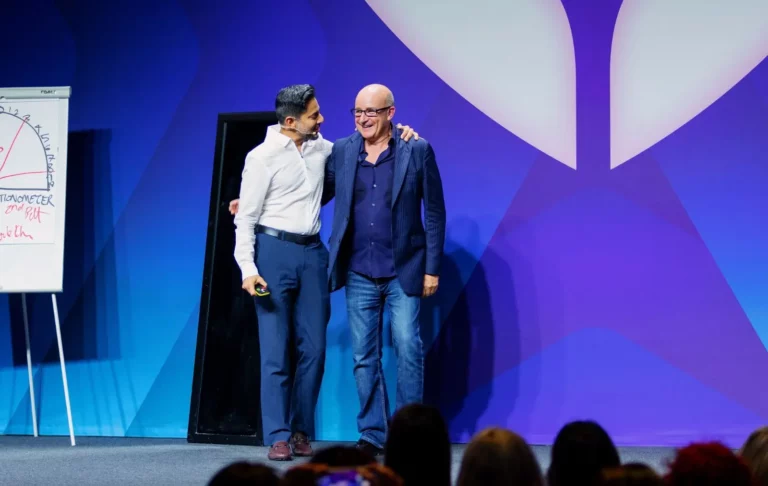
Every year, we bring together people from over 100 countries to live, learn, and grow side by side for two full weeks. Not in a lecture hall. Not behind a screen. In person. Families, entrepreneurs, artists, seekers, all eating together, learning together, raising their kids together in a pop-up community that, honestly, feels closer to how humans were designed to live than anything the modern world typically offers.
There are no pedestals at Mindvalley U. No single guru on a stage telling you what to think. There are hundreds of teachers, dozens of perspectives, and a community that operates on the same principle I saw in the Kalahari: I am because we are.
This year, we’re in Tallinn, Estonia, from July 20 to August 2, 2026. If anything in this newsletter stirred something in you, this is where you come to live it.
Featured image shared with permission from the Ombili Foundation (instagram: @ombili_foundation_namibia) that helps preserve San Culture.




269 Responses
Hello Vishen, I love your newsletter. You always stir my heart in many ways with your deep, loving, community minded posts. I always feel refreshed, or you get me thinking and my perceptions change a tad bit.
In any case, I am always excited to read the next one.
Thanks for choosing community over being The King!
Nice post. Wisdom over Ego. I AM BECAUSE WE ARE is such a nice way to put it. Keep up the good work! 😊
Wow. What an experience. Thank you for capturing and unfolding this beauty for us readers. This is what i would call ‘enlightened society’. Brutally pure and elegant. I love it.
I lived in Japan for over 13 years and grew up with a family from Hong Kong as my second family. The cultural values of family and community over individuality are permeant in Asian cultures. There are times when as a Westerner and someone who values individuality that egalitarianism could feel almost oppressive; however, there is not this trampling on others for personal gain as much as a I see in the United States where I grew up. The globalization of the planet and the advancements in technology and AI are forcing us to face ourselves, and it’s creating a paradigm shift that is not altogether easy, but it’s necessary for our species to survive and ultimately thrive.
Beautiful! Thank you, Vishen!
You’re asking yourself whether the world needs “Less ego. More community. More women in positions of power. More leaders who foster connection rather than division?” YES is definitely the answer to all of that!
The problem I see with “universal basic income shifting from theory to inevitability” right now, is that it’s not being proposed by us, by humanity as a whole, but rather imposed on us by a small group of dangerously ego-driven, soulless individuals, who have their own power, and not humanity’s well-being, in mind.
A future where “humanity isn’t glorifying certain individuals, but living in equality” will come one day, but I don’t think it’s the one they’re trying to design right now, where governments & friends decide that everyone else needs to be equal in their disempowerment.
The day when most humans will have restored the lost connection to their own souls, and recognised and embraced their limitless power, is the day they won’t feel the need to use it over anyone else anymore; it’s the day they will understand oneness and ubuntu, and the day they won’t settle for anything less than true equality anymore.
Beautiful! Thank you, Vishen!
You’re asking yourself whether the world needs “Less ego. More community. More women in positions of power. More leaders who foster connection rather than division?” YES is definitely the answer to all of that!
The problem I see with “universal basic income shifting from theory to inevitability” right now, is that it’s not being proposed by us, by humanity as a whole, but rather imposed on us by a small group of dangerously ego-driven, soulless individuals, who have their own power, and not humanity’s well-being, in mind.
A future where “humanity isn’t glorifying certain individuals, but living in equality” will come one day, but I don’t think it’s the one they’re trying to design right now, where governments & friends decide that everyone else needs to be equal in their disempowerment.
The day when most humans will have restored the lost connection to their own souls, and recognised and embraced their limitless power, is the day they won’t feel the need to use it over anyone else anymore; it’s the day they will understand oneness and ubuntu, and the day they won’t settle for anything less than true equality anymore.
Vishen, your blog verifies what I heard from another speaker several months ago. Unfortunately I can’t remember his name or occupation, or even the topic of his talk. During his talk, he said that historically conflict, wars, etc. only started when mankind discovered agriculture and began fencing off areas of land to grow their crops. At the time I thought it was a revolutionary idea, but the more I thought about it, it made a lot of sense. The key point in your blog is that the San are hunter/gathers, not farmers, which validates what I heard the prior speaker say. You mention they have San schools. I can’t help wondering what education they are getting, how much of it is about the outside world, and how long their culture will remain distinct. I noticed the name of the foundation trying to preserve the San culture, but still can’t help wondering how education is going to affect them in the future.
Good Point- I was wondering about that too !!!
Vishen, your points on the San people and matrilineal elephant societies hit home for me. If we want to build a society as happy and non-egocentric as the San, we have to look at how we start life. Breastfeeding and skin-to-skin contact aren’t just parenting choices; they are biological blueprints for nervous system regulation, trust, and empathy (a critical piece often missing from what we’re teaching kids in our society). I’d love to help Mindvalley explore a course on preserving this connection as a baseline for human development and modern parenting. Modern ‘high-tech’ mothering often disrupts this regulation. I’m envisioning a quest that teaches parents how to return to that low-tech, nervous-system-led connection. It’s the ultimate foundation for a more compassionate society. How can I share more about this with your team?
Beautiful! Thank you, Vishen!
You’re asking yourself whether the world needs “Less ego. More community. More women in positions of power. More leaders who foster connection rather than division?” YES is definitely the answer to all of that!
The problem I see with “universal basic income shifting from theory to inevitability” right now, is that it’s not being proposed by us, by humanity as a whole, but rather imposed on us by a small group of dangerously ego-driven, soulless individuals, who have their own power, and not humanity’s well-being, in mind.
A future where “humanity isn’t glorifying certain individuals, but living in equality” will come one day, but I don’t think it’s the one they’re trying to design right now, where governments & friends decide that everyone else needs to be equal in their disempowerment.
The day when most humans will have restored the lost connection to their own souls, and recognised and embraced their limitless power, is the day they won’t feel the need to use it over anyone else anymore; it’s the day they will understand oneness and ubuntu, and the day they won’t settle for anything less than true equality anymore.
Thank you so much for sharing this. It is an incredible article and so important for the world to hear. We can only wish for this type of peace. Any chance you’re willing to run for President? 😉
Beautiful, thank you so much, Vishen!
You’re asking yourself whether the world needs “Less ego. More community. More women in positions of power. More leaders who foster connection rather than division?” YES is definitely the answer to all of that!
The problem I see with “universal basic income shifting from theory to inevitability” right now, is that it’s not being proposed by us, by humanity as a whole, but rather imposed on us by a small group of dangerously ego-driven, soulless individuals, who have their own power, and not humanity’s well-being, in mind.
A future where “humanity isn’t glorifying certain individuals, but living in equality” will come one day, but I don’t think it’s the one they’re trying to design right now, where governments & friends decide that everyone else needs to be equal in their disempowerment.
The day when most humans will have restored the lost connection to their own souls, and recognised and embraced their limitless power, is the day they won’t feel the need to use it over anyone else anymore; it’s the day they will understand oneness and ubuntu, and the day they won’t settle for anything less than true equality anymore.
Vishen, You have written many interesting and thought provoking pieces. And, this may be your most profound and breakthrough piece of work, not just for you and your company but for society as a whole. The challenge now is how do you/we embed this consciousness into our thoughts, actions, goals, individuals, professionals, leaders, companies, organizations, governments, . . . . I hope you and your team will take on how we do this. “I am because we are” may be the beginning and core principle of a larger technologically advanced future utopian society or country. I hope your company becomes rich enough to buy/form a country where its citizens live this principle and prosper happily so that it can become a modern model of the San. You will be accused of being a cult leader until a time when other countries begin to mimic and mirror your society/country until it reaches critical mass and then your utopian country will become a reputable form of governance for its citizens.
Phenomenal! Keep thinking, being, doing, growing, sharing and building around this principle!
Brilliant blog post.
I’ve been feeling this so much recently and really considering how I share that with others through my trauma work and rebuilding people through divorce.
When ego is released we can finally live in peace, which is challenging but is possible for everyone despite not being able to live like the San people. It’s not giving up on goals or no longer wanting to make a difference, but it certainly allows you to choose what is right and important. Living differently risks being rejected by others, but when that happens you see ego even more clearly. Fascinating! 🙏
Loved this article. My husband has taken me outside my comfort zone as we have traveled around the world, while my favorite place is still my home. I have met lovely people in entirely different cultures. Actually we are more similar than different. We all want to provide a better future for our families. I don’t know if the thought that different equals danger is born into us as a protective device but I would hope that we could evolve beyond that. “The unexamined life is not worth living” is so true. I love reading articles that make me think, so thanks for writing this article.
Really compelling perspective, especially the San model of regulating ego and elevating community.
It does make me reflect on how platforms like Mindvalley can sometimes feel quite sales-driven, which sits a bit in contrast to the message here.
Curious how you think about that balance. I love so much of your content and I love that your platform enables teachers to share their wisdom and earn money for it but sometimes the upsell is a little rough.
Hello I don’t read most of my emails ever. This one though really struck a chord. This was definitely inspiring and I believe if we could all learn to understand and begin to live by theses practical principles life could be much more abundant for everyone. Thank you for sharing this, I love your content. I’d like to know more about this company and what it is you all teach and do. I’m looking for a new way of life out of this silly rat race we’ve all been living in. Thank you again and God bless.
Sincerely, Korey
I almost never open up my email inbox anymore because I have so much random advice pouring in from all of the sites I’ve visited over the years. For some reason I felt compelled to actually open this one and I’m really grateful I did. It gives me hope that there are individuals out there who could take on that role of “wise supreme leader,” but decline it, and instead take on the role of teacher to share wisdom and continue learning from other humans. Thank you.
Thank you for nurturing the collective into what could very well be peace on Earth. We all derive from these ancient traditions, this way of life is deeply embedded in us all and I pray we all can awaken to it. I am because we are <3
I see some elements of this in western culture.
The way Americans keep their government from an explosive ego is gun ownership.
It may appear on the surface that owning a gun is for their own individual protection. But the real reason why the founding fathers baked gun ownership into the constitution was that they were aware of precisely this problem. Government accumulating too much power over people. When the majority of the population owns a gun, there is only so much control a government can exercise out of fear of real retribution.
Europeans did not create that break and look where their governments have pushed them, to the brink of extinction.
Church, not a guru sets moral rules.
This is why communism collapses over time in every culture that naively tries to make it work (most of the time against the will of the people like we currently see in EU and it will backfire). Individuals like Marx and Engels are glorified, their opinion is the enlightened approach to life, both wealthy men who were detached from the reality of human nature much like the current governor of California, now trying to make himself more palatable to blue collar white Americans he can’t possibly relate to in any shape or form. He believed himself to be an idol, delusional in his belief that he truly will save California by putting it into horrible debt dismissing important safety measures established by previous occupants of California who had seen the local reality and implemented intelligent measures.
There are more commonalities than differences with our world today if you look hard enough.
This is the most though provoking views I read this entire month. I also like that Mindvalley is not about one person but provides platform for so many individuals who co tribute to make this world a better place and in the process we become better individuals.
So much to learn from San culture . Humility is such an underestimated virtue…thanks for brining it in spotlight.
Gratitude Vishen and Mindvalley