

What if the happiest humans who ever lived had no money, no government, and no ambition?
I know that sounds like a provocation. But stay with me, because over the last two weeks something has been quietly dismantling my understanding of progress — and I think it might dismantle yours too.
It didn’t come from a book. It didn’t come from a billionaire on a stage at Davos. It came from a group of people who have lived on this land for longer than any culture on Earth. People that most of the West has never heard of. And people who have heard of them have called them “primitive.”
They are the San people of Africa.
And what I learned from them might be the most important thing I write this year.
The thought experiment that changes everything
Before I get to San, I want you to try something. It’s a thought experiment, and it’s not a light one. It’s the kind of question that, if you sit with it long enough, starts to rewire how you think about civilization itself.
Here it is.
If you could go back in time and be born into any culture, in any era of human history — but you had to come back as a random person. Not the king. Not the nobleman. Not the person with the right gender or the right skin color. Just a random human being in that society. You could come back as a woman. As a slave. As a member of a persecuted minority. As anyone.
Which civilization gives you the best odds of actually being happy?
Think about it.
Ancient Greece during the age of Pericles? Maybe — if you came back as a wealthy male citizen. But there were tens of thousands of slaves who built the Parthenon, and women had no legal rights. Roll the dice wrong, and your golden age is somebody else’s nightmare.
America in the 1950s? Sure — if you happened to be white, male, and straight. Otherwise, you’re drinking from a separate fountain.
The advanced Muslim Abbasid Empire in 12th-century Spain? A genuine golden age of science, art, and tolerance. But still, constant wars and battles with Christian Spain.
I started asking this question to historians, to thinkers, even to multiple AI systems. And the answers were fascinating. Modern Scandinavia kept coming up. The Abbasid Caliphate. Periclean Athens. But then there was one unlikely candidate that surfaced again and again.
The San people. Anytime before the 21st century. In three different AI models (Claude, OpenAI, Kimi), the San Culture came in the Top Ten.
Of all the cultures that have ever existed on this planet — cultures that built pyramids and parliaments and empires — the one where you could come back as anyone and almost surely live a dignified, equal, and connected life… was a group of hunter-gatherers roaming the savannahs of southern Africa.
That stopped me cold.
Because here’s the fascinating thing. This culture is the longest unbroken culture we have, dating back tens of thousands of years. And mostly unchanged.
Writing this from Namibia & Botswana
I’m writing this from a hotel room in Botswana. Over the past two weeks, I’ve been traveling across Namibia, Botswana, and Zimbabwe — watching wildlife that feels almost mythological, standing in landscapes that look untouched by time, and learning about a continent that many of us in the West have come to severely misunderstand. Or worse — to underestimate entirely.
Last week, I wrote to you about what female elephants taught me about leadership. About how the matriarch leads not through force but through memory. About how nature, across species, keeps arriving at the same answer: wisdom over dominance.
This week goes deeper.
This week gets uncomfortable.
Because the San don’t just challenge how we lead. They challenge how we live. They challenge what we call progress. And they hold up a mirror to the modern world that, honestly, I wasn’t prepared for.
The oldest culture you’ve never heard of
If you haven’t heard of the San, you might know the term “Bushmen.” That’s what the West has called them for centuries. But that word carries the stench of colonialism — it comes from the Dutch bossiesman, meaning “bandit” or “outlaw,” a name given to them by the very people trying to destroy them.
The San have their own identity. And it goes back further than almost anything.
We’re not talking about a few hundred years. We’re not even talking about a few thousand. Genetic evidence suggests the San lineage diverged from other modern humans somewhere between 100,000 and 200,000 years ago. Their culture has been continuous for at least 20,000 years. Some scholars argue it’s the oldest living culture on Earth.
Let me put that in perspective. The ancient Egyptians built the pyramids about 4,500 years ago. Ancient Greece peaked around 2,500 years ago. The Roman Empire rose and fell. The Renaissance came and went. The industrial revolution, the digital revolution — all of it — and the San were already ancient when those civilizations were young.
We built progress. And lost happiness.
They never had what we call progress. And may never have lost what we’re desperately trying to find.
6,000-year-old maps of the mind
In Damaraland, Namibia, I stood in front of rock paintings left by San ancestors over 6,000 years ago.
I expected something crude. Stick figures. Basic hunt scenes.
That’s not what I found.

These were sophisticated. They depicted animals and watering holes, yes — but they also depicted something far more startling: altered states of consciousness. Shamans in trance. Humans transforming into animals. Maps of inner worlds that were as real to the San as the physical landscape around them.
See the Lion at the bottom with the extended tail. That’s not representing a physical lion. It represents the Shaman entering the consciousness of the Lion to gain insights on the world around him. This was breathwork and trance states 6,000 years ago.
The San didn’t just survive in the desert. They built a civilization of the mind. While we were still millennia away from writing our first philosophical texts, they were already exploring the architecture of consciousness — and painting what they found on rock walls.
The moment I didn’t expect
A few days later, I visited a small San school in Namibia. I sat down to greet the children, expecting maybe a few shy smiles. Some polite curiosity.
Instead, the children rushed toward me.
They surrounded me — laughing, reaching out, completely unafraid. And then they started touching my beard. Gently. Carefully. Almost reverently, like they were discovering a new texture that didn’t exist in their world.

Image shared with respect and permission from the Ombili Foundation that runs this school in Namibia
It was one of the most beautiful moments of my life. About a dozen kids, all stroking my chin, giggling, fascinated. And in that moment, it clicked:
They had never seen a beard before.
What a beard might reveal about violence
Now here’s where things get genuinely fascinating.
There’s a hypothesis in evolutionary biology — still debated, but compelling — that beards may have evolved partly as protection. Studies have shown that facial hair can absorb and distribute the force of a blow to the jaw, reducing the chance of a fracture by as much as 30%. In environments where male-to-male violence was common, this would have been a significant survival advantage. Over thousands of generations, men in violent cultures would have been selected for thicker facial hair.
So think about what it means when an entire culture barely has beards.
The San are known to be one of the least violent societies in human history. No wars. No armies. No glorification of dominance. Anthropologists who have studied them describe them as “fiercely egalitarian” — not passively peaceful, but actively committed to preventing any individual from rising above the group.
And possibly — even at a biological level — they carry the evidence of tens of thousands of years without the kind of violence that shaped the rest of the human family.
Some evolutionary biologists suggest that their faces may be telling a story their culture has been living all along.
An operating system that actually works
If you’ve read my book, The Code of the Extraordinary Mind, you know I think about human behavior in terms of operating systems. Every civilization runs on one — a set of models of reality and systems for living that determine how people think, act, and organize themselves. I call the outdated, unquestioned rules in these systems Brules — bullsh*t rules. And most of the Brules we carry about what makes a “successful” society come from civilizations that lasted a few hundred years at best.
The San operating system has been running for tens of thousands of years. And it breaks almost every rule the modern world takes for granted.
No hierarchy. The San have no chiefs, no permanent leaders, no one who accumulates power over others. Leadership is fluid and contextual — whoever has the knowledge the moment requires takes the lead. A skilled hunter leads during the hunt. A healer leads during the ceremony. Then they step back into the group. No pedestals. No thrones. No corner offices.
Men and women are genuinely equal. Not in the performative way modern societies talk about equality — where we write policies and still pay women less. In the San world, men and women hold distinct roles that are equally vital and equally respected. The men hunt. But the women are the navigators. They know where the water sources are hidden beneath dry riverbeds. They track the movement of game across vast stretches of savannah. They know which plants heal, which nourish, which kill. When the tribe moves — and they move constantly, following the game — it’s the women’s knowledge that keeps everyone alive.
If you read last week’s newsletter on female elephants, you’ll recognize the pattern. In elephant herds, the matriarch leads because she remembers where the water is. Among the San, the women carry the same knowledge. Nature keeps arriving at the same answer, across species, across millennia: memory and wisdom over force and dominance.
Everything is shared. When a hunter makes a kill, the tribe moves its portable shelters to the site. They feast together. Then they move again. They’ve been doing this for 10,000 years. There is no accumulation. No identity tied to what you own. No hoarding. This isn’t poverty — it’s a design choice. The San solved an equation that modern economists are still struggling with: beyond a certain point, more stuff doesn’t make you happier. They figured this out before the wheel was invented.
Insulting the meat
Now here’s the part that really broke something in me.
The San have a practice that anthropologist Richard Lee documented called “insulting the meat.” It is, without exaggeration, one of the most brilliant social technologies I’ve ever encountered.
Here’s how it works. A hunter goes out. He tracks an animal — sometimes for days. He makes the kill. He comes back to camp. And instead of being celebrated, instead of anyone saying you’re incredible — everyone, including the hunter himself, downplays the kill.
“That? That skinny old thing? Barely worth eating.”
“Look at that pathetic animal. You call that a hunt?”
And the hunter joins in. He laughs about his mistakes. Jokes about how the giraffe nearly trampled him because he tripped over his own feet. He makes himself small — on purpose.
This isn’t cruelty. It’s not false modesty. It’s a social technology designed to prevent the most destructive force any community can face: unchecked ego.
An elder from the group explained it like this: “When a young man kills much meat, he comes to think of himself as a big man, and he thinks of the rest of us as his inferiors. We can’t accept this. So we always speak of his meat as worthless. In this way, we cool his heart and make him gentle.”
We cool his heart and make him gentle.
Forty thousand years of social cohesion. Built on a single insight: ego is the enemy of community.
Now hold that in your mind. And think about the kind of leaders we celebrate today.
The ego problem we refuse to see
We are living in an era that glorifies the opposite of everything the San built.
We amplify ego. We reward dominance. We build pedestals for individuals who speak about power as though volume equals vision. We have world leaders who threaten to wipe out entire civilizations and face no consequence.
In the San culture, this doesn’t stand. It can’t stand. Their entire social operating system is designed to prevent exactly this — the elevation of any single ego above the group.
Last week, I wrote about female elephants and how nature chose wisdom over dominance. This week, the San are showing me the same pattern, but in human terms: civilizations that glorify ego eventually collapse under the weight of it. Civilizations that regulate the ego endure.
So I keep coming back to the same uncomfortable question: What if we have this fundamentally wrong? What if the future of humanity isn’t in glorifying certain individuals, but in equality? What if the world needs less of the strongman archetype and more of the leadership model that nature — and the San — arrived at independently?
Less ego. More community. More women in positions of power. More leaders who foster connection rather than division.
The San figured this out before the Bronze Age. And we still haven’t caught up.
The fire, the dance, and the oldest technology of consciousness
One evening in Namibia, a San guide walked me through their shamanic healing rituals. And it felt like stepping into another dimension of human experience. I didn’t witness the healing, but my guide explained it to me via a mural on the wall of a San School in Namibia.

The San have healers — both men and women — who enter altered states of consciousness through what’s known as the trance dance. Women sit in a circle around a fire, clapping and singing medicine songs that they’ve known since childhood. The healers dance around the periphery, sometimes for hours, until a spiritual energy the San call n/om rises through their bodies. It starts in the belly, rises through the spine, and then the healer crosses over into what they describe as another reality.
My guide described a ritual where…as the “patient” goes into a trance, the healer heats a knife in the fire until it’s red hot. He then plunges the knife into the patient and pulls it out. When the knife is pulled out, there is no scar, there is no wounding. The patient also experiences no pain. The illness is then healed.
You will see this in the mural above. One shaman gently caresses the woman while the shaman behind her is about to plunge a knife into her.
In this state, healers touch the sick and draw illness from their bodies. They mend disputes. They restore the social fabric of the group. The San describe it as “arrows of sickness” being pulled from the community and flung into the darkness.
My guide explained to me that his grandfather, a San shaman, still performs this healing ritual today.
By the time San adults reach maturity, roughly half the men and a third of the women have become healers. This isn’t a priesthood reserved for the elite. It’s distributed. Communal. Available.
The rock paintings I saw — 6,000 years old — depicted exactly this. Shamans in trance. The boundary between human and animal is dissolving. Consciousness expanding beyond the body.
We in the West tend to dismiss this as superstition. But I’ve spent two decades studying consciousness, meditation, and human performance. I’ve built Mindvalley on the premise that transcendent practices — the Silva Method, meditation, altered states — are not fringe experiences but essential human technologies. And what the San developed isn’t primitive. It’s the original technology of consciousness. It’s been running, unbroken, for longer than any other system on Earth.
We think we invented mindfulness. The San have been practicing it for 20,000 years.
What I learned building Mindvalley
This brings me to something personal.
When The Code of the Extraordinary Mind hit number one globally in 2017, I had a choice. I could lean into being “the guru.” Build the personal brand. Become the center of the platform. Every incentive in the modern world pointed that direction — because our systems reward exactly that kind of ego amplification.
I chose to break the model.
Instead of positioning myself as the singular voice, I opened Mindvalley to hundreds of teachers. Different perspectives. Different modalities. Even ideas that conflict with my own. Because I believe that truth doesn’t belong to one person. It emerges from many.
Compare this to the guru model that dominates the personal development world — where a single personality becomes the brand, the doctrine, the untouchable center. Some of those gurus built grandiose names for themselves and then turned up in the Epstein files. That’s what happens when ego goes unchecked. The San would have seen it coming.
That decision to distribute authority rather than concentrate it changed everything — not just for the company, but for me. Because the moment you remove ego from the center of leadership, you create space for something the San have always known is more powerful: community.
I am because we are
There’s a word that echoes across southern Africa. In Botswana, they call it botho. In South Africa and much of the Bantu-speaking world, it’s ubuntu. The translation sounds simple, but it contains an entire philosophy of what it means to be human:
I am because we are.
Not “I think, therefore I am” — the Cartesian formula that built the entire Western model of selfhood on the isolated individual mind. But something fundamentally different: I exist because of my connection to you. My humanity is not mine alone. It is something we create together.
Archbishop Desmond Tutu put it like this: “Ubuntu is not ‘I think therefore I am.’ It says rather: ‘I am a human because I belong. I participate. I share.'”
The San embody this more deeply than perhaps any culture in history. When a healer enters trance to draw out sickness, they’re not treating an individual — they’re healing the community. When the tribe insults the meat, they’re not putting down the hunter — they’re protecting the collective from the cancer of ego. When men and women share leadership based on who holds the right knowledge for the moment, they’re not being “progressive.” They’re running an operating system that’s been tested and optimized across more generations than any civilization on Earth.
The future is moving toward them
Now layer something else onto all of this.
AI.
Over the next decade, we are heading toward a world where work becomes optional for many. Where universal basic income shifts from theory to inevitability. Where ownership starts to lose its meaning because access becomes abundant, and the cost of goods approaches zero. Where the game we’ve built our identities around — accumulation, status, dominance — begins to dissolve.
In other words, whether we realize it or not, the future is starting to look less like modern capitalism and more like a campfire in the Kalahari.
Shared resources. Fluid roles. Community over status. Identity rooted not in what you own, but in who you are to others.
We are drifting — some of us kicking and screaming — back toward something ancient.
And the most important thing I can tell you for the next ten years is this: be careful who you follow. Avoid egocentric leaders. Vote for people who foster community rather than division. The world doesn’t need more strongmen on pedestals. It needs more leaders who understand, at a bone-deep level, that their power belongs to the group.
The San knew this before they had a written language. We’re going to have to re-learn it with all of ours.
The question that won’t leave me
So I sit here in Botswana, about to fly home. And one question keeps looping through my mind, and I can’t make it stop.
What if the most advanced civilization in human history wasn’t the one that built the tallest buildings, the fastest computers, or the most destructive weapons?
What if it was the one that figured out how to keep every single member of the group — regardless of gender, regardless of role — fed, healthy, equal, and connected? For longer than any other culture on the planet?
What if we didn’t evolve forward, but sideways — gaining technology while losing something essential about how to be human together?
We optimized life. And forgot how to live.
But the blueprint for something better has been here all along. In a place where children have never seen a beard, because they’ve never needed protection from each other. Where a hunter comes home with a kill and the first thing his people do is laugh at him, because they know that the moment his ego grows, the community dies. Where healers dance themselves into another dimension to keep their people whole. Where the oldest woman in the group holds more authority than any king, because she remembers where the water is.
I am because we are.
Maybe it’s time we remembered that.
If this sparked anything in you, take a moment to leave a comment below—I read them all.
Vishen
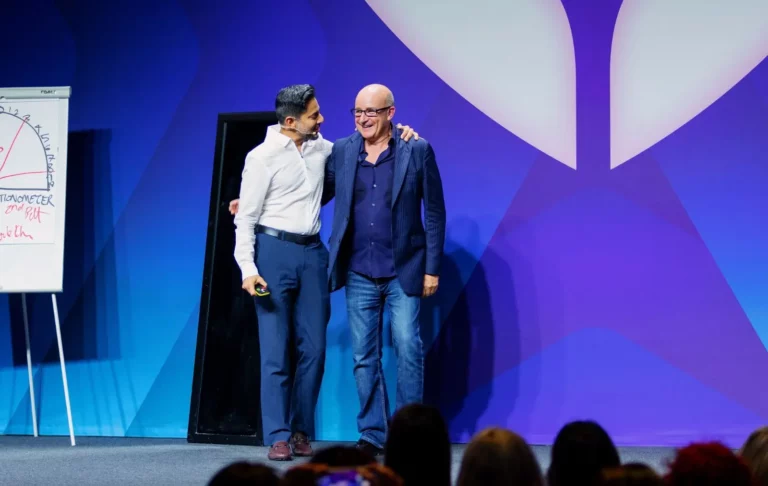
PS: Everything I wrote about in this newsletter – community over ego, shared learning over guru worship, the idea that human beings thrive when they grow together rather than alone — that’s exactly what Mindvalley U was built to be.
Every year, we bring together people from over 100 countries to live, learn, and grow side by side for two full weeks. Not in a lecture hall. Not behind a screen. In person. Families, entrepreneurs, artists, seekers, all eating together, learning together, raising their kids together in a pop-up community that, honestly, feels closer to how humans were designed to live than anything the modern world typically offers.
There are no pedestals at Mindvalley U. No single guru on a stage telling you what to think. There are hundreds of teachers, dozens of perspectives, and a community that operates on the same principle I saw in the Kalahari: I am because we are.
This year, we’re in Tallinn, Estonia, from July 20 to August 2, 2026. If anything in this newsletter stirred something in you, this is where you come to live it.
Featured image shared with permission from the Ombili Foundation (instagram: @ombili_foundation_namibia) that helps preserve San Culture.




269 Responses
I love this so much, “I am because we are.” It really encapsulates so simply and beautifully the idea I have been trying to participate in my whole life.
I have tried in various ways to live in community but have not achieved the feeling of integration and connection I yearn for. I’m not giving up though and this is another reminder it is out there and I just need to keep searching for my people 💙
Yes, it’s easier with your people, but it really stems from inside yourself. Live and be as though you were in an equal and reciprocal community – people will follow your lead
Hi Vishen and Mindvalley community,
Reading this brought a deep sense of resonance. My purpose centres around connection, which is why I moved into community organising. Yet over the past 5 years I’ve realised something uncomfortable: even progressive and justice spaces often replicate the same “us vs them” dynamics the broader system thrives on — showing up as groupthink, alienation, and an inability to truly listen across difference, even when community and inclusion are part of the vision.
Your emails about the female elephants and about an AI-fuelled future both landed with me. Building a ‘modern’ world where leadership is more fluid across contexts, centred in community benefit, and culturally embedded across generations would be transformative.
But the AI future also raised unadressed questions — such as, what happens to the 185 countries without universal basic income at the outset, to whether it meaningfully addresses the climate crisis within a consumer driven system it may actually accelerate.
Which brings me back to what feels fundamental for us to thrive: the conscious practice of managing ego to cultivate collective wisdom across generations, reframe leadership, and come together in difference for the benefit of all.
So my question to you, Vishen and Mindvalley community, is: in a world where even leadership and managing ego have been commoditised, from your perspective how do we build these practices at scale — especially across communities that don’t have access to spaces like Mindvalley or may not share the same worldview?
I am so glad that you have “discovered” the San, or KhoiSan culture while in Africa. I have known about their culture all my life and have studied it at the university of Cape Town to Master’s level. The oldest art piece discovered and dated to 77,000 years is in the national museum in Cape Town.
This, to my mind, is proof of a developed consciousness. Trance dancing had it’s part to play as well. I would love to tell more, but that will be another thesis.
I loved your article. For sure this is the way of the future. Building community regarding each other as equals. No hate and destruction.
You always spark something in my soul. Reading this piece today change my perspective about many things.
Thank you for always transforming our mind with this insights.
A thoughtful and insightful post. Ego-based leadership is causing so much devastation, human suffering, and long-term disasters in the making that will take years to recover from. Being a more thoughtful and humane citizen is an important call to action in the decisions we make, the people we choose to follow and what we endorse through our actions and inactions. I feel more hopeful about our collective futures after connecting with your words today, thank you.
So glad you have “discovered” the San, or KhoiSan as they are also named by western anthropology. I have known about their culture for a lifetime, as I lived in Africa for more than half my life. I also studied their culture and rock art at the University of Cape Town on Masters level. The oldest rock art found and dated is 77,000 years old. This is proof enough that they had t
hen already developed unique consciousness. There is a lot of speculation about their cultural habits by western anthropologists, not all entirely true, but just conjecture. I would love to tell more, but space is limited.
Thank you for sharing your thoughts. There are 2 places where you lost me:
1. I wish you would stop using the word “guru” in its appropriated western sense to mean self- proclaimed egoic attached teacher when it’s true meaning is “disspeller of darkness” and refers to a self realized being that is unattached and exists for the spiritual liberation of all beings. Your usage perpetuates a harmful western perspective and appropriation of a word that is ultimately sacred. (By the way, I am saying this as a person of Indian descent).
2. I’m not sure how you can think that a world that continues to favor AI (and thus supporting all of the harm that it causes to our environment) will lead to some type of throwback world that favors community and shared resources. It’s likely that the depletion of resources that AI requires to grow to that level will destroy our environment first and is the exact opposite of living in harmony in a society that centers community and shared resources.
Other than that, I thought the article was great.
Hi I am a European decent born in cape Town and found your reseach very interesting. Even the click they use when speaking was adopted by the bantu people. .thanks for the informative story. Take care torben martens
It’s been so long that I have read something you wrote from your heart. Lately Mindvalley has been feeling very mindless. This article gladdened my heart and filled me with hope.
Beautiful! I am happy you were able to experience this as so many in the West have no idea of Africa. I lived there for 8 years and learned so much about love and life! “Africa is now in you! Always with you from now on. The rivers run in currents in the swirl of your thumb prints, African drumbeats counting your pulse, the coast line the silhouette of your soul” anonymous writer
Wonderful to hear…also, I found YOU Vishen when I was living and struggling during covid in Africa (covid in Africa was far worse than the west or Europe). But that is a story for another time!
Vishen, long time follower, first time commenter. Thank you. Profoundly from my heart. Over the past few years, I sometimes skim your emails, usually don’t make it to the bottom. I’ve started many Mindvalley quests on the app, finished many less. The concept of mindvalley appealed to me, but I found my relationship to it transactional. This article ignited something in me, a very different feeling. It resonated in a core of my being, like parts of a puzzle that were finally fitting together. It inspired me about the criticalness of the moment we are all sitting in, and pushed me to more actively be an agent building the tomorrow you discuss, the return to community. Thanks again for sharing this and being a steward of our familiar – helping us remember who we are and building a bridge back.
Thank you Vishen.
From my heart.
I live and work with Indigenous Australians, more than 60,000 years of continuous culture. I have had the privilege to work with hundreds of Aboriginal artists in remote and rural Australia and my area of expertise is ‘art centres’ – artist owned cooperatives.
I found my purpose at 22 years old in 1986 after leaving Melbourne to travel. I knew the dominant paradigm was no fit for me.
The realisations you have had came to me in a moment of clarity, a couple of weeks in to my first time of being in a remote community in 1986. For me – it was their holistic world view – nothing and nobody is separate, everything (place, rock, tree, element), every being is connected and honoured and felt and ceremonies are dedicated to maintaining balance. Humans are not separate or superior, we are just part of and must use our time on earth to nurture the whole.
My life has been dedicated to promoting greater awareness of and respect for Indigenous ways of being/seeing/knowing, to me that is the most important work on the planet.
I found Mindvalley to be the right learning platform for me. I found your non-hierarchical approach fascinating. I found your teachers stimulating, humane, thoughtful and generous as well as wise and knowledgable. I’m a member and have been doing courses for some time.
The most recent course is Social Media Mastery as I am called to share more. My visibilty wound is not wanting to push myself forward, not wanting to set myself as someone who ‘speaks for them’.
I see you. I respect you.
Thank you again.
Dear Vishen, this is such a nice story,
A guidance for living life.
You organise this big happening in Tallinn, Estonia, which is beautiful. But do you realise, that it is only a small group of people who can attend? Your tickets in US dollars make it unaffordable to most hard working people.’
Keep up the good work, make it accessible to all!
Excellent article. I read it because I am going to SA & Botswana later this year and want to know more before I go so I can connect even just a little with the people there. My experience will be very different as I am doing a horse riding safari but still our guides and others will be local.
My only question to your words was that the Aboriginal Australians have been around as the “oldest continuous culture stretching back over 60,000 years”. They have some similarities with the San but sadly their culture has been decimated & desecrated by western so called civilisation.
I applaude the wisdom of the San and the perspective of “I am because we are”.
I hope I have lived that way at least to some extent already.
I hope also that your positive vision of our future with AI can come to pass. My concern is with the innate greed of too many…
Dear Vishen,
This sharing of yours has been the most refreshing piece of observation and shared reflection I’ve come across.. in a long while… I came across mindvalley only this past month and find your intentional approach a refreshing exercise in, as you say, not simply following the expected model of centering the self.
In this post you share reflections I’ve held for many years… not sure if you are familiar but there is a book called the African Intellectual Heritage- by Molefi Kete Asante and Abu S. Abarry… such richness to be found in it, one of them invited me to think along the lines I believe you are sharing here. One of the texts in it is by Olaudah Equiano ” Identity, Culture, and Kidnapping” is the title. It is the story of a man from what we now call Nigeria who is first enslaved in their home nation, and then sold into the transatlantic enslavement- they survive and share their story. In it they share the surprise of the ships white slavers have- as well as their cruelty- not only to the people they capture but amongst themselves. This most painful story invited me to hold a similar reflection- our focus in modern/western culture on technology- on the visible- is seen as dominant and therefore better than what is invisible. How communities who invested in their wellness as you say their social technology (a new term I learned from this post which I appreciate), have been seen and made lesser than, those focused on material technology.
While working in eastern DRC in amidst an area that has been under conflict for decades now, a european humanitarian attested to this way of thinking – stating -” there is nothing here”… what he was referencing was that he perceived no material development – no historical signs of constructions and therefore no sign of cultural development- in an area so culturally rich and diverse… it deeply disturbed me .. but further confirmed this fixation on the material as being more valuable and superior.
In the observations you share about the San people, many of these ways of being I recognize from what I learned about growing up around Inuit- who have also learned to survive in more than challenging conditions based on community, not competition. I also realized, when you spoke of other nations that were mentioned such as Scandinavian countries- they also share practices I perceive as keeping ones ego in check- ever seen a Norwegian comment after winning a 50+ km ski Loppet (marathon) “oh you know – the skis were really good”…decentering the ego is present even in this contemporary lifestyle- so more to explore there too perhaps.
I too believe there is indeed much to learn from circular leadership, especially about the clarity in how they operate, they are not chaotic or disorganized or ambiguous, they are intentional inclusive structures. Which leads me to think of the need for clear processes – for systems with fluid leadership- to be able to grow and expand more sustainably rather than in the margins. In these collective social technologies Id venture to say that they hold the road maps for developing the needed peace architectures required for the peace we need, as much for nature and human societies (as we are also interdependent) for our collective wellness and into a new transformation.
One last note, the Zulu people have a personal declaration (1825, South Africa), it speaks of the value of UQOBO – the essence… Without trying to explain it, ill share that it dives into the philosophies tied to the self-collective.. and invites ongoing reflections… many thanks again for so freely sharing your experience and reflections, your voice is appreciated and welcomed.
Thank you for this article. It was beautifully written and timely, for sure. I recently learned about the San people, and love everything about them and their culture. I plan to visit them…stay there awhile…let their ways sink in…so I return more like them than I already am…so that I am wholeheartedly San in the US, where I live. BTW, we live by ubuntu at my non-denominational church. I am because we are. We are because I am. Eemah Jamelle Rackley
Vishen, as always a truly inspiring article. It got me thinking or rethinking about where I want to spend my retirement years doing something useful and where I may be accepted for my race, religion, and skin color. Needless to say, I never felt one of the people (even my own family) anywhere that I’ve lived and I often wonder is there a place for me somewhere and how would I find it? Thanks for sharing all your interesting experiences.
Hi, I know you don’t know me, but I have this message for you from Maja. This will change everything. Check out Carl Jung’s work on empaths. Thanks to you, I now know what I and all other empaths are preparing for.
This is truly beautiful—I read every bit of it. We devote so much effort to understanding the vast universe, yet often overlook the entirety of the human psyche, which is even more fascinating, more intricate, and equally worthy of deeper understanding
This is a lovely tribute to who appear to be a beautiful people. Thank you for sharing this. It reflects the kind of space I want to be in at this point in my earthly journey. I believe that ego really is destructive, I don’t want to be naive to think we can achieve a world where respect and mutual consideration become ubiquitous, however, if not the world, then why not myriad communities built on kind principles?
In one of the many books I am currently reading – “Slowing Down to the Speed of Joy”. Author Matthew Kelly, has me really thinking about how I might achieve a relative state of ubuntu/nirvana. True freedom that I can share across communities.
I enjoy vicariously your exploration of new untouched spaces. Keep on writing. Thank you.