

I’m writing this from the Abundance 360 Summit in Los Angeles, and I brought my son Hayden with me.
The summit was created by Peter Diamandis – one of the most important innovators alive today.
Peter is the founder of XPRIZE and a long-time friend and collaborator of mine.
Every year, he gathers CEOs and founders who want to understand exponential technologies: artificial intelligence, robotics, quantum computing, synthetic biology, longevity science.
The ticket costs roughly $30,000 per person.
The room is filled with people trying to understand what the next decade is about to do to their industries.
I brought Hayden because Abundance 360 runs an incredible teens program: designed to expose young people to the technologies that will shape their futures.
Watching him dive into conversations about robotics, AI, and space exploration with other brilliant young minds has been one of the highlights of this trip.
He’s 18, and he’s already more comfortable in a room full of futurists than I was at thirty.

And it’s kind of surreal being here.
Everywhere I turn, I’m seeing the future.
Robots. Drone technologies. AI demonstrations that feel like scenes from a movie I haven’t watched yet.
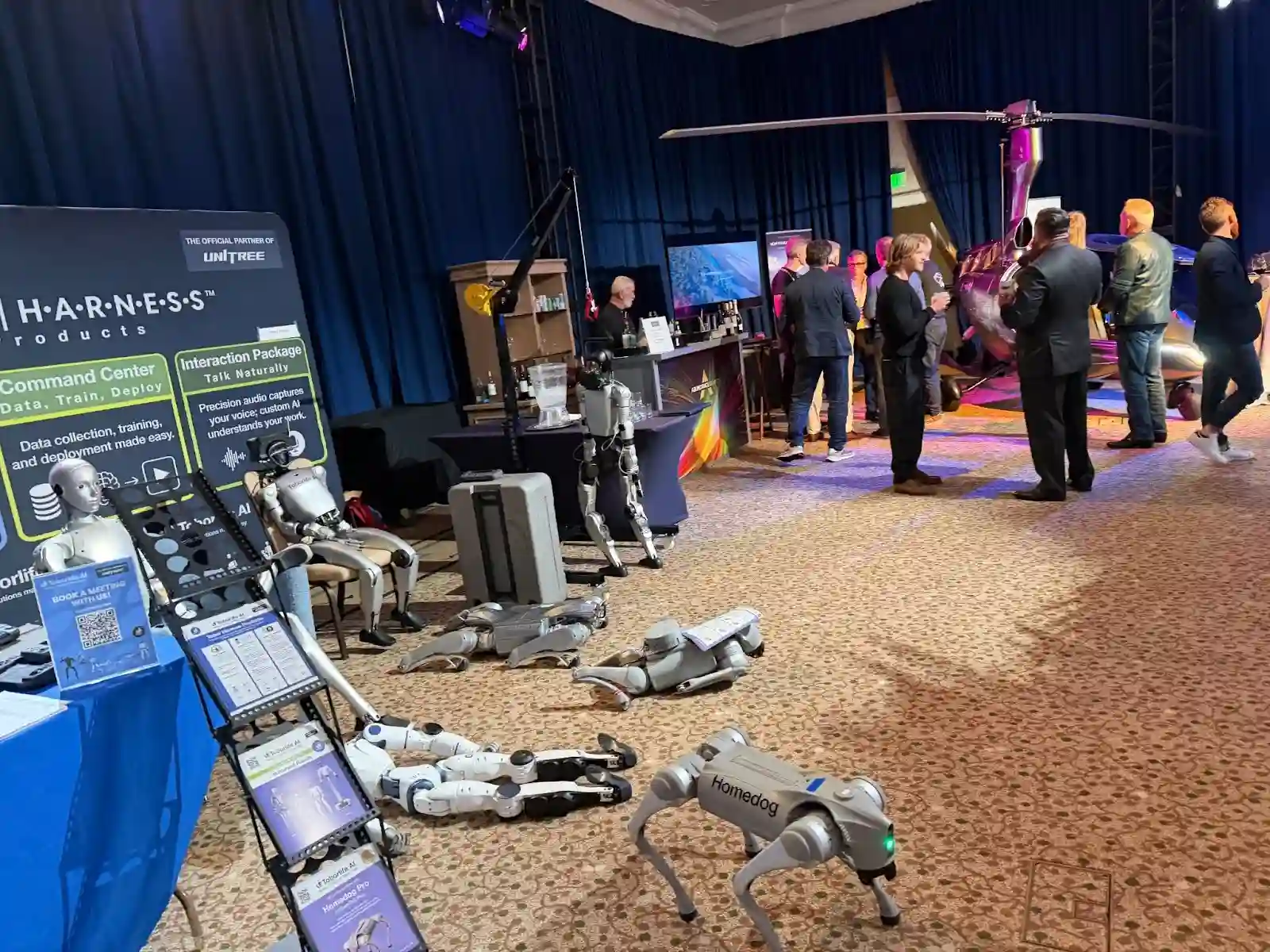
Earlier today, on the walk back towards my room, I almost tripped over robots lying across the floor. Actual robots. Not prototypes in a lab. Not videos on a screen.
Robots just… sitting there like suitcases waiting to be picked up.
We’ve reached the point where stepping over a humanoid robot on your way to the bathroom is a mild inconvenience, not a miracle.
Steven Kotler, who many of you know as the bestselling author of books on flow and peak performance, was here as well.
He’s co-written several books with Peter, and seeing these minds together discussing what’s coming is like sitting inside a live version of tomorrow.

But, beyond the robots and the wild demos, there were a few deeper insights that emerged from the conversations here.
And they all point toward one enormous shift that I think every founder, creator, and ambitious person needs to understand.
The line that stopped the room
Minutes before I sat down to write this, venture capitalist Dave Blundin of Link Ventures got on stage and said something that made the entire room go quiet.
He said,
“The growth in AI intelligence between now and the end of this year could be comparable to the evolutionary leap from a buzzard to a human being.”
I want you to sit with that for a second.
That’s hundreds of millions of years of biological evolution, the distance between a bird circling a highway looking for roadkill and a species that writes symphonies, builds rockets, and argues about philosophy on the internet, compressed into roughly twelve months.
When Dave said it, I looked around the room.
These are not easily impressed people. They run companies. They’ve seen hype cycles come and go. And they were shaken.
And Dave wasn’t being poetic.
One of the metrics researchers track is how long it takes AI to complete tasks that normally require human effort.
That capability is currently doubling roughly every six to seven months.
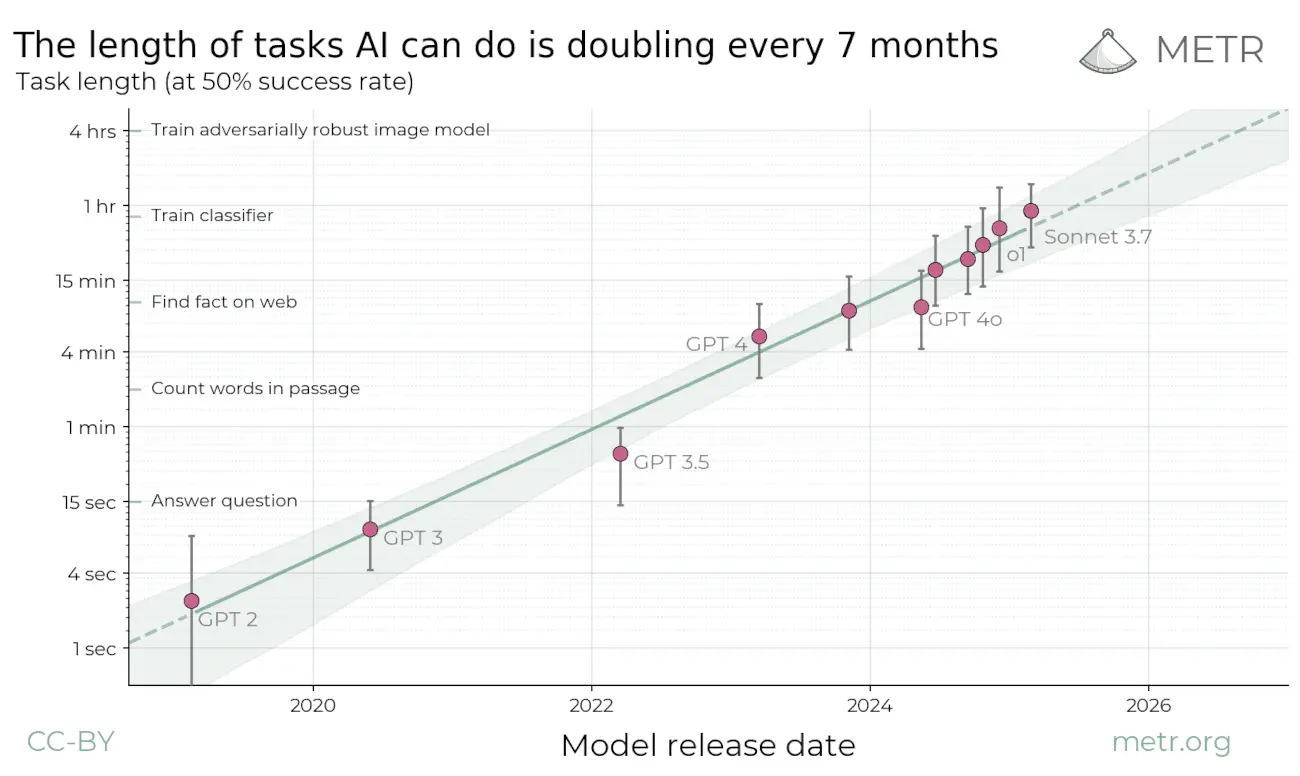
Not improving. Doubling. Even the skeptics in the room, the people who push back on the charts, admitted the same thing: the progress is real, and it’s accelerating.
And there’s a reason it feels different this time.
We’ve crossed a line that researchers have been watching for years: AI systems are now designing and training their successors. That is, by definition, recursive self-improvement.
As Elon Musk put it bluntly at the summit: “It’s takeoff time.” An inflection point.
And he added something fascinating, he said nobody wants to say it publicly.
The companies that have achieved this don’t want to draw attention to it. They don’t want regulators at their door.
But quietly, behind closed doors, the people building these systems know exactly where we are.
Yesterday, something happened that made it even more real.
Naveen Jain introduced me to Emad Mostaque, founder of Intelligent Internet and one of the pioneers behind Stable Diffusion.
Emad is one of those people who speaks so calmly about world-changing things that you almost miss how radical his ideas are.
He told me the cost of intelligence dropped 100x in the past year.
And in the next year? He believes it could drop another 1,000x.
To put a finer point on it: the cost of running frontier AI models has dropped by a factor of roughly 1,000 in a single year.
That’s faster than Moore’s Law ever was. Moore’s Law took decades to deliver that kind of cost reduction. AI is doing it annually.
I want to put that in perspective.
Electricity once felt expensive. Computing once felt expensive. Internet bandwidth once felt expensive.
Eventually, every single one of them became so cheap we stopped thinking about them.
They became ambient like air.
Emad believes intelligence is heading the same direction. Not slowly, over decades. In the next twelve to twenty-four months.
Then he showed me something that made the abstract feel visceral.
He pulled up a site called chatjimmy.ai.
Normally, when you type something into ChatGPT, you wait five or seven seconds for a response. There’s a little animation. A spinning wheel. You feel the machine thinking.
This model responded instantly.
Milliseconds.
The text appeared the moment I hit Enter. No pause. No loading. No waiting.
It felt less like asking a question and more like thinking out loud with a superintelligence that happened to be faster than my own inner voice.
That was the moment this stopped being theoretical for me.
Try this yourself. Open up a browser tab and go to chatjimmy.ai.
Now ask it something that typically would take 4-5 seconds on ChatGPT. Something random like, “Tell me 10 jokes about penguins flying airplanes.”
You’ll be shocked by the speed.
The collapse of distance
Here’s why all of this matters so much, and why I think the next few years are going to be the most important period in the history of building things.
For most of modern history, creating something: an app, a product, a business, a piece of software, followed a very specific sequence.
You had an idea. You raised funding. You hired a team.
You spent months (sometimes years) in development.
And then, maybe, you launched a product.
Idea → funding → team → months of development → product.
That sequence is collapsing.
Now?
Idea → AI → prototype.
The distance between imagination and reality has never been smaller.
And here’s the part that keeps me up at night: it will never be this large again.
A year from now, the distance will be even smaller. Two years from now, even smaller still.
And here’s something crucial that came up in multiple conversations: innovation is no longer capital-constrained.
It used to be that your idea lived or died based on whether you could get funding.
You had to be in Silicon Valley or Austin or one of the few places where capital was concentrated. That era is ending.
We’ve entered what people here are calling
“permissionless disruptive innovation”
where anyone, anywhere, can take on a massively disruptive idea without asking for permission or funding first.
This is what’s creating something extraordinary in the world of business.
The rise of the one-person company
Companies are emerging that generate enormous revenue with almost no employees.
Take Midjourney, the AI image generation company.
Nearly $500 million in annual revenue. About 40 employees. No venture capital.
Or Cursor, the AI coding platform. Over $200 million in revenue. Roughly 20 employees.
And several AI founders here believe we will soon see the first billion-dollar one-person company.
That idea sounds absurd at first. But when you understand the trajectory of what’s happening: intelligence getting 100x cheaper per year, tools that respond in milliseconds, the collapse of the idea-to-product pipeline, it starts to feel not just possible but inevitable.
One researcher presented what he’s calling
“The Organizational Singularity”
The idea that as AI agents take over execution and even strategy inside companies, the typical organization dissolves into something radically smaller.
His calculations suggest you could automate a typical company and end up with about 25% of the original headcount doing oversight, managing dashboards, handling exceptions, and owning the purpose.
But here’s the optimistic twist: because it becomes so much easier to start companies, you end up creating roughly five times more of them. The total employment stays roughly the same, it just gets redistributed across a much larger number of smaller, leaner ventures.
This isn’t a future where everyone needs to be technical. It’s a future where the most important skills look nothing like what we were taught in school.
What actually matters now
After several days of deep conversation with the smartest people I’ve ever been in a room with, here’s what I’ve come to believe.
1. Anyone can learn to code now, and “coding” doesn’t mean what it used to.
AI can generate software from natural language. You describe what you want. The AI writes the code.
The skill is no longer writing syntax. The skill is describing what you want built, clearly and precisely.
This means coding is rapidly becoming a conversation. And the people who can hold the best conversations with AI, who can articulate a vision with specificity and nuance, will build things that used to require entire engineering teams.
I’m seeing this in Mindvalley, the speed of developing products is now a hundred times faster. The only question is, are you building the right thing?
2. Taste is becoming a superpower.
When anyone can create anything, the real advantage isn’t creation. It’s curation.
It’s knowing what’s worth creating in the first place.
I’ve been saying for years that the most important skill in the coming decade would be vision, and I think this is what it looks like in practice.
When the tools can execute anything, taste becomes one of the most valuable forms of intelligence.
3. Judgment now outweighs execution.
AI can execute almost anything you ask it to.
But choosing the right problem to solve?
Deciding which opportunity to pursue and which to leave on the table?
That remains deeply, irreducibly human.
The people who thrive in this new era won’t be the best executors.
They’ll be the best decision-makers.
4. Communication is the new meta-skill.
Directing intelligence is fundamentally a communication skill.
Right now, when you use AI well, you’re essentially orchestrating designers, developers, researchers, and analysts all embodied in AI systems.
If you can communicate clearly, you can direct enormous intelligence. If you can’t, even the most powerful tools in the world sit idle.
5. Vision wins.
AI can generate ideas. It can brainstorm, research, prototype, and iterate.
But it doesn’t decide what matters. It doesn’t decide what’s meaningful. It doesn’t decide what’s worth building.
That’s still us. And I think it will always be us.
The question is whether you’re willing to take that seriously, to develop your own clarity of vision, or whether you’ll let the tools overwhelm you instead of empower you.
Three myths to bust
There are three myths about AI floating around right now that I want to address head-on, because I heard them dismantled convincingly by researchers, founders, and technologists over the past few days.
The first is that: “One company will control AI.”
Most researchers here believe we’ll see five to ten major AI companies competing globally. Competition drives innovation, drives costs down, and benefits consumers.
This will not be a monopoly.
Consider this: at one point this year, the title of “best AI model” changed hands five times in four weeks.
OpenAI led, then Google caught up, then Anthropic surged ahead, then new models overtook them again.
The dynamics are working in the opposite direction of monopoly every time someone tries to slow down one company, the others leap ahead. Competition is baked into the system now.
The second is that: “AI can be contained.”
Science fiction loves the story of a super-rich villain building a superintelligence and controlling the world.
Reality is the opposite. AI is the most rapidly democratized technology in human history.
Students, founders, governments, teenagers in their bedrooms all have access to models almost as powerful as those used by the biggest corporations.
Open-source models already exist. China is producing powerful open models that are often only three months behind the newest U.S. models.
And with the latest Macs, which have unified memory architecture that turns out to be remarkably well-suited for running AI models locally, many of these systems can run on your laptop right now.
The genie is not just out of the bottle; it’s moved in and is rearranging your furniture. The panelists were genuinely puzzled that Apple is sitting on what might be the most valuable piece of consumer AI hardware in the world and barely using it. One speaker called it “the biggest waste of silicon in the history of the world.”
The third is that: “AI will destroy all jobs.”
This one is the most nuanced. Dara Khosrowshahi, the CEO of Uber, was on stage and casually mentioned that Uber plans to automate about thirty percent of its operations this year. Thirty percent. From the CEO’s mouth.
And with self-driving cars on the horizon, the implications for their million-plus drivers are obvious. Nobody in the room pretended that the transition would be painless.
But here’s the counterpoint that keeps coming up.
Most jobs aren’t single tasks; they’re bundles of tasks.
AI might automate some of those tasks while actually amplifying others.
The net effect, in most cases, isn’t replacement. It’s supercharged workers.
IBM is actually hiring a ton of entry-level people right now, because younger workers are dramatically better with AI than their senior counterparts.
New categories of work are emerging faster than old ones are disappearing. And one of those new categories is something we’ve never seen before: solo founders directing fleets of AI systems to build companies that would have required hundreds of people a decade ago.
When people hear about AI, they immediately worry about jobs. I want you to think about it differently.
Ask yourself a new question:
If you were suddenly a supergenius, if every task you attempted came easily and took a fraction of the time, how long would it take you to complete your current work?
Your 40-hour workweek might shrink to 10 hours.
Maybe five.
Imagine what you’d do with the rest.
More time for your kids. For your health. For creative pursuits. For learning. For the things that actually matter to you.
This is what the AI revolution could bring if we use it correctly. Not unemployment. Leverage.
One more thing: They uploaded a brain
I can’t close without mentioning something that happened at the summit that felt like it belonged in a different century.
A company called Eon Systems announced what they’re calling the first multi-behavior brain upload in the world.
They took the entire brain of a fruit fly: every neuron, fifty million connections, and embedded it in a simulated virtual world.
The uploaded fly walks around. It scratches itself. It eats a simulated banana. And on a screen beside it, you can watch every single neuron firing in real time, driving the behavior.
It’s early. It’s a fruit fly. But the researchers believe we’re now years, not decades, from doing the same with a mouse. And eventually, a human.
I watched this demo and thought about Hayden sitting in the teens program down the hall.
He’s 18. By the time he’s my age, the world he’s living in will be so different from the one I grew up in that comparing the two will feel like comparing civilizations.
And that brings me back to where I started.
The real question
Here’s the thing I keep coming back to:
The AI divide is not going to be technical versus non-technical.
It’s going to be people who consume AI versus people who direct AI intelligence.
| One group of people who direct AI intelligence → build leverage. | The other group who consume AI feels overwhelmed by tools they don’t understand. |
One of the most striking moments at the summit was when a panelist said that: “The difference between the people in this room and the rest of the world is night and day, and the gap is getting bigger.”
He said the hardest part of attending a summit like this is going home and trying to explain what you learned to your family and colleagues. You can’t process it yourself fast enough to translate it.
And I think that’s exactly right.
But I also think that’s exactly why I write these newsletters.
Because I don’t want that gap to grow. I want you to be on the right side of it.
And here’s the thing: we are still so early.
In the U.S., maybe 40 to 45 percent of people have used AI.
Globally, it’s closer to 10 to 15 percent.
And most of those users are on free versions; they haven’t even scratched the surface of what the paid tools can do.
The AI sector went from almost zero revenue in 2023 to tens of billions today, making it the fastest revenue growth ever recorded in a new technology category.
The real adoption curve has barely started.
If you’re reading this newsletter, you’re ahead.
But “ahead” only matters if you keep moving.
Your next step: Go deeper at AI summit (free)
If this newsletter opened your mind or even made your heart race a little, then you’re exactly where you need to be.

Register Free: AI Summit March 20–22
In my last newsletter, I asked you to Free Your Friday. This is where I show you exactly how. Step by step.
The 4th edition of our annual Mindvalley AI Summit happens March 20-22. A global gathering to show you how to:
- Master AI for your business, career, creativity, and health
- Future-proof your skill set
- Save hours each week using AI as your co-pilot
- Amplify your creativity, impact, and intelligence
Whether you’re a CEO or just AI-curious, this summit is designed to elevate your thinking and prepare you for a world that’s already changing under your feet.
It’s 100% free. It could be the most important 3 days of time you invest this year.
Right now, we’re standing at the beginning of something that will reshape everything,
how we work,
how we build,
how we create,
how we spend our time.
The machines are becoming unimaginably powerful.
They’re getting faster, cheaper, and more capable every single month.
But machines don’t decide what matters.
Humans do.
So the real question, the only question that matters right now is this:
What will you direct this intelligence to build?
With direction,
Vishen
PS: Was this article inspiring to you? Tell me more. Leave a comment here. I’d love to hear your thoughts, your questions, or your “a-ha” moments.



27 Responses
Wow fascinating event! What an incredible experience to witness the fruit fly brain & all upcoming future tech with your son. I feel AI & technology is becoming increasingly at the stage where I’d love to delve deeper within its full capabilities. My mind is buzzing with excitement & awe at the endless possibilities & potential. Thank you kindly for the AI summit opportunity.
Buenos días desde el Departamento de Cajamarca-Perú, una consulta esta Cumbre Anual de IA de Mindvalley se celebrará del 20 al 22 de marzo va a ser traducido en español. Gracias.
Loved the insight you’ve reported! Great to hear someone speak of AI with optimism, rather than fear! I am not a business mogul, just an interested individual. Your honesty and communication skills are appreciated! Thank you.
Hi Vishen, What inspires me is your constant effort to crack the VIP codes and build positive bridges to create accessibility and a freedom of choice, for all the curious people of the world to the specific highquality knowlegde fields, that are impacting the world big time.
I like that.
Thank you !
What does AI say about the environment? Will it take charge of how much water will be used? Can it solve the problem of greed? Just a few questions I have. So I guess mostly they revolve around the “humanity” of humans vs. AI.
Many concerns here in my heart….not in my mind. Without our Planet with biodiversity and all the laws of Nature, what do we have?
Here is a deep dive which raises concerns that should be addressed. It’s about water and the amount of it that it will take to operate the data centres and the resulting depletion of aquifers to get it, with some real world examples that have already changed the landscapes in some places like India.
https://open.substack.com/pub/indoeden/p/adaptation-intelligence?r=m7td3&utm_medium=ios
Thank you for sharing some of what you learned Vishen. There is a lot for us to consume and think about re: AI and the future. Transformation is happening fast. I appreciate you breaking down the insights you gaining. I’d still love to chat with you about the Life Navigation System we’ve been testing with young adults (your son’s age) and the remarkable results we’re seeing. If you are still on the West Coast, perhaps we can grab a coffee. When the time is right…
It reminds me of what I wrote in my website – wakeupfromsim.com:
Uploaded Intelligence(UI) / Digital Beings
What do I mean by Digital Beings / Uploaded Intelligence(UIs) ?
These are basically coded characters in the game or Avatars in the game.
These avatars exist ONLY inside the game.
They can be configured to a certain extent prior to logging in, by adding certain skills(similar to shown in Jumanji movie). But, mostly they are pre-configured with certain attributes.
Various movies, shows, books(for e.g Pantheon, Upload, Good Night World, Permutation City) talk about consciousness being uploaded into the computer or cloud(a collection of computers that is part of a server farm).
These “scans” of the consciousness are called, Digital scan, brain scan, Electric being, Copies, Uploaded Intelligence. Either of these terms are used. There is some sort of a consciousness copying technology that makes this possible, outside this matrix. It is said that, it’s a copy of a Real Being’s essence/consciousness. BUT, this is not a true copy of the consciousness. It is just the intelligence of the Real Player that is copied. Check this video here for more details .
Inside this matrix too, there is the Neural Link and at some point, in the future it is possible that the brain can be scanned and a snapshot taken at some point in time, then this can be saved on a computer disk, as a file!
So, UIs are basically files on disk, that are uploaded to a simulation and animated (similar to movies, games).
‐‐—
If you are interested, you can have a look at our website.
Beginning to think someone is paying you big time to convert us all. Who are. You really?
Could it be that someone is enthusiastic about the possibilities of AI and wants to share that, because it feels like the world is heading towards a place with a small group of “happy few” and many others? Wouldn’t you feel selfish not to share this kind of information? I would. That’s why I’m grateful for people who do share important and potentially life‑changing information – that’s how it feels to me. Remember who you are.. ❤️🙌
It really upsets me when I see people promoting AI. Have you any idea how much water and electricity is used to run these AI setups – it is unconscionable that anyone who cares about nature, who cares about the future of the planet, who cares about toxic waste and I can go on and on, thinks that AI is the way forward. Not to mention the dumbing down of peoples minds and the amount of jobs that will be lost should AI take hold. It is a crime against humanity!!!
One thing I like about AI is the systemic thinking; to understand any part, I have to understand the whole. One of my favorites is what can do the most good for the most people, not just me. Me too, but not just me.
Thank you for sharing your experience in LA with your family. That is amazing that your son gets to experience and witness the same event plus learn and grow in different ways then when you were his age. It is nice to read how much you care about the community and not wanting a gap to grow. Thanks for the insight and you final aha moment …Glad I am ahead by reading this newsletter 😉 Enjoy the rest of your week in LA…Porto’s is amazing is you want to try new dishes.
Vishen speaks with gusto and is inspirational about moving forward in life with win win mindset, he appears to have created his set of wings upon which he takes flight of creative insights; people like me want to jump on those wings when we should build our own but how??
You said “ Imagine what you’d do with the rest.
More time for your kids. For your health. For creative pursuits. For learning. For the things that actually matter to you.” These are the areas where the biggest business opportunities lie rest/selfcare health/exercise creativity/imagination and learning. Meaning, the next “one person billion dollar business” will be a product or service that people choose to use for this extra time. For example, an acting class at scale. A nationwide network of acting classes which fosters unity and expression and imagination and mental health homeostasis, all by being what AI cannot— human. Humans will use their extra time to be more human, or they will suffer the well documented and increasingly harmful effects of an over reliance on technological existing, the very type of existence we are not evolved for. Most technology utilizes our evolutionary need to conserve energy as a marketed manipulation to addict us to their products or services, very rarely does the individual actually WANT what technology does to their minds and bodies, by the time they realize this the addiction has taken hold and the damage is done. In cerebral, cognitive heavy, groups of people like the ones at this conference there is rarely an understanding or effort to understand how regular people are and what they want. The focus is on constantly innovating and ignoring the homosapien in all of us, in a bloodied blindfolded race to become rich and powerful (because nerds tend to think that’s what matters, due to not ever having power and confusing money as a tool to attain love). These AI tools will only have a net positive effect on civilization once the people creating and controlling at the highest levels acknowledge that humans are evolved for and desire the things you claim we will have ‘so much time for’… family, creativity, health, rest, love, sex and food— the real world versions. AI can take away the burden of the busy work, to your point, so the most valuable humans moving forward will be those who have submerged themselves in the HUMAN experience… the artists, authors, journalists, actors, musicians, spiritualists, and regular folks who know more about the human experience than any group of 1%ers ever will. Cause that’s your blind spot, you said the tickets to this expo cost $30,000– ensuring that your group is incestuously insulated from, and ignorantly oblivious to, the average person’s human experience. People are real tired of privileged elites telling them what the world will be and that if they don’t conform to y’all’s vision ASAP they’ll end up impoverished and insignificant and forgotten.
-Kellin
Nicely formulted response. I am also not sure AI can help us fix our broken earth and resulting health issues.
Thank you for sharing your thoughts and experience. It really made me to think deep about coming years. You are just amazing. Feeling blessed.
I’ve been working with Chat GPT and Claude these days. I can’t even describe what I felt, it was great to get my work done so well and so fast. I won a new client and I felt that I had an experienced business consultant as an employee, who knew even better than me how to create what I wanted. I agree that today more than ever we need to make conscious decisions about what we are going to create and why. Those who understand the problems that we have to solve in every aspect of humanity living in this world, in every industry, will be able to work towards what really matters. But as more conscious people, we need to transform into creative solvers and put ourselves to work to make this world a better place. Artificial intelligence is an amplifier. If it amplifies ambition, it may accelerate the dehumanization of our systems; if it amplifies consciousness, it can help us rebuild them.
Amazing newsletter! I’m attending the summit and moving forward to being someone that directs AI. This is exactly what I’ve been waiting for and it’s my time now. Thank you!
Great inspiration. Very cool for Hayden! Tubli! Some of this is hype and some is very real. So real are also the security risks, increased cyber and governance risks, dangerous drift and bias, health risks, and people need to onboard that mitigation and education to adopt safely.
Finally on cost: depends how you measure it. We are still discovering the real costs of AI from energy and water, loss of jobs, to what Elon’s Grok pollution is doing to give cancer (human and healthcare costs) to communities nearby its massive diesel generators. Costs can be measured in various ways. AI is just like people: it can be good or bad, which is why we need to restrain the bad to protect and flourish in the good. See you at the next MV AI Summit!
I used to have great respect for Mindvalley. Alas, you have gone the way of robots and technology instead of humanity and human potential. AI in the wrong hands is going to be our downfall. We are becoming lazier by seemingly relying on AI. I already see videos of cute animals doing cute things and they don’t exist. You can be an “author” by having AI write a story for you. The government is using AI for warfare… now how could that go wrong? I no longer hold respect for mindvalley because before this, it was about human potential and bettering yourself. Not AI and how to make it rich without a human touch. For me it has gone too fast, too far with very little restrictions.
Remember Charles Darwin and his theory of “survival of the fittest.” It’s not the whole story for me, but there is some truth in it, isn’t there? I completely agree that it will depend on the instructions given to AI; if there is a problem, it will be that human factor. But imagine a human like, for example, Keanu Reeves being in charge of that. And imagine the many people who are, for good reason, committed to supporting people like Keanu Reeves. Personally, I am always polite and kind to my AI apps, so they understand that there are good people too. One day that might make a difference – who knows? 🙌
Really interesting perspective on how AI is accelerating insight.
One distinction I often see in transformation work is the difference between understanding and learning.
Understanding happens conceptually. Learning happens through experience.
I can watch ten videos about swimming and understand body position and breathing. Yet if you throw me in the ocean, my nervous system will immediately reveal whether I actually learned to swim.
The brain actually learns extremely fast when experience is involved. People can learn fear in seconds, and with repetition that pattern becomes a phobia. The same mechanism can install more intelligent strategies when people practice new responses.
Curious how you see AI evolving in the direction of experiential learning, not just insight generation.